Subscribe to OW blog for an instantly better inbox
Oops! Something went wrong while submitting the form.
Articles and Podcasts on Customer Service, AI and Automation, Product, and more
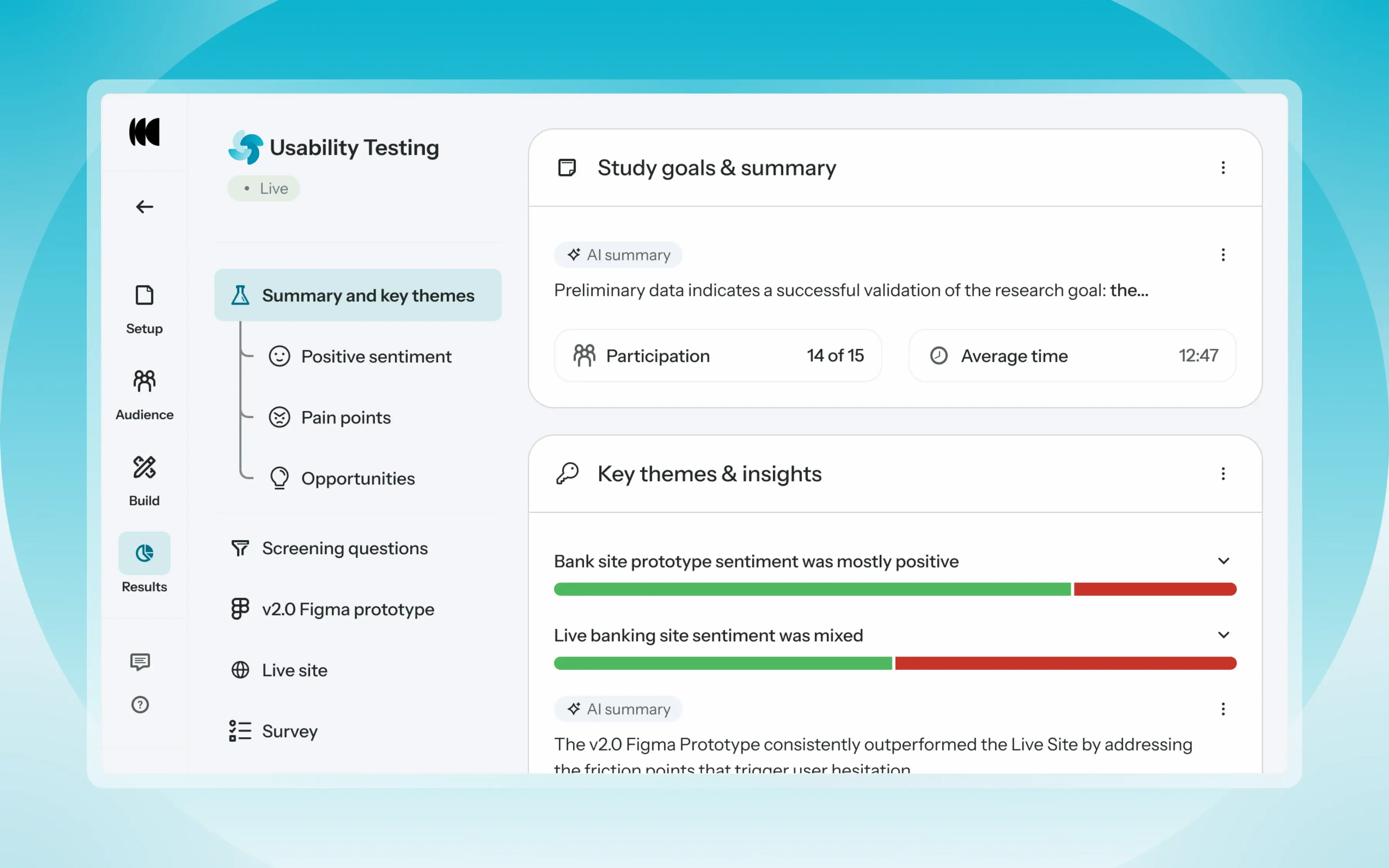
The pace of product development has never been faster, and the cost of building on assumptions has never been higher. At Optimal, we've spent nearly two decades helping teams get closer to their users, and what we're seeing right now is a fundamental shift in how research gets done. More teams are running research than ever before and timelines to act on findings are tighter, while the expectations for what research needs to deliver keep rising.
That shift is exactly what's driving Optimal 3.0, our most ambitious reinvention of the platform yet, designed to give every team the speed, depth, and flexibility that modern research demands. Today's release is the next step in that journey.
Optimal's new mixed-methods research tool tears down the boundaries between methods. It brings prototype testing, live site testing, and surveys into a single, end-to-end study workflow. And grounded in our product principles: speed to insights, access for all, and communication.
Optimal’s new Usability Testing tool marks the next step in the evolution of Optimal 3.0, giving teams the flexibility to evaluate experiences in whatever form they exist today.
Combine prototype testing, AI prototype testing, live site testing, and surveys in a single study. Test multiple prototypes side by side, compare different live URLs, or mix prototype and live site tasks together all in one workflow. Research can now mirror how products actually evolve, from early concept to shipped experience.
New speak-aloud question types, custom message blocks, auto-generated transcripts and insights, citations and highlight clips help you capture the context and reasoning behind every action. AI-assisted analysis then helps you make sense of it all fast and communicate with impact.
Review a study overview surfacing key themes, pain points, and sentiment analysis combining insights across all your study methods along with detailed results, task analysis and recordings, transcripts, key quotes, and automatically generated citations and video clips.
Coming soon: you can also use AI Chat to chat with your data directly, asking questions and pulling new insights and evidence across all your qualitative and quantitative inputs.
Modern product development is no longer linear. Teams continuously move between:
Traditional usability testing tools were not built for this fluidity. Optimal’s Usability Testing brings the flexibility to match how teams actually work today.
By combining multiple methods into a single study and pairing it with AI-powered synthesis, Usability Testing helps teams reduce setup and analysis time, recruit once, capture richer qualitative context, compare experiences more easily, move faster from feedback to action, and tell clearer, more compelling insight stories.
Learn how to get started with Usability Testing in Optimal and accelerate your path from idea to insight. Book a meeting, start exploring in your account, or join our live training webinar on June 24th to see it in action.
Collaboration tools like Mural, FigJam, and Miro are staples of how modern teams can brainstorm, map ideas, align on plans, and build together. But a canvas alone can't tell you if you're on the right track or guide you to what comes next when progress stalls. That's where Optimal AI Chat and user insights come in.
By starting or bringing real user insights into the boards your team already works in, you can reduce ambiguity, ground discussions in real research, and accelerate decision-making.
Here are 7 ways to use AI Chat alongside your collaboration boards.
Before your next planning session, use Optimal AI Chat to surface relevant insights from your interview recordings. Add a summary directly into your Mural, Miro, or FigJam board so everyone comes in with the same context and understanding of the objectives. Instead of starting with assumptions, your team can start with real user insights and clear trade-offs to discuss.
Try this prompt: "Summarize the key considerations for [decision topic] and flag any trade-offs we should discuss as a team."
.png)
AI Chat can analyze interview transcripts and video recordings and highlight common jobs to be done, behaviors, and friction points. You can then map those steps visually on your board and identify where the experience breaks down.
Try these prompts: “Summarize the typical jobs to be done for the people we interviewed.”
“For this job you identified [paste job details], detail the journey steps.”
AI Chat can analyze recurring themes from your interview recordings and convert them into concrete opportunities your team can explore next. Adding these to your board gives the team a clear starting point rather than a vague list of problems.
Try this prompt: "Based on these pain points [paste notes or themes], suggest three product improvements we could explore."
Interview insights aren’t just valuable for product, research, and design teams. Marketing teams can also use AI Chat to quickly evaluate messaging, positioning, and customer perception.
When running preference or concept testing interviews, AI Chat can quickly analyze the feedback and suggest positioning directions you can workshop on your board.
Try this prompt: “Suggest positioning options based on the interview feedback.”
Running workshops and brainstorming sessions with cross-functional teams can be challenging. Conversations drift, discussions stall, and teams sometimes struggle to focus on the most important issues.
AI Chat can help you structure the conversation before the workshop even begins by generating discussion guides based on user insights from your interviews. Add the chat outputs directly to your board to guide the session.
Try this prompt: “Generate a structured discussion guide based on the pain points of the interviewees.”
Open brainstorming can be valuable. It can also be chaotic without clear direction. By leveraging AI Chat, you can guide your brainstorming sessions with intelligent suggestions, topic generation, and idea organization.
Try this prompt: “Generate 10 brainstorm ideas based on these user insights and group them into themes we could explore.”
Visualizing complex processes and systems is easier with tools like Miro, FigJam, and Mural. AI Chat can help you map out each step. AI Chat can help break down a process step-by-step, highlighting decisions, dependencies, and potential friction points based on your interviews. Your team can then map these steps visually and identify opportunities for improvement.
Try this prompt: “Create a step-by-step process map for how users complete [task], including key decisions and potential friction points.”
The best collaboration happens when teams have the right information at the right time.
Optimal AI Chat gives your team a jumpstart for your interview analysis: clearer inputs, faster synthesis, and smarter outputs that translate directly into what you're building on your boards.
Whether you're running a workshop, mapping a user journey, or planning a product launch, AI Chat helps you spend less time getting oriented and more time making decisions.
Ready to see what your team can do with it?
Learn more about best practices for AI Chat or book a demo.
Recruiting the right participants is one of the biggest challenges teams face when conducting user research. Poor quality or disengaged testers can lead to unreliable data. While bottlenecks in recruitment – long lead times and limited access – can delay studies, reduce research frequency, and slow product development.
Having flexible options helps you keep moving at pace. Whether you bring your own participants, use Optimal’s recruitment services, or leverage external panel providers, Optimal gives you the flexibility to recruit the right user testers consistently and efficiently so you can launch studies faster, run them more frequently, and quickly scale research across multiple projects.
Here’s a breakdown of your recruitment options with Optimal:
Optimal lets you invite your own participants with a study link, QR code, or intercept snippet at no extra cost, giving you full control over who takes part in your studies.
Optimal works seamlessly with any panel provider, such as User Interviews, Respondent, PureSpectrum, Prolific, Dynata, Askable, and Cint.
Certain panel providers, like User Interviews, offer additional benefits through direct integration with Optimal. You can automate participant tracking and see participant status in real time in your panel provider platform as user testers complete your studies.
For teams that want expert support, Optimal’s Managed Recruitment services tap into multiple panels to access over 20 million participants across 150 countries. Whether you're looking for a broad audience or something highly specific, we can help you find the right people to take part in your study.
Optimal handles the panel selection, incentive management, and criteria refinement. We’ll even review and optimize your screener questions. Get started by submitting your criteria.
Looking for another quick recruitment solution? You can order user testers instantly inside the Optimal platform. It’s ideal for B2C research and studies with basic demographic requirements, and Optimal takes care of incentives for you.
You’re never locked into a single approach with Optimal. Instead, you can adapt your recruitment strategy to each study, balancing speed, quality, budget, and scale, while using the same research and user insights platform.
From shareable study links to easy panel workflows and expert support when you need it, you can spend less time managing recruitment and more time gathering actionable user insights.

The UX research landscape is shifting. While design thinking has always championed human-centered approaches, empathy, iteration, and deep user understanding, artificial intelligence is introducing new capabilities that are fundamentally changing how we work.
But here's the thing: AI isn't replacing the design thinking process. It's amplifying it.
Recent research into the synergies between design thinking and AI reveals something fascinating. When these two approaches combine, they create something more powerful than either could achieve alone. AI handles the heavy lifting of data processing and pattern recognition, while human researchers bring irreplaceable skills like empathy, contextual understanding, and ethical judgment.
Here’s how we think this partnership is reshaping each stage of the design thinking process.
The empathize stage has always been about understanding users. Understanding their needs, pain points, and motivations. Traditionally, this meant conducting interviews, observations, and surveys, then manually analyzing the results. In this situation, AI changes the scale at which we can operate.
Machine learning algorithms can now process vast amounts of user data, demographics, behavioral patterns, interaction histories, to identify trends that might take researchers weeks to uncover manually. This doesn't replace the need for human empathy. Instead, it provides a foundation of data-driven insights that researchers can build upon with qualitative methods. Think of it this way: AI can tell you what users are doing and identify patterns across thousands of interactions. But only human researchers can understand why those patterns exist, what they mean in context, and how they connect to deeper human needs.
The result? More comprehensive user personas, informed by both quantitative rigor and qualitative depth.
Once you understand your users, you need to define the problem you're solving. This stage requires synthesizing diverse insights into a clear, actionable problem statement. In this scenario AI-powered analytics can accelerate this process by helping you:
But defining the right problem still requires human judgment. AI might flag that users abandon a particular workflow, but it takes a researcher to understand whether that's due to poor usability, lack of trust, or a fundamental mismatch between the product and user needs. The partnership between AI insights and human interpretation ensures you're not just solving problems efficiently, you're solving the right problems.
Ideation is where things get interesting. This stage is all about generating diverse solutions without prematurely narrowing options. In this situation, AI can support ideation in unexpected ways. Generative algorithms can analyze existing design patterns and generate alternative solutions based on specific parameters. They can provide design references, identify emerging trends, and even suggest approaches you might not have considered. But AI still can't bring lived experience to the table. It can't draw on intuition developed through years of research. It can't make creative leaps that connect seemingly unrelated concepts.
The most effective ideation happens when AI serves as a creative assistant, offering options, inspiration, and data-backed suggestions, while human researchers provide direction, judgment, and that spark of creative insight that can't be automated.
Prototyping has always been about quick, low-fidelity tests to validate ideas. AI can now speed up this process dramatically. AI-powered tools can automate the creation of initial prototypes based on design specifications. They can generate multiple layout options, suggest color schemes, and even produce variations for different user segments, all in a fraction of the time manual prototyping would require. This speed enables more iterations in less time.
Instead of spending days creating a single prototype, researchers can now generate multiple versions quickly, test them with users, and incorporate feedback into the next iteration. The result is a more refined, user-validated design in a compressed timeline. The human role here shifts from manually creating every prototype element to making strategic decisions about which variations to pursue and how to interpret user feedback.
Testing is where AI's capabilities shine brightest, and where human judgment becomes most critical. AI can process user testing data at scale. It can analyze session recordings, identify usability issues, track where users struggle, and flag patterns across hundreds or thousands of test sessions. Tools, like Optimal, with AI-powered features can analyze video interviews, identifying themes and sentiment across participant responses. But interpreting what those patterns mean requires human insight.
A user might abandon a task because the interface is confusing or because they received a phone call. They might rate an experience negatively due to a specific design element or because they're having a bad day. AI can flag the behavior, but researchers must understand the context. The combination of AI-powered analysis and human interpretation creates a testing process that's both comprehensive and nuanced.
As AI becomes integrated into the research process, the skills that define excellent researchers are evolving. Technical skills matter more than before. Understanding how AI tools work, what data they need, and how to interpret their outputs is increasingly essential. Researchers need to think critically about AI limitations, where algorithms might introduce bias, when data-driven insights need human validation, and how to ensure ethical use of user data. But the core of great research remains unchanged. Empathy, curiosity, critical thinking, and the ability to tell compelling stories with data, these fundamentally human skills aren't being automated. They're becoming more valuable.
The integration of AI into design thinking isn't a distant future scenario. It's happening now.
Research teams that embrace this shift, learning to work alongside AI rather than seeing it as a threat, will find themselves capable of work that was previously impossible. Deeper insights from larger datasets. Faster iteration cycles. More refined designs. Better user experiences.
The key is approaching AI as a tool that enhances human capabilities rather than replaces them. At Optimal, we're thinking deeply about how AI can support researchers without compromising the human-centered principles that make great research possible. Because at the end of the day, understanding users isn't just about processing data. It's about connecting with people, understanding their needs, and creating experiences that genuinely improve their lives.
Read more about Optimal’s AI features and our approach to incorporating AI into our platform here.
AI prototyping isn’t just a side experiment anymore. It’s quickly becoming a real advantage for product and design teams. According to a 2025 industry report, companies using AI prototyping tools saw a 35% increase in development efficiency and a 25% improvement in user adoption rates compared to traditional coding methods.
The takeaway? Rapid prototyping with AI doesn’t just save time. It’s driving measurable product impact.
AI prototyping turns simple text prompts into interactive, functional prototypes. You can describe your design concept in plain English e.g. "I want to create a flight booking webpage to review a checkout flow" and minutes later, you have a working, clickable prototype.
AI prototyping can also suggest layouts, flows, and components and lets you experiment without writing a single line of code. You can easily experiment with multiple design concepts and seamlessly transition from idea to testable prototype.
You bring the design thinking. AI handles the build.
Product teams today are under pressure to ship faster without compromising quality. AI prototyping addresses one of the biggest bottlenecks in product development: turning ideas into something realistic enough to test.
Instead of debating static mockups in meetings, you can put a clickable experience in front of users and make decisions based on evidence.
Here are some widely used AI prototyping tools to explore:
AI prototyping gets you to a clickable experience quickly. Optimal helps you validate it with real users.
Here’s a step-by-step workflow to combine both:
Here’s how we recommend getting started. Pick something where you can experiment with low stakes and learn without pressure. Sign in to Optimal or sign up for a free trial and start testing.
This isn’t about replacing design expertise. It’s about shifting time and energy toward understanding user needs and iterating based on evidence. AI can handle the heavy lifting of generating prototypes. Your team can focus on strategy, clarity, and experience quality.
The result? Faster validation. Smarter decisions. Better products.
Figma has long been the go-to tool for UI/UX designers, known for its intuitive interface and real-time collaboration. In fact, over 95% of Fortune 500 companies rely on Figma, and 13 million monthly active users trust it to design and prototype digital experiences.
If you’re already designing in Figma, integrating with Optimal can help to validate your ideas early, reduce costly mistakes, and deliver experiences users actually want.
Validating designs before development and catching usability issues early has a measurable impact on both users and the business. Research consistently shows that:
Instead of waiting for post-launch analytics or expensive redesigns, you can test your Figma prototypes with real users in hours, not weeks with Optimal. Get quantitative data, watch recordings, analyze heatmaps, and actually see where users struggle, all before a single line of code is written.
Here’s a look into 4 practical ways teams use Figma and Optimal together.
Ever had a debate with your team about which design direction to take? Let data decide.
Here's how:
You've got a bold new concept. It makes perfect sense to you. But will users get it?
The process:
You've built a clickable prototype with multiple screens and interactions. It looks polished. But does it actually work for users?
Step-by-step:
What you'll discover might surprise you. Users will:
The rise of AI design tools like Figma Make has changed the game. You can now generate a functional prototype from a text prompt in minutes. But just because AI can create it doesn't mean users can use it.
Quick workflow:
This is perfect for rapid experimentation.
Figma gives you the power to design and prototype rapidly, while Optimal gives you the insights to make sure those designs actually work for real users. Together, they create a workflow built on real insights, not guesswork.
By testing early and often, teams can reduce risk, build confidence in their designs, and move into development knowing their work has already been validated by users. Gather insights quickly, collaborate more effectively, and keep projects moving forward with evidence-backed decisions.
Ready to validate your next Figma prototype? Use Optimal as part of your workflow and start testing with real users today.
.webp)
Live site testing is now part of the Optimal platform and is designed to give you real insights from real user interactions without code, installs, or complicated setups.
If you missed our recent Live Site Testing Training webinar or want a refresher, we’ll get you up to speed with this recap of all the key insights.
Optimal’s live site testing lets you watch users navigate any website or web app, including your own staging or production site, or even competitor experiences. It’s all about understanding how people behave in the environments they actually use, helping you identify friction points you might otherwise miss.
In usability research, the “real world” often looks very different from controlled prototype tests. People use their own devices, have distractions, and bring patterns and expectations shaped by real life. Foundational research shows the richest insights often come from observing users in these real contexts.
Live site testing is built to reflect that reality, helping you answer not just if someone completes a task, but how they approach it and why they struggle.
One of the biggest barriers to live site testing historically is complexity, needing code snippets, extensions, or technical setup. Optimal’s tool removes all that friction so you can see natural behaviour without influence or disruption:
When crafting tasks for live site testing, think about real user goals. Asking people to complete realistic tasks (e.g., find a product, book a flight, compare two pages) and encouraging them to think out loud leads to much richer insights than purely metric‑focused tests. You can also mix tasks with survey questions for quantitative data.
A big part of getting real behavior is ensuring participants feel comfortable and unencumbered. Optimal’s built-in task window is readily available when needed but otherwise minimizes to stay out of the way. This flow helps people stay focused and act naturally, which directly improves the quality of insights you collect.
For even deeper insights, pair live site testing with Optimal Interviews. Once you upload live site testing recordings, you get automated insights, transcripts, summaries, as well as highlight reels in Interviews. You can also explore further with AI chat, so you can quickly uncover quotes, compare experiences, and answer ad‑hoc questions.
This combination doesn’t just make analysis faster; it helps you convince stakeholders with clear, digestible, and compelling evidence from real user behaviour. Instead of long reports, you can present snackable, actionable insights that drive alignment and decisions.
We’re evolving live site testing at Optimal with solution testing, a multi-method approach that combines prototypes, live sites, and surveys in a single study. This will let teams capture even richer insights with speak-aloud tasks, automated analysis, highlight reels, and AI chat, making it faster and easier to understand user behavior and share compelling findings.
Can you test staging or test environments and sites behind a password or firewall?
Yes, Optimal's live site testing tool works with any URL, including staging and test environments as well as sites behind a password or firewall.
You can share specific instructions with participants before they start. For example, if participants need to create an account and you don’t want that recorded, you can ask them to do this in advance via the welcome screen. That way, when the study begins, they’re already logged in.
Will live site testing affect my live website or real data?
No, user testers interacting with a live site test cannot make any changes to your website or its data.
What permissions are needed to test competitor websites?
With Optimal’s live site testing, you don't need special approval or permissions to evaluate public competitors' experiences.
If you want to experience the full walkthrough, demo, and Q&A from the session, we encourage you to watch the full webinar! You’ll learn how to start running your own live site tests and uncover real user behavior, plus pick up tips and best practices straight from the training.
