Subscribe to OW blog for an instantly better inbox
Oops! Something went wrong while submitting the form.


Better products start with understanding people. That means understanding the people who use them, and also the people who design, build, and make decisions about them.
When teams bring different experiences and perspectives to a problem, there are more opportunities to challenge assumptions and ask better questions. But, it takes the right scaffolding. Channels and structures need to be set up to make it possible for people across teams to collaborate, have their perspectives heard, and have their ideas challenged and built on.
This truly matters in product development, where early assumptions influence research questions, design decisions, and ultimately the end experience people have with a product.
It starts with who is at the table. In 2025, 29% of C-suite positions in tech were held by women. At Optimal, more than half of our senior leadership team are women, and that shapes how we think about the work.
“Diversity in leadership matters because it expands perspective. It challenges groupthink. It surfaces blind spots. Diversity is often reduced to a numbers conversation, but diversity in leadership is far more powerful when it starts from the ground up. When leaders build teams that bring together different cultures, experiences, perspectives and they actively listen, they amplify those insights and it becomes embedded in how the organisation thinks, not just how it looks.” - Jill McCarthy, Vice President of Operations
Listening is at the heart of our value “In It Together”, leading with kindness, empathy, and respect, listening fully, and lifting others up. One way we embed this value is through innovation days like our annual company hackathons, which give people across the business space to spot opportunities and share freely, try new skills, and turn ideas into action. Cross-functional hackathons bring together people who might not otherwise work side by side, creating opportunities to solve problems from different perspectives. We’ve seen Operations, Engineering, and Finance collaborate to develop breakthrough technology and last year, one idea went from concept to launch in just one week.
Inclusive collaboration also depends on who gets the opportunity to develop, take on responsibility, and influence what happens next. If access to mentorship, high-visibility projects, or leadership opportunities depends on informal networks, it’s hard to build a healthy environment for innovation. At Optimal, we support development through regular one-on-ones, coaching, mentoring, and supporting professional development opportunities. And our values shape how we approach this in our day to day work. “Bold & Brave” encourages us to try new things and be honest about where we can improve, and “Own It” asks us to challenge with care, support each other, and commit fully because we’re in this together, building towards a better future and better experiences.
"I started my career in tech when diversity was the exception, not the rule. The mentors and leaders who I looked up to at that time had to work twice as hard as others, but never stopped showing up anyway. Their efforts made it easier for me to find a seat at the table. International Women's day for me is a reminder of how grateful I am for each of those individuals who helped prove that diverse teams make better decisions, build better products and create better businesses and I hope to keep playing my small part in opening doors for the next generation. " - Amberlie Denny, Chief Marketing Officer
Inclusion is easy to describe in terms of a value or an intention, but making progress requires looking at what happens in practice. Organizations can start by asking a few straightforward questions about their policies and practices:
There is more to product work than execution, it comes from understanding the people we’re building for and learning from the people we build with.
“Building diversity means we can draw on a richer pool of experience, making for better understanding, discussion, and decisions.” - member of Optimal’s senior leadership
At Optimal, that’s something we continuously work to build up, creating space for diverse perspectives to shape how we think, collaborate, and build better products.
Learn more about us and how we approach product innovation at Optimal here.
As product managers, we all know the struggle of truly understanding our users. It's the cornerstone of everything we do, yet the path to those valuable insights can often feel like navigating a maze. The endless back-and-forth emails, the constant asking for favors from other teams, and the sheer time spent trying to find the right people to talk to, sound familiar? For years, this was our reality. But there’s a better way, Optimal's participant recruitment is a game-changer, transforming your approach to user research and freeing you to focus on what truly matters: understanding our users.
User research processes often hit a significant bottleneck: finding participants. Like many, you may rely heavily on sales and support teams to connect you with users. While they were always incredibly helpful, this approach has its limitations. It creates internal dependencies, slows down timelines, and often means you are limited to a specific segment of our user base. You frequently find ourselves asking, "Does anyone know someone who fits this profile?" which inevitably leads to delays and sometimes, missed crucial feedback opportunities.
Enter Optimal's participant recruitment. This service fundamentally shifts how you approach user research, offering a hugely increased level of efficiency and insight. Here’s how it can level up your research process:
The participant recruitment service integrates with the Optimal platform. Whether you're conducting tree testing to evaluate information architecture, running card sorting exercises to understand user mental models, or performing first-click tests to assess navigation, everything is available within one intuitive platform. It really can become your one-stop shop for all things user research.
Perhaps the most unexpected and significant benefit of streamlined participant recruitment comes from the positive shift in your team's culture. With research becoming so accessible and efficient, you're naturally more inclined to validate our assumptions and explore user needs before making key product decisions. Every product decision is now more deeply grounded in real user insights, fostering a truly user-centric approach throughout your development process.
If you're still wrestling with the time-consuming and often frustrating process of participant recruitment for your user research, why not give Optimal Workshop a try. It can transform what is a significant bottleneck in your workflow into a streamlined and efficient process that empowers you to build truly user-centric products. It's not just about saving time; it's about gaining deeper, more diverse insights that ultimately lead to better products and happier users. Give it a shot, you might be surprised at the difference it makes.

The skills market has a familiar whiff to it. A decade ago, digital execs scratched their heads as great swathes of the delivery workforce decided to retrain as User Experience experts. Project Managers and Business Analysts decided to muscle-in on the creative process that designers insisted was their purview alone. Win for systemised thinking. Loss for magic dust and mystery.
With UX, research and design roles being the first to hit the cutting room floor over the past 24 months, a lot of the responsibility to solve for those missing competencies in the product delivery cycle now resides with the T-shaped Product Managers, because their career origin story tends to embrace a broader foundation across delivery and design disciplines. And so, as UX course providers jostle for position in a distracted market, senior professionals are repackaging themselves as Product Managers.
The skills market has a familiar whiff to it. A decade ago, Project Managers (PMs) and Business Analysts (BAs) pivoted into UX roles in their droves, chasing the north star of digital transformation and user-centric design. Now? The same opportunities to pivot are emerging again—this time into Product Management.
And if history is anything to go by, we already know how this plays out.
Between 2015 and 2019, UX job postings skyrocketed by 320%, fueled by digital-first strategies and a newfound corporate obsession with usability. PMs and BAs, sensing the shift, leaned into their adjacent skills—stakeholder management, process mapping, and research—and suddenly, UX wasn’t just for designers anymore. It was a business function.
Fast-forward to 2025, and Product Management is in the same phase of maturation and despite some Covid-led contraction, bouncing back to 5.1% growth. The role has evolved from feature shipping to strategic value creation while traditional project management roles are trending towards full-stack product managers who handle multiple aspects of product development with fractional PMs for part-time or project-based roles.
📈 Job postings for product management roles grew by 41% between 2020 and 2025, compared to a 23% decline in traditional project management roles during the same period (Indeed Labor Market Analytics).
📉 The demand for product managers has been growing, with roles increasing by 32% yearly in general terms, as mentioned in some reports.
💰 Salary Shenanigans: Product Managers generally earn higher salaries than Business Analysts. In the U.S., PMs earn about 45% more than BAs on average ($124,000 vs. $85,400). In Australia, PMs earn about 4% to 30% more than BAs ($130,000 vs. $105,000 to $125,000) wave.
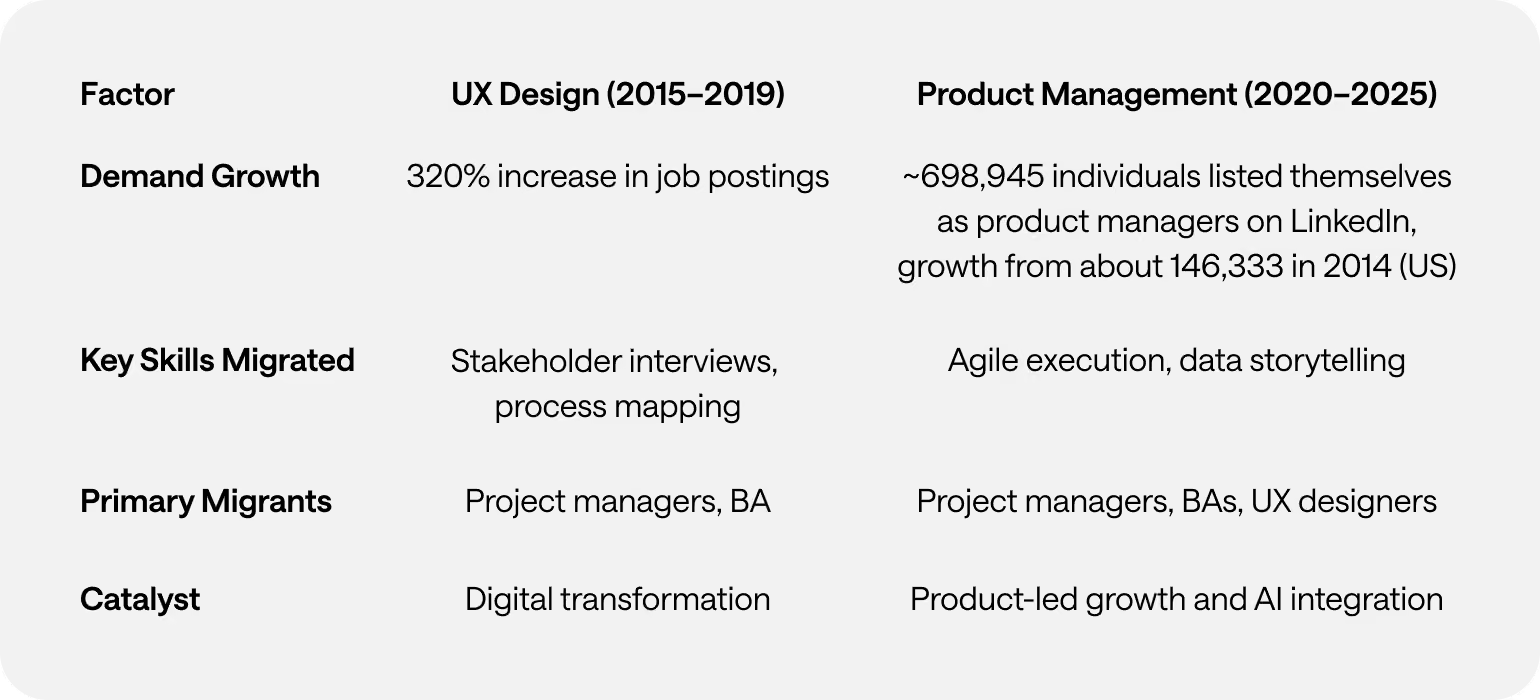
Same pattern. Different discipline.
👀 Outputs vs. Outcomes – PMs think in deliverables. Transitioning PMs struggle to adjust to measuring success through customer impact instead of project completion.
🛠️ Legacy Tech Debt – Outdated tech stacks can lead to decreased productivity, integration issues, and security concerns. This complexity can slow down operations and hinder the efficiency of teams, including product management.
😰 Imposter Syndrome is Real – New product managers feel unqualified, mirroring the self-doubt UX migrants felt in 2019. Because let’s be honest—jumping into product strategy is a different beast from managing deliverables.
🏆 Structured Reskilling – Programs like Google’s "PM Launchpad" reduce time-to-proficiency for new PMs. Enterprises that invest in structured career shifts will win the talent war.
📊 Hybrid Role Recognition – Expect to see “Analytics-Driven PM” and “Technical Product Owner” job titles formalising this shift, much like “UX Strategist” emerged post-2019.
🚀 AI Will Accelerate the Next Migration – As AI automates routine PM/BA tasks, expect even more professionals to pivot into strategic product roles. The difference? This time, the transition will be even faster.
Tech talent moves in cycles. Product Management is simply the next career gold rush for systems thinkers with a skill for structure, process, and problem-solving. A structural response to the evolution of tech ecosystems.
Companies that recognise and support this transition will outpace those still clinging to rigid org charts. Because one thing is clear—the talent migration isn’t coming. It’s already here.
This article was researched with the help of Perplexity.ai

User Experience (UX) research has always been about people. How they think, how they behave, what they need, and—just as importantly—what they don’t yet realise they need. Traditional UX methodologies have long relied on direct human input: interviews, usability testing, surveys, and behavioral observation. The assumption was clear—if you want to understand people, you have to engage with real humans.
But in 2025, that assumption is being challenged.
The emergence of digital twins and synthetic users—AI-powered simulations of human behavior—is changing how researchers approach user insights. These technologies claim to solve persistent UX research problems: slow participant recruitment, small sample sizes, high costs, and research timelines that struggle to keep pace with product development. The promise is enticing: instantly accessible, infinitely scalable users who can test, interact, and generate feedback without the logistical headaches of working with real participants.
Yet, as with any new technology, there are trade-offs. While digital twins may unlock efficiencies, they also raise important questions: Can they truly replicate human complexity? Where do they fit within existing research practices? What risks do they introduce?
This article explores the evolving role of digital twins in UX research—where they excel, where they fall short, and what their rise means for the future of human-centered design.
For decades, UX research has been grounded in methodologies that involve direct human participation. The core methods—usability testing, user interviews, ethnographic research, and behavioral analytics—have been refined to account for the unpredictability of human nature.
This approach works well, but it has challenges:
In short: traditional UX research provides depth and authenticity, but it’s not always fast or scalable.
Digital twins and synthetic users aim to change that.
While the terms digital twins and synthetic users are sometimes used interchangeably, they are distinct concepts.
A digital twin is a data-driven virtual representation of a real-world entity. Originally developed for industrial applications, digital twins replicate machines, environments, and human behavior in a digital space. They can be updated in real time using live data, allowing organisations to analyse scenarios, predict outcomes, and optimise performance.
In UX research, human digital twins attempt to replicate real users' behavioral patterns, decision-making processes, and interactions. They draw on existing datasets to mirror real-world users dynamically, adapting based on real-time inputs.
While a digital twin is a mirror of a real entity, a synthetic user is a fabricated research participant—a simulation that mimics human decision-making, behaviors, and responses. These AI-generated personas can be used in research scenarios to interact with products, answer questions, and simulate user journeys.
Unlike traditional user personas (which are static profiles based on aggregated research), synthetic users are interactive and capable of generating dynamic feedback. They aren’t modeled after a specific real-world person, but rather a combination of user behaviors drawn from large datasets.
Think of it this way:
Both approaches are still evolving, but their potential applications in UX research are already taking shape.
The appeal of AI-generated users is undeniable. They can:
These capabilities make digital twins particularly useful for:
However, digital twins and synthetic users are not a replacement for human research. Their effectiveness is limited in areas where emotional, cultural, and contextual factors play a major role.
For all their promise, digital twins and synthetic users introduce new challenges.
Rather than viewing digital twins as a replacement for human research, the best UX teams will integrate them as a complementary tool.
The future of UX research is not about choosing between AI and human research—it’s about blending the strengths of both.
Digital twins and synthetic users are exciting, but they are not a magic bullet. They cannot fully replace human users, and relying on them exclusively could lead to false confidence in flawed insights.
Instead, UX researchers should view these technologies as powerful, but imperfect tools—best used in combination with traditional research methods.
As with any new technology, thoughtful implementation is key. The real opportunity lies in designing research methodologies that harness the speed and scale of AI without losing the depth, nuance, and humanity that make UX research truly valuable.
The challenge ahead isn’t about choosing between human or synthetic research. It’s about finding the right balance—one that keeps user experience truly human-centered, even in an AI-driven world.
This article was researched with the help of Perplexity.ai.
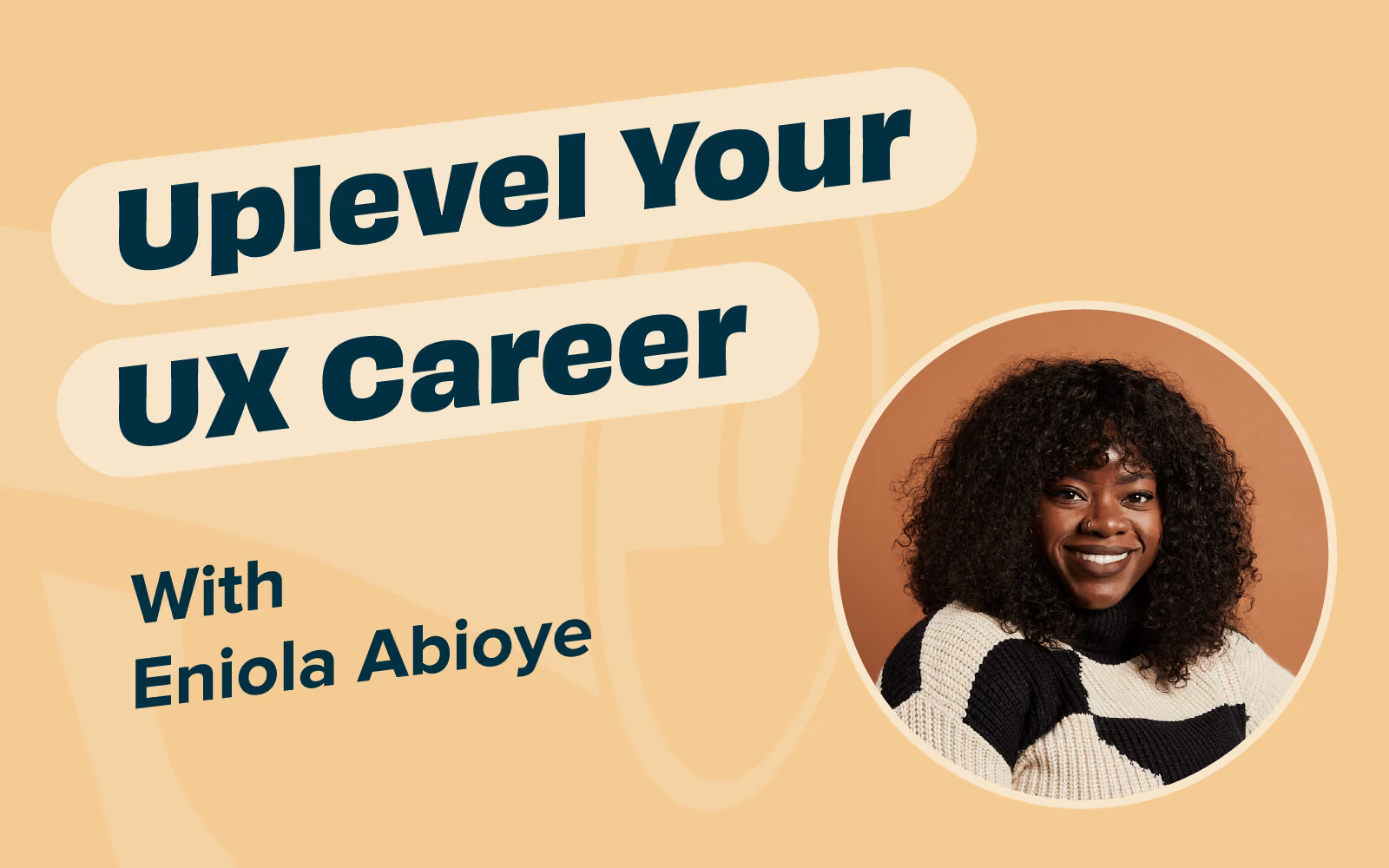
Recently, Optimal Workshop partnered with Eniola Abioye, Lead UX Researcher at Meta and UXR Career Coach at UX Outloud to host a career masterclass featuring practical advice and guidance on how to: revamp and build a portfolio, emphasize the impact of your projects and showcase valuable collaborations. It also included panel discussions with experts from a variety of roles (UX, product management, engineering, career coaching and content design) talking about their journeys to becoming UX leaders.
Keep reading to get key takeaways from the discussion on:
At a time when businesses are reducing costs to focus on profitability - proving the value of your work is more important than ever. Unfortunately, measuring the impact of UX isn’t as straightforward as tracking sales or marketing metrics. With this in mind, Eniola asked the panelists - how do you show the impact of UX in your work?Providing insights is simply not enough. “As a product manager, what I really care about is insights plus recommendations, because recommendations make my life easier,” said Kwame Odame.
Auset Parris added her perspective on this topic as a Growth Content Designer, “the biggest thing for me to be impactful in my space [Content Design] is to consistently document the changes that I’ve made and share them with the team along with recommendations.” Auset also offered her perspective regarding recommendations, “recommendations are not always going to lead to the actual product executions, but recommendations are meant to guide us.” When it comes to deciding which recommendation to proceed with (if any) it's important to consider whether or not they are aligned with the overarching goal.
As UXR becomes more democratized in many businesses and the number of stakeholders increases, the ability to gain cross-functional buy-in for the role and outcomes of UXR is a key way to help keep research a priority.
In his past experience, Kwame has realized that the role of a user experience researcher is just as important as that of a product manager, data scientist, engineer, or designer. However, one of the biggest blockers for him as a product manager is how the role of a UX researcher is often overlooked. “Just because I’m the product manager doesn’t mean that I’m owning every aspect of the product. I don’t have a magic wand right? We all work as a team.” Furthermore, Kwame notes that a user researcher is an incredibly hard role and a very important one, and I think we need to invest more in the UX space.
Auset also shared her perspective on the topic, “I wouldn’t say this is a blocker, but I do think this is a challenging piece of working in a team - there are so many stakeholders.” Although it would be ideal for each of the different departments to work seamlessly together at all times, that’s not always the case. Auset spoke about a time where the data scientists and user researchers were in disagreement. Her role as a Growth Content Designer is to create content that enhances the user experience. “But if I’m seeing two different experiences, how do I move forward? That’s when I have to ask everyone - come on let’s dig deeper. Are we looking at the right things?” If team members are seeing different results, or having different opinions, then maybe they are not asking the right questions and it's time to dig deeper.
The number and type of roles that now engage with research are increasing. As they do, the ability to collaborate and manage stakeholders in research projects has become essential.
Kwame discussed how he sets up a meeting for the team to discuss their goals for the next 6 months. Then, he meets with the team on a weekly basis to ensure alignment. The main point of the meeting is to ensure everyone is leaving with their questions answered and blockers addressed. It's important to ensure everyone is moving in the right direction.
Auset added that she thinks documentation is key to ensuring alignment. “One thing that has been helpful for me is having the documentation in the form of a product brief or content brief.” The brief can include the overarching goal, strategy, and indicate what each member of the team is working on. Team members can always look back at this document to ensure they are on the right track.
One of the participants asked the panel, “how do you secure the stability of your UX career?”
Eniola took this opportunity to share some invaluable advice as a career coach, “I think the biggest thing that comes to mind is value proposition. It's important to be very clear about the value and impact you bring to the team. It used to be enough to just be really, really good at research and just do research and provide recommendations. Now that’s not enough. Now you have to take your teams through the process, integrate your recommendations into the product, and focus on driving impact.”
Companies aren’t looking to hire someone who can perform a laundry list of tasks, they’re looking for UX professionals who can drive results. Think about the metrics you can track, to help showcase the impact of your work. For example, if you’re a UX designer - how much less time did the user spend on the task with your new design? Did the abandonment or error rate decrease significantly as a result of your work? How much did the overall customer satisfaction score rise, after you implemented your project? Before starting your project, decide on several metrics to track (make sure they align with your organization’s goals), and reflect on these after each project.
Fatimah Richmond offered another piece of golden career advice. She encourages UX researchers to create an ongoing impact tracker. She’ll create a document where she lists the company's objectives, the projects she worked on, and the specific impact she made on the companies objectives. It's much easier to keep track of the wins as they happen, and jot a few notes about the impact you’ve made with each project, then scrambling to think of all the impact you’ve made when writing your resume. It's also important to note the impact your work has made on the different departments - product, marketing, sales, etc.
She also advises UX researchers to frequently share their science insights with their colleagues as the project progresses. Instead of waiting until the very end of the project and providing a “perfectly polished” deck, be transparent with the team about what you are working on and the impact it's having throughout the duration of the project.
Another participant asked - what if you need help determining the value you bring? Auset recommends asking for actionable feedback from coworkers. These people work with you every single day, so they know your contributions you are making to the team.
Documenting the tangible impact you make as a UX professional is crucial - not only will it help create greater stability for your career, but it will also help organizations recognize the importance of a UX research. As Kwame discussed in the “blockers” section, one of the biggest challenges he faces as a product manager is the perception of the UX role as less important than the more traditional product manager, Engineer, and Designer roles.
Eniola helps UX researchers improve their research practice. Whether you’re seasoned and looking to level up or a new researcher looking to get your bearings in UX, Eniola can help you focus and apply your skillset. She is a UX Researcher and Founder of UX Outloud. As a career coach, she guides her clients through short and long term SMART goals and then works with them to build a strategic plan of attack. She is innately curious, a self-starter, adaptable, and communicative with a knack for storytelling.
Learn more about UX Outloud.
Connect with Eniola on Linkedin.
The panel was comprised of talented professionals from a variety of fields including UX research, content strategy, product management & engineering, and career coaching. Their diverse perspectives led to an insightful and informative panel session. Keep reading to get to know each of the amazing panelists:
Growth Content Designer: Auset Parris is a growth content designer at Meta. She has spent 7 years navigating the ever-evolving landscape of content strategy. She is passionate about the role of user research in shaping content strategies. Furthermore, Auset believes that understanding user behavior and preferences is fundamental to creating content that not only meets but exceeds user expectations.
Senior UX Researcher: Jasmine Williams, Ph.D. is a senior researcher with over a decade of experience conducting youth-focused research. She has deep expertise in qualitative methods, child and adolescent development, and social and emotional well-being. Jasmine is currently a user experience researcher at Meta and her work focuses on teen safety and wellbeing.
Product Manager: Kwame Odame has over 7 years of high-tech experience working in product management and software engineering. At Meta, Kwame is currently responsible for building the product management direction for Fan Engagement on Facebook. Kwame has also helped build Mastercard’s SaaS authentication platform, enabling cardholders to quickly confirm their identity when a suspicious transaction occurred, leveraging biometric technology.
UX Researcher (UXR): Fatimah Richmond is a well-rounded UX researcher with over 15 years of experience, having influenced enterprise products across leading tech giants like Google, SAP, Linkedin, and Microsoft. Fatimah has led strategy for research, programs and operations that have significantly impacted the UXR landscape, from clinician engagement strategist to reshaping Linkedin Recruiter and Jobs. As a forward thinker, she’s here to challenge our assumptions and the status quo on how research gets planned, communicated, and measured.
Career Coach: An Xia spent the first decade of her professional life in consulting and Big Tech data science (Netflix, Meta). As a career coach, An has supported clients in gaining clarity on their career goals, navigating challenges of career growth, and making successful transitions. As a somatic coach, An has helped clients tap into the wisdom of their soma to reconnect with what truly matters to them.
UX Strategist: Natalie Gauvin is an experienced professional with a demonstrated history of purpose-driven work in agile software development industries and higher education. Skilled in various research methodologies. Doctor of Philosophy (Ph.D.) Candidate in Learning Design and Technology from the University of Hawaii at Manoa, focused on empathy in user experience through personas
Here at Optimal we really care about helping UX researchers level up their career. This is why we’ve developed the Optimal Academy, to help you master your Optimal Workshop skills and learn more about user research and information architecture.
Check out some of our free courses here: https://academy.optimalworkshop.com/
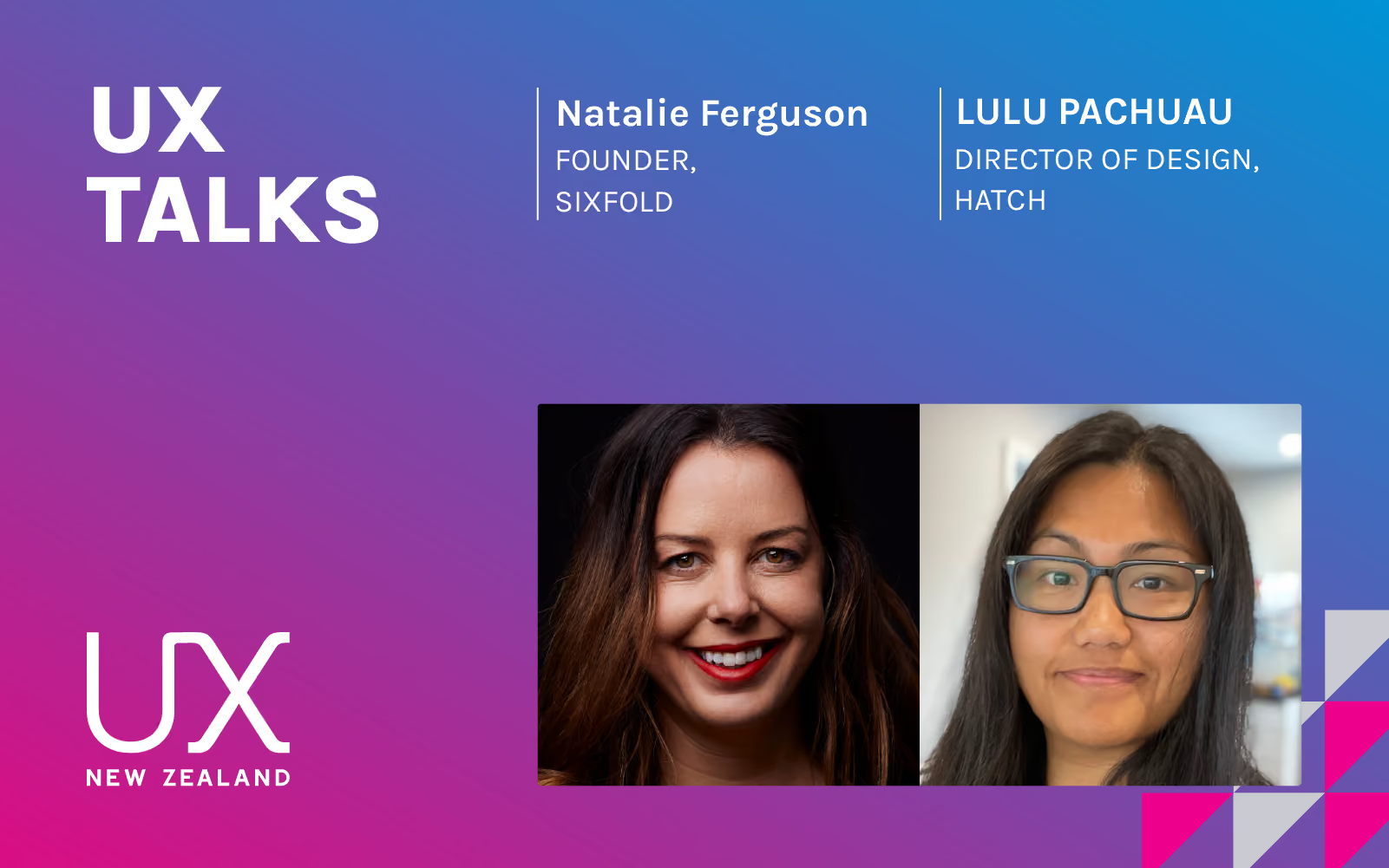
Natalie and Lulu have forged a unique team culture that focuses on positive outputs (and outcomes) for their app’s growing user base. In doing so, they turned the traditional design approach on its head and created a dynamic and supportive team.
Natalie, Director of Design at Hatch, and Lulu, UX Design Specialist, recently spoke at UX New Zealand, the leading UX and IA conference in New Zealand hosted by Optimal Workshop, on their concept of “radical collaboration”.
In their talk, Nat and Lulu share their experience of growing a small app into a big player in the finance sector, and their unique approach to teamwork and culture which helped achieve it.
Over the last two decades, Lulu and Nat have delivered exceptional customer experiences for too many organizations to count. After Nat co-founded Hatch, she begged Lulu to join her on their audacious mission: To supercharge wealth building in NZ. Together, they created a design and product culture that inspired 180,000 Kiwi investors to join in just 4 years.
Contact Details:
Email: natalie@sixfold.co.nz
LinkedIn: https://www.linkedin.com/in/natalieferguson/ and https://www.linkedin.com/in/lulupach/
Nat and Lulu discuss how they nurtured a team culture of “radical collaboration” when growing the hugely popular app Hatch, based in New Zealand. Hatch allows everyday New Zealanders to quickly and easily trade in the U.S. share market.
The beginning of the COVID pandemic spelled huge growth for Hatch and caused significant design challenges for the product. This growth meant that the app had to grow from a baby startup to one that could operate at scale - virtually overnight.
In navigating this challenge, Nat and Lulu coined the term radical collaboration, which aims to “dismantle organizational walls and supercharge what teams achieve”. Radical collaboration has six key pillars, which they discuss alongside their experience at Hatch.
Listening to hundreds of their customers’ stories, combined with their own personal experiences with money, compelled Lulu and Nat to change how their users view money. And so, “Grow the wealth of New Zealanders” became a powerful mission statement, or North Star, for Hatch. The mission was to give people the confidence and the ability to live their own lives with financial freedom and control. Nat and Lulu express the importance of truly believing in the mission of your product, and how this can become a guiding light for any team.
As Hatch grew rapidly, trusting each other became more and more important. Nat and Lulu state that sometimes you need to take a step back and stop fueling growth for growth’s sake. It was at this point that Nat asked Lulu to join the team, and Nat’s first request was for Lulu to be super critical about the product design to date - no feedback was out of bounds. Letting go, feeling uncomfortable, and trusting your team can be difficult, but sometimes it’s what you need in order to drag yourself out of status quo design. This resulted in a brief hiatus from frantic delivery to take stock and reprioritize what was important - something that can be difficult without heavy doses of trust!
During their journey, the team at Hatch heard lots of stories from their users. Many of these stories were heard during “Hatcheversery Calls”, where team members would call users on their sign-up anniversary to chat about their experience with the app. Some of these calls were inspiring, insightful, and heartwarming.
Everyone at Hatch made these calls – designers, writers, customer support, engineers, and even the CEO. Speaking to strangers in this way was a challenge for some, especially since it was common to field technical questions about the business. Nevertheless, asking staff to wear many hats like this turned the entire team into researchers and analysts. By forcing ourselves and our team outside of our comfort zone, we forced each other to see the whole picture of the business, not just our own little piece.
In an increasingly competitive industry, designers and developers are often tempted to consistently deliver new and exciting features. In response to rapid growth, rather than adding more features to the app, Lulu and Nat made a conscious effort to really listen to their customers to understand what problems they needed solving.
As it turned out, filing overseas tax returns was a significant and common problem for their customers - it was difficult and expensive. So, the team at Hatch devised a tax solution. This solution was developed by the entire team, with almost no tax specialists involved until the very end! This process was far from glamorous and it often fell outside of standard job descriptions. However, the team eventually succeeded in simplifying a notoriously difficult process and saved their customers a massive headache.
Over time Hatch’s user base changed from being primarily confident, seasoned investors, to being first-time investors. This new user group was typically scared of investing and often felt that it was only a thing wealthy people did.
At this point, Hatch felt it was necessary to take a step back from delivering updates to take stock of their new position. This meant deeply understanding their customers’ journey from signing up, to making their first trade. Once this was intimately understood, the team delivered a comprehensive onboarding process which increased the sign-up conversion rate by 10%!
Nat and Lulu describe a moment when Allbirds wanted to work with Hatch to allow ordinary New Zealanders to be involved in their IPO launch on the New York stock exchange. Again, this task faced numerous tax and trade law challenges, and offering the service seemed like yet another insurmountable task. The team at Hatch nearly gave up several times during this project, but everyone was determined to get this feature across the line – and they did. As a result, New Zealanders were some of the few regular investors from outside the U.S that were able to take part in Albirds IPO.
Over four years, Hatch grew to 180,000 users who collectively invested over $1bn. Nat and Lulu’s success underscores the critical role of teamwork and collaboration in achieving exceptional user experiences. Product teams should remember that in the rapidly evolving tech industry, it's not just about delivering the latest features; it's about fostering a positive and supportive team culture that buys into the bigger picture.
The Hatch team grew to be more than team members and technical experts. They grew in confidence and appreciated every moving part of the business. Product teams can draw inspiration from Hatch's journey, where designers, writers, engineers, and even the CEO actively engaged with users, challenged traditional design decisions, and prioritized solving actual user problems. This approach led to better, more user-centric outcomes and a deep understanding of the end-to-end user experience.
Most importantly, through the good times and tough, the team grew to trust each other. The mission weaved its way through each member of the team, which ultimately manifested in positive outcomes for the user and the business.
Nat and Lulu’s concept of radical collaboration led to several positive outcomes for Hatch:
Over the next week, Lulu and Nat encourage designers and researchers to get outside of their comfort zone and: