Subscribe to OW blog for an instantly better inbox
Oops! Something went wrong while submitting the form.


Was human-centered design all wrong?
No, but it fails to capture the whole picture.
Don Norman introduced human-centered design (HCD), the approach of putting people and their needs at the center of the design process, in the 1980s and almost 50 years later at DDX San Diego 2026, he challenged the philosophy.
Human-centered design gave the industry an important shift in perspective, paying close attention to the people who would actually live with what we create, but there’s tension. Design can create tremendous value for people while also creating unintended consequences for cultures, communities, organizations, and the world around them.
If we optimize for the person in front of us, what happens to everyone and everything outside the frame?
And as technology becomes increasingly agentic, that broader view becomes even more relevant. We're no longer designing only things that people interact with. We're increasingly designing systems that can act, make decisions, and influence what happens next.
Life-Centered Design (LCD) expands the focus from the individual user to the larger living system that the product or service exists within. It seeks to align design decisions with global goals such as the United Nation’s Sustainable Development Goals.
Intelligence-Centered Design (ICD) and Human-Agent Centered Design (H-ACD) are extensions of HCD where AI plays an active role in the design process alongside human intelligence, each learning from, making decisions, and mediating the process.
Agent-Centered Design (ACD) puts AI agents at the center as the primary participant in the process, agents building for agents.
Good experiences have always started with deep understanding of the people who use the product, service, or system. Needs, expectations, and priorities are shaped by environment, so what works in one market, organization, or culture can't automatically be treated as a universal truth for all.
That's why ethnography and other forms of contextual research remain so valuable. Before asking what we should build, we need to understand the world people are navigating.
Questions to ask:
The discipline of understanding people hasn't gone anywhere. It's just being asked to stretch further, to the systems, risks, and impacts beyond individuals.
Behavior is shaped by systems, organizational structures, constraints, and the decisions made around you, so those factors are part of what we are designing for. Agentic AI makes this deep understanding of context even more important.
When AI can act, make decisions, and influence what happens next, it becomes a key part of the system. Therefore, design has to account for the relationship between humans and their agents including how they work together, what artifacts are created along the way, how do they communicate, what decisions does AI make and what are its responsibilities.
Questions to ask:
One practical takeaway is to spend more time understanding what people actually do, not just what they say they do. Diary studies, observation, prototype testing, and live site testing can all help surface what people may not be able to articulate themselves. Rather than simply asking “why,” ask, “What drove you to make that decision?” This is an open question to prompt an honest explanation of what influenced their thinking and led them to take a certain action.
Design has no shortage of frameworks, methodologies, books, and white papers. While these give us useful ways to think, real change only happens when teams transform what they’ve learned into something tangible. In the end, impact isn't measured by the depth of your knowledge, but by what you actually create with it.
Question to ask: What's the smallest thing I could do to build or test this idea this week?
A simple prototype will reveal insights that hours of discussion never could. A real interaction exposes the hidden gaps between what people say and what they actually do. A quick experiment tells a team far more than another round of debate.
At its best, good design thinking must always lead to good "design doing."
Research and design often sits in the middle of an organization. Leadership sets direction, research gathers insight, design shapes the experience, then implementation follows. When each function speaks a different language, intent can get lost along the way.
Designers and researchers are inherently connectors. We bring together different perspectives, make sense of complexity, and help people see how decisions affect one another. But we aren't often in the room when the decisions themselves are being made. Policy, process, business models, and organizational structures are all forms of design, yet designers are often brought in after those choices have already been made.
There is an opportunity and a need for design thinking and "design doing" to move further upstream, and that starts with speaking the language of the people making those decisions: finances and margins.
Questions to ask:
Business decisions are design decisions.
The next era of design is expanding what we consider when we design.
As systems become more autonomous, designers have an opportunity to shape not only experiences, but the policies, services, and the systems around them.
The future of design is less about finding the right framework and more about what we choose to do with what we know.
Our monthly newsletter, User Tested is for product, design, and research teams who want to make UX research a strategic accelerator. Subscribe to User Tested.

We spent Research Week in San Francisco listening, taking notes, and talking with the UX and market researchers, research managers, human factors engineers, research operations program managers, and product designers who gathered coast to coast. Sessions covered Advanced Market Research, Growth UXR, Great Research, AI and UXR, Up Up and Away!, and Moonshot Research.
The gap in research most teams face right now is translation. Every function hears research differently. Each has a completely different "so what," as Apurva Luty puts it, so you need to respond and hear different ways, hearing data science in questions, design in critique, marketing in frameworks, engineering in constraints, and leadership in confidence. No one wants to hear: "we need to do more research”, but when you feel rushed for insights, you can always ask upfront if it’s a quick directional and recognize when you need more time for a comprehensive answer.
Building that bridge doesn’t mean you’re a gatekeeper. Rachel Ousley has seen democratizing access to data play out through more conversations and approaches with better questions. Map your stakeholders' "so what" and foster an open line of communication because you are working towards the same goal in the end.
Influence isn't a moment, it's a structure. Jess Holbrook breaks down direct influence versus indirect influence where direct influence is the central mechanism you present to senior leadership, and indirect influence is about setting the stage. Get ahead of it: know what your organization needs to understand in three months, six months, nine months, and how do we set ourselves up now to do that?
Build a culture of influence by giving credit loudly and often, saying people's names in the room by sharing wins and shoutouts. At Optimal, we do this through a celebrations Slack channel and quarterly value awards with open nominations through the company. Bring stakeholders, even ones you might not see eye-to-eye with upfront, into conversations where their perspective is genuinely valued, and anticipate what your team needs.
The value of research is clear: to build better experiences, you must listen to the people who are using the product, service, the thing you’re making, and are affected by it. It is in discovery where you, well, discover what users actually want. As Andrew Chamberlain says, those hack projects and rapid prototypes can scale and become new products, and beyond that, research is how you elevate your brand and get invited into new spaces.
In discovery, know when to screen for behavior and when to screen for demographics. Maybe you’re looking at how people us mobile devices in homes, where one phone does not necessarily mean one owner or one user and in this case, your questions need to be framed openly and intuitively to get insight into your users’ mental models and actions, often different from your own, with people assigning different meanings to the same words. Nicole Naurath uses the example of asking “Do you share a device?” instead of, “How does someone else access this device?” to capture richer, more accurate insights into actual behavior.
Research reporting is socialization. Your decks don't have to change, but the artifacts around it do. A compelling clip, a sharp stat, a well-chosen verbatim – nothing hits like it. Nicole Zeng explains UX research as the thing that silences rooms, changes minds, and redirects roadmaps.
Format your findings and discussion for the spaces people already work. Lauren Lin describes sharing insights as stackable and shareable clips on Slack as well as data cards that are downloadable as Figma components.
AI is enabling large-scale data processing that used to take months, which means you can spend less time in the weeds and more time on the work that moves the needle – the judgment, translation, organizational, goal setting, and influence-building work. AI can handle the volume and scale of your data. However, everyone has a different comfort level with new tools. Nicole Zeng uses the analogy of a lake: maybe you’re diving in headfirst, maybe you’re watching from the shore, or maybe you’re paddling through the waves.
Break your workflow and explore novel ways of leveraging AI in UX research, then share out your findings and flows, because that's how we make progress as teams, get deeper customer insights, and ultimately make better decisions. It's why we're constantly evolving Optimal, and Optimal 3.0 is built for exactly this: helping product teams discover, validate, and continuously optimize user experiences that drive real business results.
We're in an exciting time and it's moments like this when our industry comes together that we never forget. Stay connected with us on LinkedIn to get the latest updates on our upcoming events!
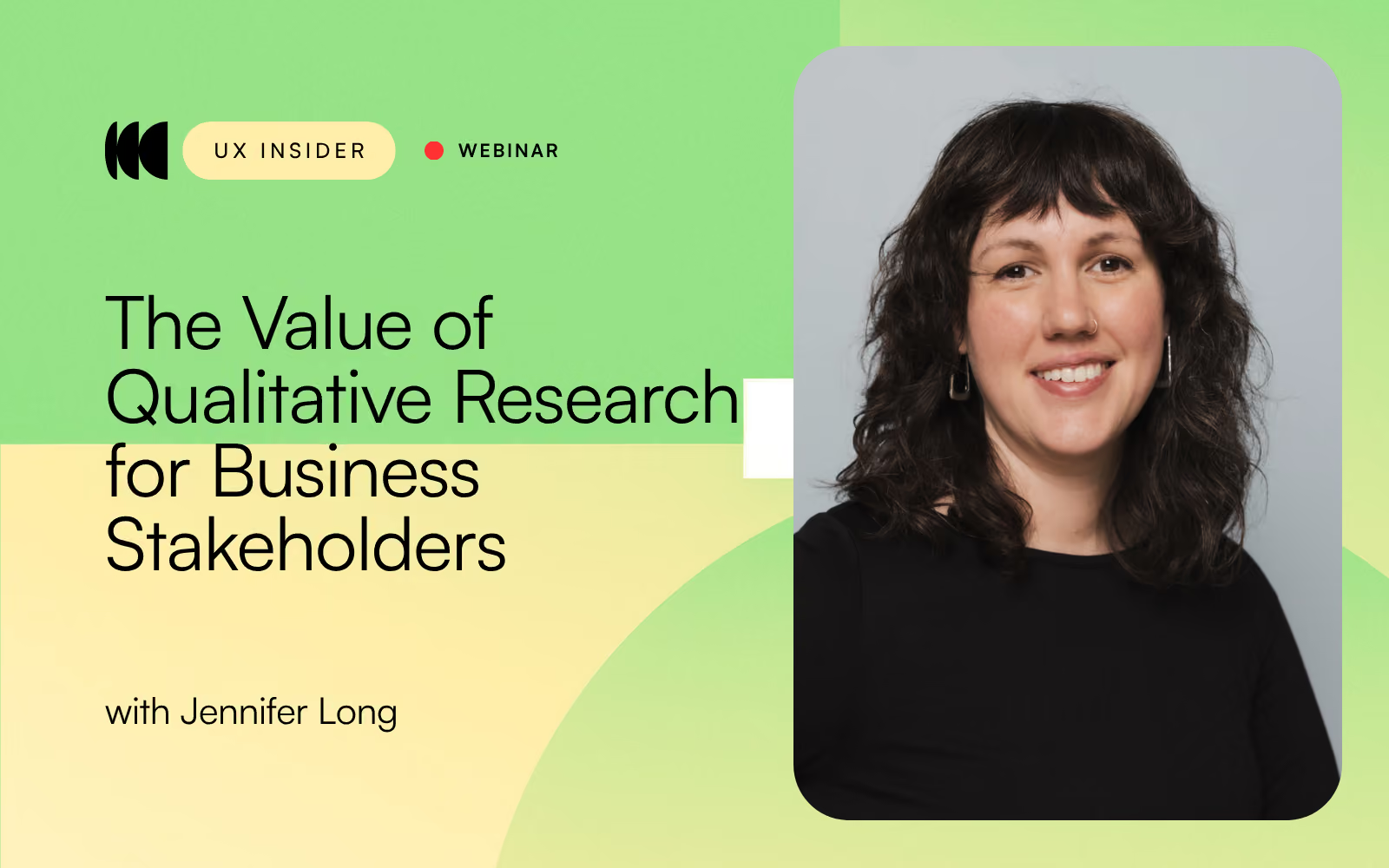
Every month we have informative “bite sized” presentations to add some inspiration to your day. These virtual events allow us to partner with amazing speakers, community groups and organizations to share their insights and hot takes on a variety of topics impacting our industry 🚀
Do you want to learn ways to uplift qualitative researchers and value their skill sets as business assets?
In an effort to make “data-driven” decisions, business leaders look to research for guidance. However, there is often an implicit priority for quantitative research over qualitative research. Often, even if qualitative research is funded and the findings are valued, the qualitative researcher and their skill sets can feel under-appreciated at an organizational or business unit level.
Let’s uplift the qualitative researcher and honor the craft of qualitative research as a transferable skill set. In this talk we will discuss:
Jennifer is a business generalist with UX Research and Information Architecture chops. She spent six years at Factor, an Information Architecture Consulting Firm, where she most recently held the Chief of Staff role. Jennifer has an MBA, a certificate of UX design from School of Visual Concepts in Seattle, and Bachelor of Arts in Theatre. She strongly believes in building stakeholder consensus and adding depth to projects through careful exploration. She lives in Washington State near the U.S./Canadian border and loves hiking in the North Cascades with her family and their German Shepherd mutt.
Take a seat, invite your colleagues and we hope to see you at our next UX Insider!
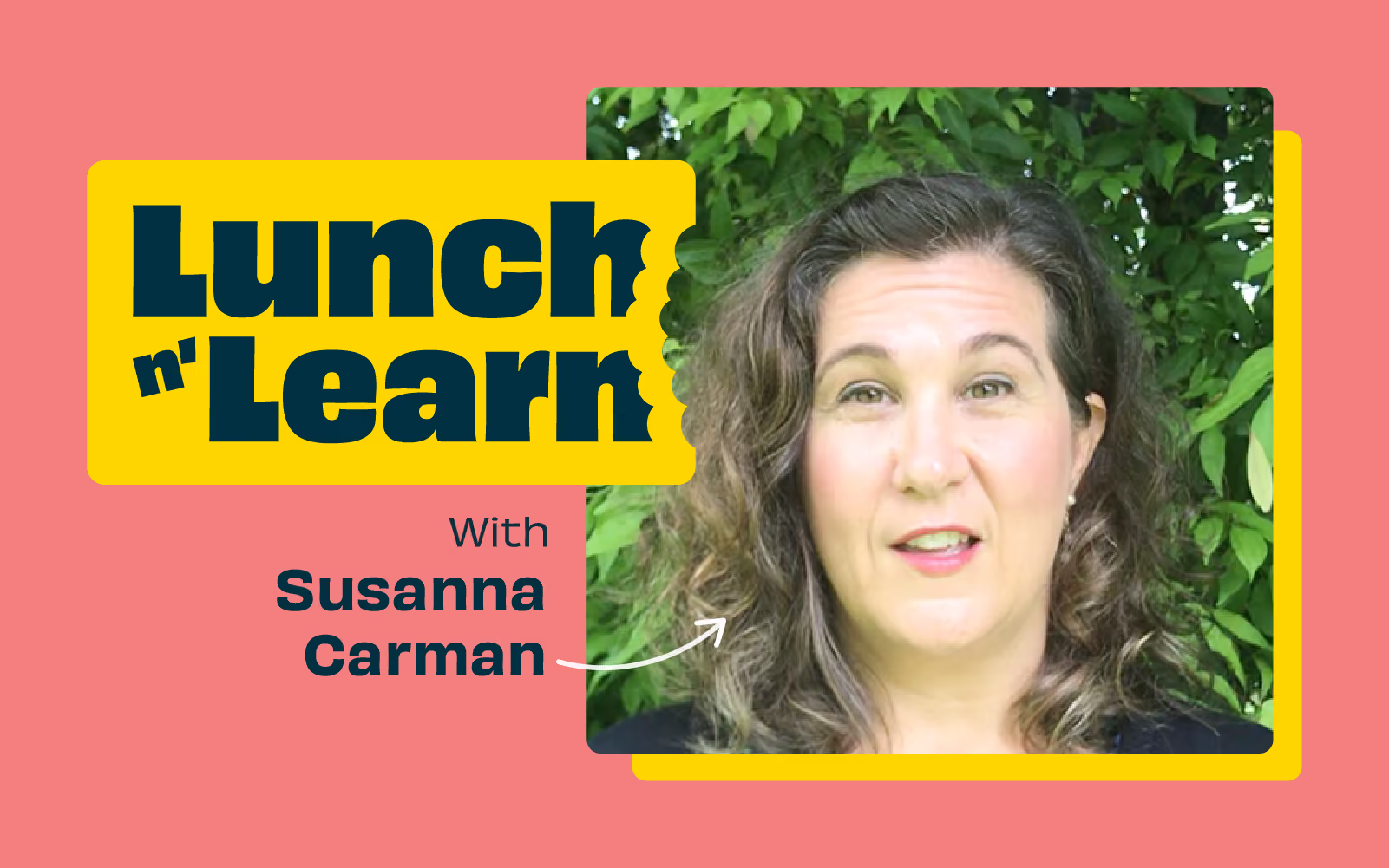
Every month we have fun and informative “bite sized” presentations to add some inspiration to your lunch break. These virtual events allow us to partner with amazing speakers, community groups and organizations to share their insights and hot takes on a variety of topics impacting our industry.
Susanna Carman is a Strategic Designer and research practitioner who helps people solve complex problems involving services, systems, and human interactions. Specializing in design, leadership, and learning, Susanna brings a high-value toolkit and herself as a Thinking Partner to design leadership and change practitioners who are tasked with delivering sustainable solutions amidst disruptive conditions.
Susanna holds a Master of Design Futures degree from RMIT University. She has over a decade of experience delivering business performance, cultural alignment, and leadership development outcomes to the education, health, community development, and financial services sectors. She is also the founder and host of Transition Leadership Lab, a nine-week learning lab for design, leadership, and change practitioners who already have a sophisticated set of tools and mindsets but still feel these are insufficient to meet the challenge of leading change in a rapidly transforming world.
Grab your lunch, invite your colleagues and we hope to see you at our next Lunch n’ Learn! 🥪
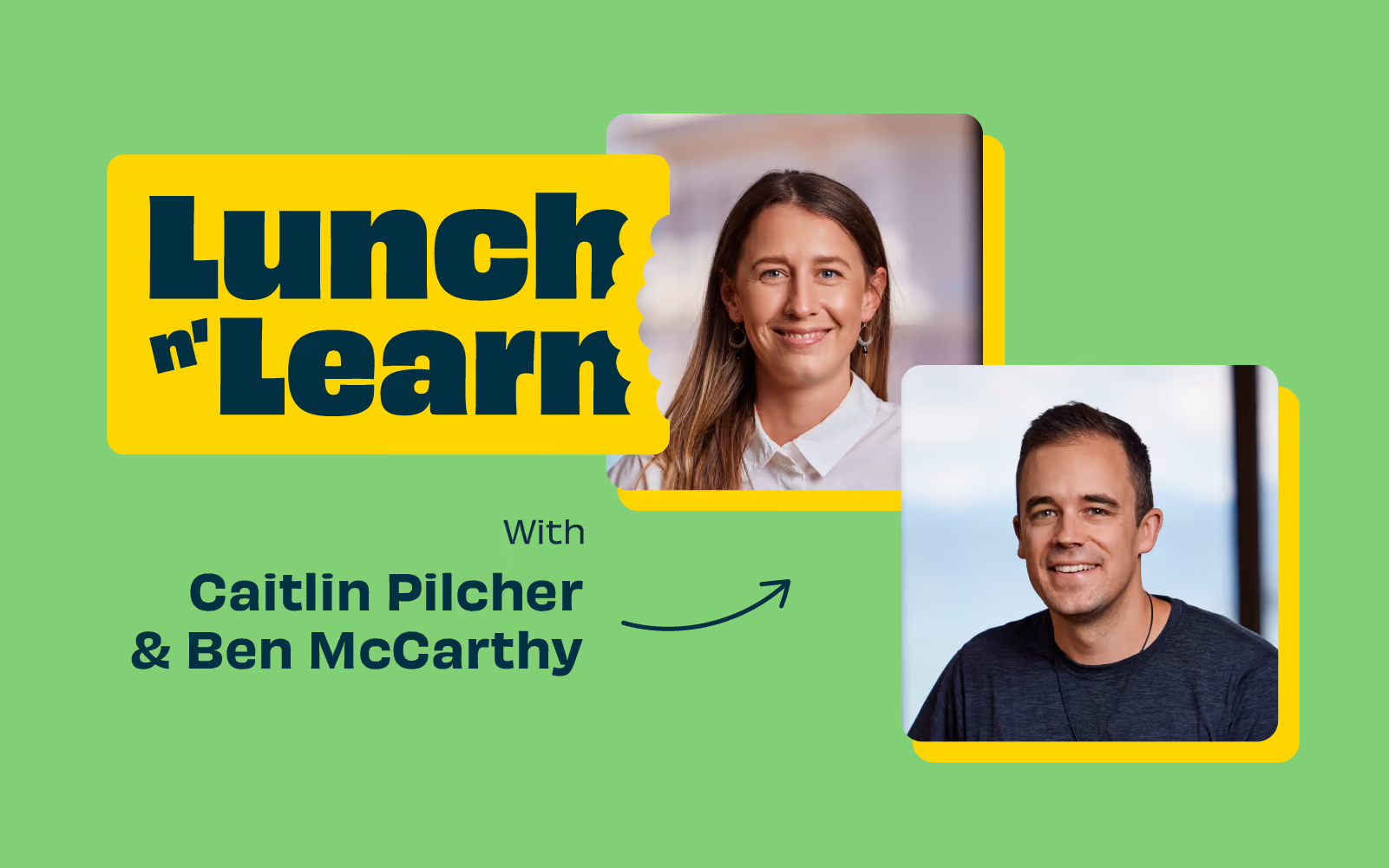
Have you ever used a self-service checkout at the supermarket, or scanned your own bags onto the belt at the airport? As much as these interactions seek to follow the same principles we apply to web and mobile interactions, often there comes a point where we need to improvise and come up with novel ways to apply what we know in a new context.
In this talk, we’ll explore what happens when the things we take for granted as digital designers go out the window and how you can adapt your design to the different needs of ‘phygital’ interactions.
Every month we have fun and informative “bite sized” presentations to add some inspiration to your lunch break. These virtual events allow us to partner with amazing speakers, community groups and organizations to share their insights and hot takes on a variety of topics impacting our industry.
Caitlin Pilcher is a digital experience designer driven by the belief people have a critical role to play in tackling the challenges we face today and building the world we want to see tomorrow. Her background in industrial and digital design has allowed her to investigate how people interact with both physical and digital environments, developing a keen interest in how we can design the space in between. Her work seeks to deeply understand and has focused on exploring complex problems with a sense of curiosity to create simple, human-centred solutions that work towards bringing exciting possible futures to life.
Ben McCarthy is driven to create incredibly positive outcomes for both people and the planet and speed up the inevitable transition to a low carbon future. Ben unpacks the complexity of human-centred systems to aid others in achieving this, looking for key interactions we have with each other, our services, and our institutions to unlock our ability to make the most meaningful change. Ben is unafraid of using novel and proven methods to tackle the most significant societal and environmental challenges we face today.
Grab your lunch, invite your colleagues and we hope to see you at our next Lunch n’ Learn! 🥪
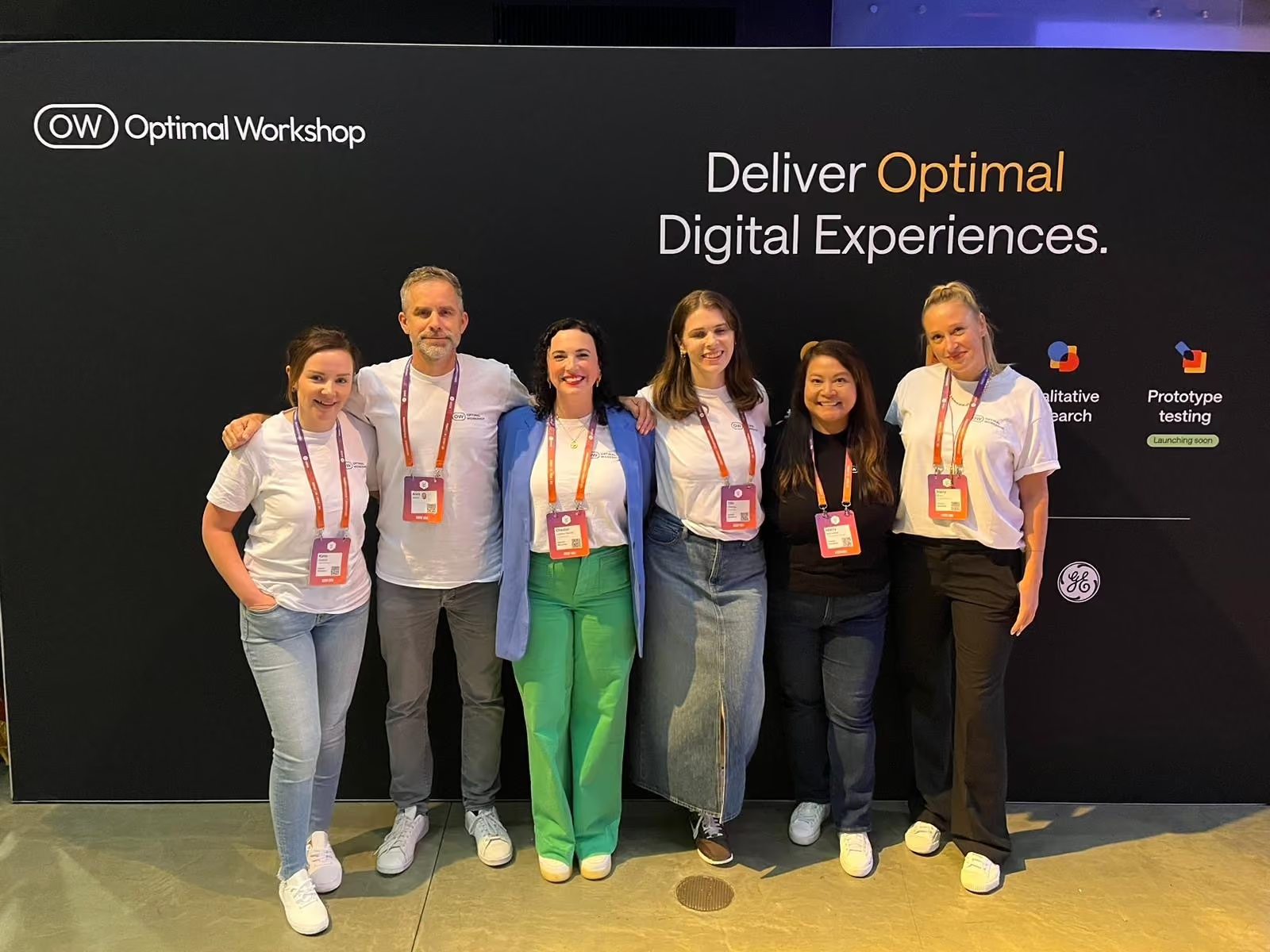
Last week Optimal Workshop was delighted to sponsor UXDX USA 2024 in New York. The User Experience event brings together Product, Design, UX, CX, and Engineering professionals and our team had an amazing time meeting with customers, industry experts, and colleagues throughout the conference. This year, we also had the privilege of sharing some of our industry expertise by running an interactive forum on “Measuring the Value of UX Research” - a topic very close to our hearts.
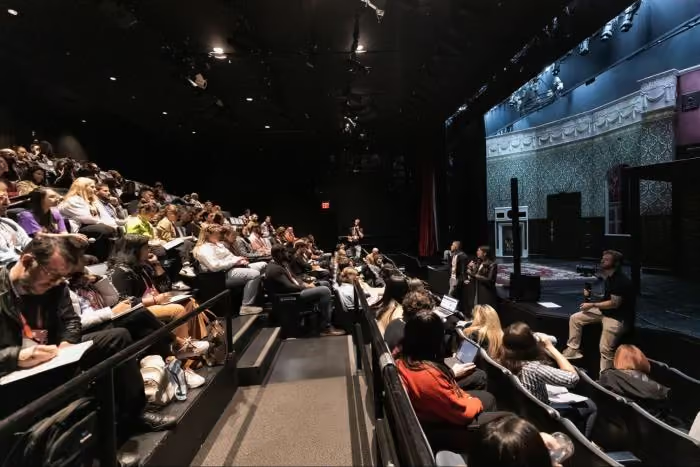
Our forum, hosted by Optimal Workshop CEO Alex Burke and Product Lead Ella Fielding, was focused on exploring the value of User Experience Research (UXR) from both an industry-wide perspective and within the diverse ecosystem of individual companies and teams conducting this type of research today.
The session brought together a global mix of UX professionals for a rich discussion on measuring and demonstrating the effectiveness of and the challenges facing organizations who are trying to tie UXR to tangible business value today.
The main topics for the discuss were:
With the large range of UX maturity and the democratization of research across teams, we know there’s a lot of opportunity for our customers to improve their ability to tie their user research to tangible business outcomes and embed UX more deeply in all levels of their organizations. To help fill this gap, Optimal Workshop is currently running a large research project on Measuring the Value of UX which will be released in a few weeks.
Keep up to date with the latest news and events by following us on LinkedIn.

