Subscribe to OW blog for an instantly better inbox
Oops! Something went wrong while submitting the form.

.avif)
Over the past year, we've spoken to more than a hundred people about the challenges of running interviews and moderated research.
In a study of 90 researchers, designers, and product owners, 61% said they regularly conduct structured one-on-one interviews. Interviewing is still one of the most valuable methods available, but it still runs into challenges and barriers.
Modern product teams are moving faster than ever, fueled by automation and AI, and research is expected to keep up. But sourcing, screening, scheduling, and managing participants can still slow everything down. Teams need a faster, more scalable way to find qualified participants without trading away quality. Teams need a faster, more scalable way to find qualified participants without sacrificing quality.
And while speed matters, teams told us something equally important: predictability and visibility. You want confidence that recruitment is progressing, participants are being vetted appropriately, and interviews will happen as planned.
With Optimal Interviews, you can already schedule sessions, automatically record interview sessions, get automated insights and highlight reels, chat with AI, and store your findings in a central repository. Now moderated recruitment is part of that same flow.
Everything lives in Optimal. The result is less admin, fewer handoffs, more visibility and control over your participants, and a smoother path from research question to actionable insight.
In this next evolution of recruitment at Optimal, moderated recruitment gives teams greater visibility and control throughout the entire recruitment process.
The Participant Management tab becomes your central hub for moderated recruitment. From here, you can:
Instead of wondering where recruitment stands, you'll always have a clear view of progress.
As participants apply, you can review potential participants and determine who is the best fit for your study. Each applicant profile includes:
Get everything you need to make an informed decision. Review individual participant profiles, assess their suitability, and add notes. Choose your best match for your study, and maintain full control over who enters their study.
Need to follow up with applicants or confirm details before scheduling? Send messages directly from within the platform, no inbox-hopping required.
Confirmed interviews are automatically added to your Optimal Interviews schedule, reducing admin and helping you stay organized. Everything works alongside your existing integrations so you can easily:
The result is a connected workflow that reduces friction from recruitment through to analysis.
Research teams are under increasing pressure to deliver insights quickly while maintaining rigor and participant quality. Moderated Recruitment helps strike that balance.
By bringing screening and targeting, participant management, scheduling, interviewing, recording, and insight management together in one platform, teams can spend less time coordinating logistics and more time focusing on insights.
Whether you're conducting customer discovery, concept testing, or usability interviews, Moderated Recruitment helps you move from recruitment to insight faster, with visibility, control, and confidence.
Ready to see it in action? Explore Moderated Recruitment in Optimal Interviews.
Log in to see how it works or book a demo to learn more.
%2520(1).avif)
Coordinating user interviews shouldn’t feel like a full-time job. Between juggling calendars, chasing confirmations, and sending reminders, scheduling can be the hidden bottleneck in research velocity and quietly consume the time you actually want to spend talking to customers.
If you want to run more interviews and generate insights more consistently, simplifying your scheduling process is one of best ways to remove friction and streamline your workflow.
What does a simpler workflow look like?
With a tool like Optimal’s Interviews Scheduler, you can:
It’s everything you need to manage interviews without the chaos.
With the Interviews Scheduler, you can sync your availability with Google Calendar and Microsoft Outlook in real time. Connect your own calendar or your team’s to ensure every busy slot is accounted for. Avoid double bookings, block out busy times, and keep everything in one place.
Once set up, your availability automatically updates, and participants can book directly into open slots, eliminating the back-and-forth. Plus, depending on your preferences, your sessions will either sync directly to your calendar or come through as an .ics file in the confirmation email, saving you one more step.
The Interviews Scheduler integrates directly with Zoom, Microsoft Teams, and Google Meet.
When someone books a session:
No copying links. No switching between tools.
The Interviews Scheduler isn’t just about booking time slots. It’s about removing friction from your research workflow.
With integrations at its core, you can:
Whether you’re running one-off interviews or managing weekly research sprints, the Interviews Scheduler helps you move faster and stay organised.
Ready to give it a try? Log in to your Optimal account and get started or book a demo to learn more.

User interviews have always been one of the most trusted and powerful UX research methods. They give you something beyond dashboards or written surveys: real, in-depth conversations and context.
But they’ve historically come with a cost – time, coordination, and a heavy lift to review recordings and turn videos into insights. Sometimes insights get buried. Recordings sit unused and research becomes challenging to revisit.
In our recent webinar, we explored how that’s changing and how you can reduce the heavy lift of interview review, while building a research repository.
A research repository is a centralized system for storing, analyzing, and reusing research data, especially qualitative data like user interviews. It helps teams answer questions like what users said, what patterns emerged, and how past research can inform future decisions.
For interviews, this means:
Optimal Interviews brings this to life by automatically capturing recordings, generating transcripts, structuring insights from the start, and making everything searchable so teams can easily revisit, build on, and continuously learn from their research.
So what did we learn? Here are some key takeaways from this webinar, plus answers to the most common questions we heard.
Running interviews isn’t just about talking to users. It’s everything before and after:
That overhead adds up quickly. There’s opportunity in automating these workflows and removing the friction around them. Optimal Interviews solves this by:
Research isn’t slowing down. Product cycles are getting faster, and teams expect insights just as quickly.
What stood out most:
One team told us that a few years ago it took them three weeks to analyze user interviews for an initiative. When they replicated the same study in Optimal Interviews, they were able to generate usable insights in about five minutes.
That shift from lagging insight to near real-time understanding is where the real impact lies.
Interview scheduling sounds simple, but it’s often where things break down.
You can use Optimal Interviews to ensure:
When done right, scheduling fades into the background so teams can focus on conversations, not coordination.
AI is already proving its value in the analysis phase:
But one point came through clearly: AI accelerates analysis but it doesn’t replace human judgment and sensitivity.
Researchers still play a critical role in validating insights, interpreting nuance, and deciding what matters for the business. Think of AI as getting you to 80% faster, while you own the final 20%.
Here’s what you can achieve with Optimal Interviews:
This turns research from static storage into something dynamic, something you can continuously mine and build on.
Both. You can extract insights from individual interviews, but the real value often comes from patterns across multiple sessions. Aggregation helps surface stronger, more reliable themes, while still preserving standout moments from single participants.
Privacy is a core focus and consideration with Optimal Interviews. Some of the key protections include automatic redaction of personally identifiable information (PII) and enterprise-grade AI infrastructure with strict data isolation. We're also looking to expand Optimal Interviews anonymized scheduling and communication and manual redaction controls before analysis.
Integrations are available for Google Meet, Microsoft Teams, and Zoom.
You can still run everything without integrations:
Integrations are helpful but not required.
Today, teams often bring relevant interviews into one project for analysis. Looking ahead, the goal is broader. Optimal’s looking into how the platform can search and query across all research, use AI chat to explore insights across studies, and surface insights at a Workspace level.
Yes. You can search transcripts directly and use AI-powered chat to explore themes, generate summaries, or even turn findings into shareable outputs like Slack posts or reports.
Interviews aren’t new. But the way we run them and what we can get out of them is changing fast.
By removing operational overhead and reducing time to insight, teams can talk to users more often, share insights faster, and build a research repository that becomes part of everyday product decision-making.
If you want to experience the full walkthrough, demo, and Q&A from the session, we encourage you to watch the full webinar.
👉 You can watch the full training webinar here.

Since launching Optimal Interviews in December, we've been tracking closely as research, product, and design teams put it to the test. The tool is driving a real transformation in workflows, and we’re energized by the feedback so far.
Optimal Interviews was built to remove the friction from one of research's most time-intensive steps: analyzing interview recordings. With automated transcription, AI-generated insights, highlight reels, summaries, and citations, the tool transforms hours of manual review into something that happens in minutes.
But we’re not done yet. We’re constantly building and evolving based on your feedback. With the latest releases like automatic recording, every session can now be captured and stored automatically, helping teams build a centralized user research repository and supporting continuous research.
Here’s a look at how teams are using Optimal Interviews, the latest work in this space, and where we’re headed.
Researchers across industries are leveraging Optimal Interviews in a variety of ways. Here are just a few examples from current users:
It’s been a busy few months, and we’ve shipped several meaningful updates over the past few months. Here’s what’s new:
Optimal Interviews now supports 13 languages, automatically detecting and transcribing interviews in their original languages. AI Chat is also ready to assist your team in these languages, ensuring a seamless experience no matter what language your team is using.
Sync Optimal Interviews with your Google Meet, Zoom, or Microsoft Teams account to automatically generate and attach meeting links to sessions scheduled with the Optimal scheduler.
You can choose to automatically record and upload sessions scheduled through Optimal, eliminating the need for manual uploads. Sessions can now be captured and stored automatically, enabling teams to conduct continuous research. Accumulate insights over time in a central repository, where they remain always accessible and ready to be explored further with AI Chat.
Custom topics allow you to define specific areas of interest for AI to focus on for interview insights. As more recordings are added, the tool will automatically generate insights based on these topics, so you can easily filter and focus on the data that matters most to you.
Our ultimate goal? To keep finding ways to reduce manual effort. Let Optimal streamline your research workflow, automate time-consuming tasks, and help you build out your qualitative research repository.
We have a number of significant additions in development, including:
Sync you and your team’s calendars (Google and Microsoft) with Optimal Interviews so you can easily schedule and sync you and your team’s interview availability. Avoid double booking and get scheduled sessions automatically added to your calendar.
Interviewers and participants will be able to message each other directly through Optimal. This helps protect personal contact details e.g. email addresses and reduces unintended bias, such as revealing the study creator’s organization. Teams can coordinate, add clarifications, and follow up more efficiently without exposing personal information.
How are you using Optimal Interviews in your research? What's working well, and what would you like to see us build next?
And if you're just getting started, our Interviews 101 guide is a great place to begin.
Want to learn more about how to harness the full potential of Optimal Interviews and AI Chat? Register for this live training.
Optimal Interviews is updated continuously and shaped with feedback from users. Follow our release notes or share your thoughts via live chat or feature request form to give your feedback and stay in the loop.
Collaboration tools like Mural, FigJam, and Miro are staples of how modern teams can brainstorm, map ideas, align on plans, and build together. But a canvas alone can't tell you if you're on the right track or guide you to what comes next when progress stalls. That's where Optimal AI Chat and user insights come in.
By starting or bringing real user insights into the boards your team already works in, you can reduce ambiguity, ground discussions in real research, and accelerate decision-making.
Here are 7 ways to use AI Chat alongside your collaboration boards.
Before your next planning session, use Optimal AI Chat to surface relevant insights from your interview recordings. Add a summary directly into your Mural, Miro, or FigJam board so everyone comes in with the same context and understanding of the objectives. Instead of starting with assumptions, your team can start with real user insights and clear trade-offs to discuss.
Try this prompt: "Summarize the key considerations for [decision topic] and flag any trade-offs we should discuss as a team."
.avif)
AI Chat can analyze interview transcripts and video recordings and highlight common jobs to be done, behaviors, and friction points. You can then map those steps visually on your board and identify where the experience breaks down.
Try these prompts: “Summarize the typical jobs to be done for the people we interviewed.”
“For this job you identified [paste job details], detail the journey steps.”
AI Chat can analyze recurring themes from your interview recordings and convert them into concrete opportunities your team can explore next. Adding these to your board gives the team a clear starting point rather than a vague list of problems.
Try this prompt: "Based on these pain points [paste notes or themes], suggest three product improvements we could explore."
Interview insights aren’t just valuable for product, research, and design teams. Marketing teams can also use AI Chat to quickly evaluate messaging, positioning, and customer perception.
When running preference or concept testing interviews, AI Chat can quickly analyze the feedback and suggest positioning directions you can workshop on your board.
Try this prompt: “Suggest positioning options based on the interview feedback.”
Running workshops and brainstorming sessions with cross-functional teams can be challenging. Conversations drift, discussions stall, and teams sometimes struggle to focus on the most important issues.
AI Chat can help you structure the conversation before the workshop even begins by generating discussion guides based on user insights from your interviews. Add the chat outputs directly to your board to guide the session.
Try this prompt: “Generate a structured discussion guide based on the pain points of the interviewees.”
Open brainstorming can be valuable. It can also be chaotic without clear direction. By leveraging AI Chat, you can guide your brainstorming sessions with intelligent suggestions, topic generation, and idea organization.
Try this prompt: “Generate 10 brainstorm ideas based on these user insights and group them into themes we could explore.”
Visualizing complex processes and systems is easier with tools like Miro, FigJam, and Mural. AI Chat can help you map out each step. AI Chat can help break down a process step-by-step, highlighting decisions, dependencies, and potential friction points based on your interviews. Your team can then map these steps visually and identify opportunities for improvement.
Try this prompt: “Create a step-by-step process map for how users complete [task], including key decisions and potential friction points.”
The best collaboration happens when teams have the right information at the right time.
Optimal AI Chat gives your team a jumpstart for your interview analysis: clearer inputs, faster synthesis, and smarter outputs that translate directly into what you're building on your boards.
Whether you're running a workshop, mapping a user journey, or planning a product launch, AI Chat helps you spend less time getting oriented and more time making decisions.
Ready to see what your team can do with it?
Learn more about best practices for AI Chat or book a demo.
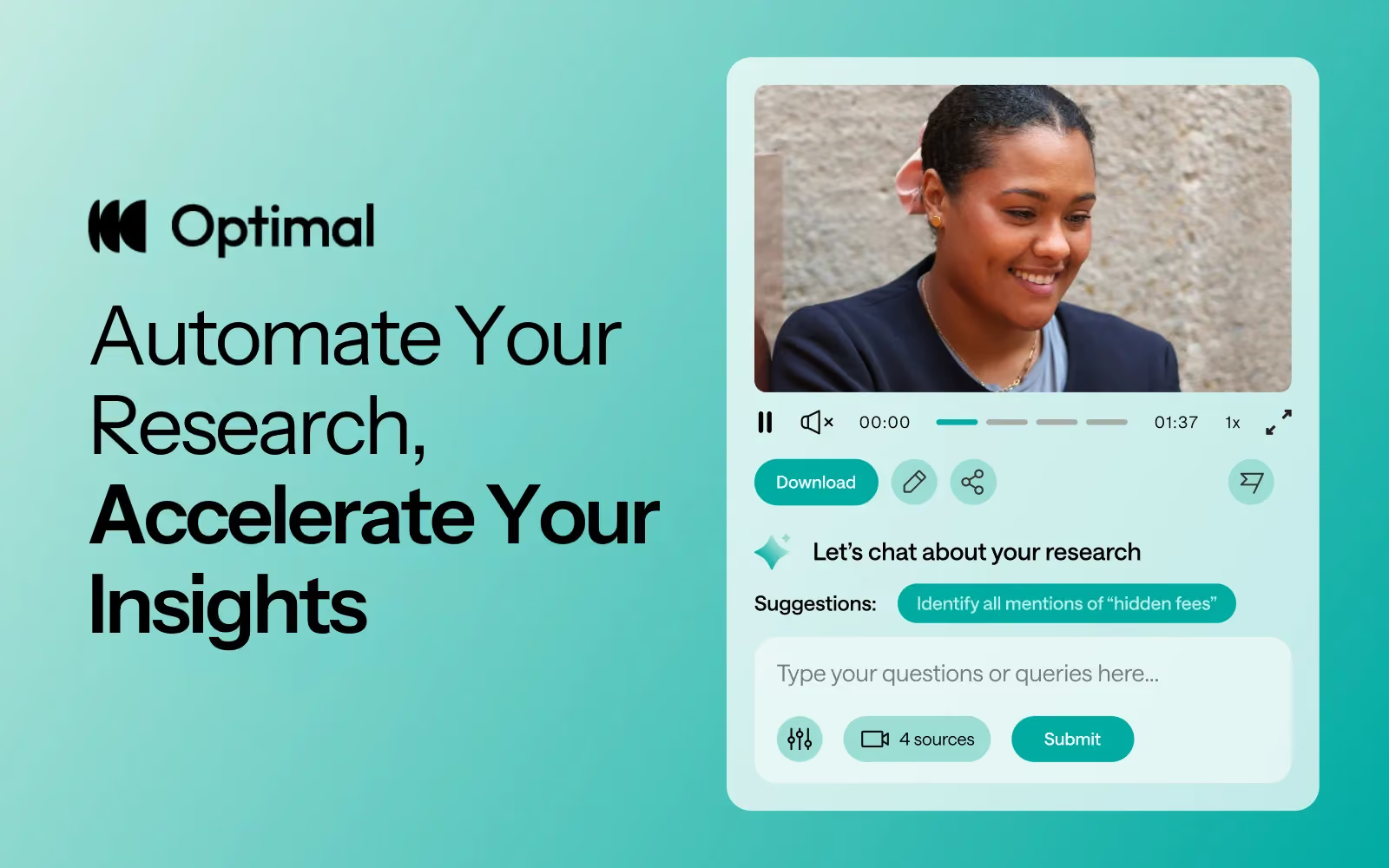
At Optimal, we know the reality of user research: you've just wrapped up a fantastic interview session, your head is buzzing with insights, and then... you're staring at hours of video footage that somehow needs to become actionable recommendations for your team.
User interviews and usability sessions are treasure troves of insight, but the reality is reviewing hours of raw footage can be time-consuming, tedious, and easy to overlook important details. Too often, valuable user stories never make it past the recording stage.
That's why we’re excited to announce the launch of Interviews, a brand-new tool that saves you time with AI and automation, turns real user moments into actionable recommendations, and provides the evidence you need to shape decisions, bring stakeholders on board, and inspire action.
We surveyed more than 100 researchers, designers, and product managers, conducted discovery interviews, tested prototypes, and ran feedback sessions to help guide the discovery and development of Optimal Interviews.
The result? What once took hours of video review now takes minutes. With Interviews, you get:
This tool is powered by AI designed for researchers, product owners, and designers. This isn’t just transcription or summarization, it’s intelligence tailored to surface the insights that matter most. It’s like having a personal AI research assistant, accelerating analysis and automating your workflow without compromising quality. No more endless footage scrolling.
The AI used for Interviews as well as all other AI with Optimal is backed by AWS Amazon Bedrock, ensuring that your AI insights are supported with industry-leading protection and compliance.
A big thank you to our early access users! Your feedback helped us focus on making Optimal Interviews even better. Here's what's new:
This new tool is just the beginning. Our vision is to help you manage the entire moderated interview process inside Optimal, from recruitment to scheduling to analysis and sharing.
Here’s what’s coming:
Imagine running your full end-to-end interview workflow, all in one platform. That’s where we’re heading, and Interviews is our first step.
Interviews is available now for our latest Optimal plans with study limits. Start transforming your footage into minutes of clarity and bring your users’ voices to the center of every decision. We can’t wait to see what you uncover.

