Subscribe to OW blog for an instantly better inbox
Oops! Something went wrong while submitting the form.

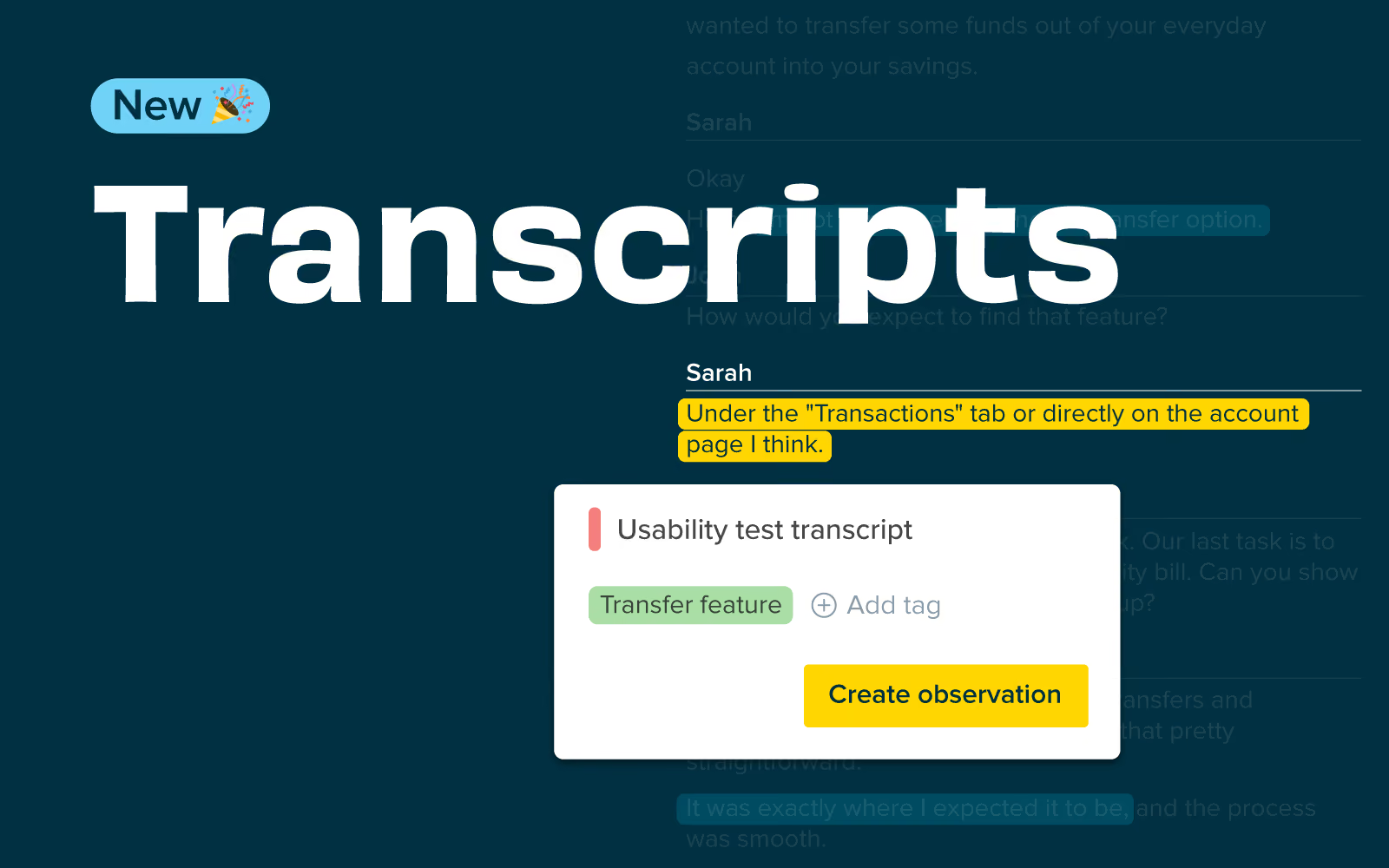
The accuracy of your data collection is crucial in qualitative research. It is vital that nothing is lost in translation or simply missed from the point of collection to analysis, and our latest release makes this even easier to achieve. You can now directly import interview transcripts into Qualitative Insights (previously known as Reframer), allowing you and your team to capture and tag observations effortlessly while maintaining the integrity of the information. Get ready to experience a new level of efficiency in your qualitative research!
Whether you are conducting interviews alone or with the support of your team, it’s important to prioritize building connections with participants rather than struggling to take notes and ask the right questions. Transcripts ensure you avoid losing crucial insights and context as you move from data collection to analysis and reduce the likelihood of human errors and missed observations that sometimes occur during live note-taking sessions.
It also enables smooth collaboration among team members by allowing them to review interviews and contribute to the analysis, even if they weren't present.
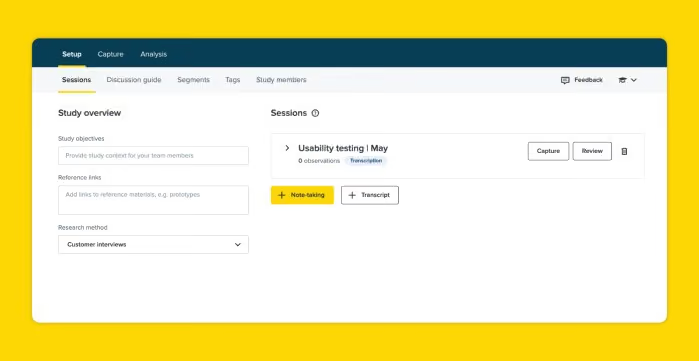
You can add a transcript to a new or existing study in Qualitative Insights with just a few clicks. After recording an interview or user testing session, open your Qualitative Insights study and click ‘Sessions’ then ‘+ Transcript.’
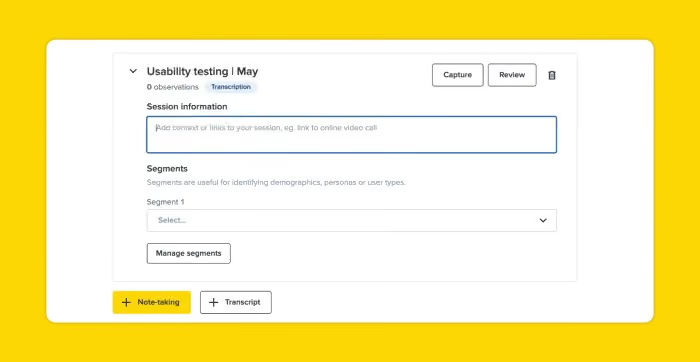
Add a session title, any session information or a link to the video for future reference in the session information box. If you have created segments, choose which ones apply to this participant; you can update these later at any time. Then click ‘import transcript.’
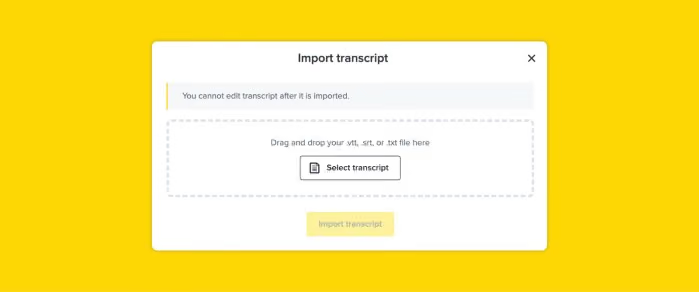
Click ‘Select transcript’ and ensure you made any edits before importing it. This feature supports .vtt, .srt, or .txt files. Now, click Capture observations’ to complete the import and create and tag your observations.
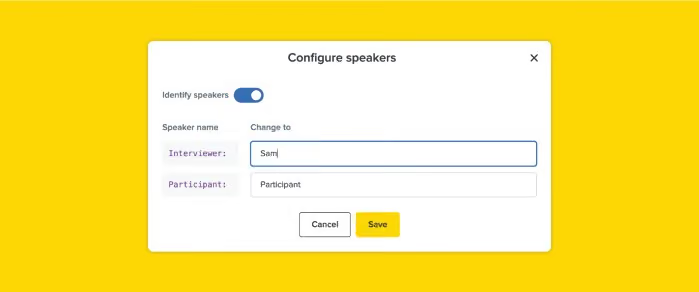
You will see your transcript displayed. If you use a .vtt or .srt file, you will see the speaker names have been identified. You can update the speaker names by clicking on configure speakers.
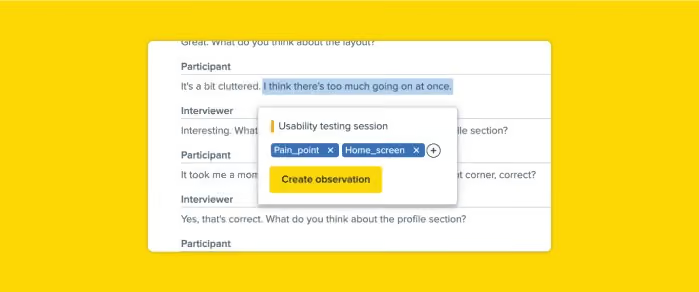
To create observations from your transcript, simply highlight text, enter a new tag or select an existing one, then click create an observation.
There is no limit to how many transcripts you can import. This means you can import all your past and future interviews, ensuring all your research data is in one place for easy access and analysis.
Welcome to another UX New Zealand 2019 speaker interview. In the lead up to the conference (which is just around the corner!), we’re catching up with the people who’ll be sharing their stories with you in October.
Today, we chat to product design managers Sophie Taylor (ST) and Julie Jeon (JJ).
JJ: It was a surprise! Throughout my time at university, I was gearing up to become a book/publication designer. After a sequence of unanticipated events, I found myself working at Trade Me on the mobile apps. I had a pretty solid plan around what I’d do after my studies at the time but it was the first unplanned decision I made, probably in my whole life, and I’m really glad I took this path. In hindsight, a lot of things I’d think about when designing a book (like how a reader would interact and navigate through the book and presenting the information clearly) were all very relevant to product design. I was also a big stats nerd during school, and I was happy I could revive that through the measure and learn approach you’d take working in product.
ST: My pathway to design was via some pretty nasty homemade cards. You know the ones; all three primary colors and too much glitter? As a kid, I couldn't get enough of the stuff, and despite the questionable taste of my creations, I was captivated by the process of making things. As I grew up this stuck with me. When I landed at university I still wasn't sure what I wanted to do and it was in the design department where I found I could learn about an endless range of topics while solving problems and making things. That in combination with a computer science paper landed me squarely in the digital world and that is where I have been ever since.
ST and JJ: As the company has grown, so has the size and number of teams we are working with. Going from collaborating with a few people to a whole room of people has changed our approach. We’ve adapted and made new ways to share knowledge and work together as a bigger team, from plain old documentation, to sessions that focus on improving the design process and how to best work with development teams as designers.
JJ: For me, it’s been about spending time with people to encourage but mainly to listen. It goes for the talented and smart designers I’ve had the pleasure of working with, but also with the development teams and product people. I don’t think I approach people with an intent to ‘coach’ them, it’s more about working and getting better together as a team or discipline.
JJ: In my spare time I exchange letters to my pen pals who are scattered all around the world from Tokyo, San Francisco to Toronto and more. It’s a privilege to be able to be a part of and get a glimpse into the various life stages that my friends are at. I’m also very much obsessed with my small indoor garden and making sure my kitten doesn’t eat any of it.
ST: I think the main thing is the subject matter, both were fascinating dives into domains with very different users. It was such an amazing opportunity at Trade Me to work on a local product that so many of our family and friends use and care about. At Xero it has been a real treat getting work on a global product and all of the challenges that come along with that.
ST: I like a good project, anything from our vege garden, house renovations through to a fiber optic light dress my friend Lisa and I made for the LUX light festival a few years back.
ST and JJ: Finding productive ways to solve problems together from start to finish is a big challenge which requires a lot of thinking ahead and preparation. But when it happens, it’s well worth the effort. Coming to agreement around what’s most valuable to solve first, making sure everyone is getting the opportunity to be part of the process to define the solution, deciding what to ship and evaluating if it actually solves the problem are some of the things that benefit from teams working together on. All of these steps need to be done in a way that’s right for the team to get the best outcome.
ST and JJ: It can be really difficult for a team if they don’t have a shared purpose. When a team is clear on the problem they are faced with, they can figure out a way to solve it that makes the best use of the strengths of the team, as well as the individuals within it. If a shared purpose is the foundation, a team with diverse perspectives ensures there are a wide range of ideas, approaches and risks identified during the process. This is more than just different disciplines too – this could be things like personality and working style as well as gender, age, and ethnicity.
JJ: The easy access to nature is my favourite thing about Wellington. There’s always a hilly walk nearby, whether you’re in the city or out in the suburbs. I live near Wrights Hill out in Karori, so we’re always in the company of tūī and kākā out in our garden.
ST: Mine too! We are so lucky to live in a city where just down the road there are a number of beautiful walks to choose from. I am also a big fan of food and here in Wellington we are spoilt for choice.
UX New Zealand is just around the corner. Whether you're new to UX or a seasoned professional, you'll gain valuable insights and inspiration - and have fun along the way! Learn more on the UXNZ website.
Welcome to our third speaker interview for UX New Zealand 2019 (check out our other interviews with Gregg Bernstein and Nate Foulds). In the lead up to the conference, we’re catching up with the people who’ll be sharing their stories with you at the conference in October. Today, we chat with Torrey Podmajersky, a UX Writer at Google and the author of Strategic Writing for UX.
Torrey: It's funny, I did not start in anything like a normal way, because UX writing was so difficult to hire for in 2010, when I was hired to do that at Xbox. They already had a very small writing team at the time that they had inherited as a result of technical writing needs, and the writing manager knew that he needed to hire another. But it's funny – the title of UX writer/content designer or anything like that just didn't exist.
At the time, I was looking to transition from doing internal communications at Microsoft into more of product-oriented work. So it seemed to be a great fit. And actually, that writing manager talked me into it, because he knew that I had been a high school teacher. I taught high school science for nine years, and he said, "Perfect. You can explain difficult abstract concepts to teenagers, and have them not hate you at the end and probably have them pass a test."
Torrey: So it’s worth mentioning that every part of Microsoft is separate from every other part, or at least that was the case when I was there.
It was the various products people were working on or even the teams inside those products that really defined what that culture was. And that culture when I was working at Xbox was incredibly collaborative and incredibly user-focused because we knew who our audience was and we knew how we wanted to expand that audience. So we knew about the core gamer and the people who were already Xbox enthusiasts at that point because we had shipped the Xbox 360 several years before.
We knew that for every household with an Xbox, there was usually one person in that house that knew how to use it and was excited about it. But we also knew that they lived with other people who could potentially also be excited about it. So focusing on the core user and that core user's family made it really easy to make product decisions and UX decisions. It kept everybody on the same page.
Torrey: Absolutely. It's important as soon as the people turn the Xbox on and are looking at the UX for the first time themselves. There’s a clear transition from marketing copy, like, "What does the box say? What do the ads say? What does the flyer say or the poster?". And then people set it up, they're turning it on. How does it greet them? How do they, or if their family member has set it up, how does it include them or exclude them when a new person wants to play for the first time? That is a UX problem, in the sense of a design problem that needs to be solved.
Torrey: I actually don't think it's very different anywhere else. Not just at Microsoft, but anytime you've got a team that understands their user. No matter if they are inside Microsoft or making a consumer app or an enterprise app. If they know who their users are and who they want to target next, every experience maker is looking to grow the audience and the appeal of their product.
Torrey: When I'm generally presenting to my teams, or talking about what I do or what I've done, people get this surprised look on their face. Because they say, "Well, how did you have time to work on all of those things? How did you ship those nine different features?" And the problem with UX writing is that it is endemic to everything. The writing, the words in any experience are probably about half of what a person experiences. People need to use those words for navigation, and control, and all of the functions, all of those user experience interactions. And there are very, very few UX writers to go around.
So whether I am consulting on those features, or engaged with the design process, or just editing them as a last minute thing, the context switching for a UX writer is pretty intense. Because I'll be talking about one feature with one team, and then my next meeting will be a different feature with a different team, sometimes with a totally different audience.
So that’s something that I think every professional UX writer is working hard at right now. I mean maybe not every writer, but a large majority of UX writers are working on how they manage their time and energy so that they can be most effective? And, how do they prioritize the work to be done so that the most important work is getting done well, and the rest of the work is pointed out to say, "That can't be done with the staffing and resources we have right now".
Torrey: There's a diagram I put in the first chapter of my book that talks about the entire life cycle of getting customers into a business or interested in a product. Getting them onboarded, engaged into that product, supporting them if anything goes wrong, and hopefully transforming them into repeat customers or fans of the experience. And hopefully then they also bring along their friends and family or coworkers, or whatever's appropriate for that experience.
What happened then is the first part of that cycle really is the domain of core marketing and copywriting, the descriptions of the app, the positioning in the marketplace. The social media engagement that uses that brand voice extremely well, and differently than the UX writer does. That's where to entice and engage and make things that are snappy lines, and very memorable taglines, for example.
And then that person really cares about the funnel, and getting people to the point of purchasing and engagement in that first moment of using the experience. And sometimes that that moment is bridged by a different person entirely, doing sales. So we have the marketing motion, the sales motion, and then when people are in the experience: that's when the UX text really needs to shine.
Interestingly, and this is especially true for enterprise apps, the people who need to be engaged with the marketing and the advertising and who are committed to the sale are not the people who are going to use the experience every day. For example, in an education environment, it's school boards and administrators that choose the software for the school district. And then it's teachers and students who end up using it.
So it's very different audiences there for the two groups. But even when they're the same group, if the copywriting before the moment of sale and the UX text after the sale are not aligned, if they don't feel like the same product, that's a big problem. So there needs to be a lot of alignment there.
Torrey: This is something that plenty of companies are still struggling with. Whether that's Microsoft, or Google, or even Facebook. I mean, Facebook has a bunch of content strategists, Google has a bunch of UX writers. Microsoft has a content developers and content designers and UX writers. Part of the problem here is the difference in titles and also the widespread title differences. But trying to make the case for, "Why should we have this person or somebody in charge of this?" is a tough thing to do, until you start saying, "Hey, if we took out all the words on this screen that we're designing, nobody could use it at all. If we took out all the labels and the titles and descriptions, it's unusable."
In fact, for most of the experiences we design, the text is half or more of what people interact with. That text creates a story and creates a sense of the brand. We can build people's confidence, we can hint at what's coming next.
So when the value of UX writing is made clear, people tend to get it pretty fast. But it's making that case and finding different approaches that is difficult. It helps that there's more books coming out about it, it helps that it’s becoming more widely recognized, "Hey, these people are great at that." Well, they have somebody full-time, writing those words. Turns out, that’s an area that makes sense to invest in.
Torrey: I like to ask people, "Are you shipping things with words on it?" If you are shipping experiences that have letters next to each other that form words, or characters in non-letter-based languages, then you have UX writers. Are those the UX writers that should be doing it? Or is it everybody doing a little bit of it? What are you doing to keep them consistent? What are you doing to make sure that you have only hired people to do the UX writing, who have capability in the language that you're shipping in?
If you're shipping in say, American English as we generally do in the US, are you only hiring people that have English as their first language? Whether it's the engineers or the product owners or the support personnel, do you look at their writing samples before you hire them?
It'd be pretty silly to do that, but at the same time, it's also pretty silly that we have historically not been paying much attention to the language skills of the people who are putting all of this language in front of our customers. People spend a lot more time with the UI text than they do with any single piece of marketing text, and that marketing text I know gets a lot more scrutiny.
Torrey: Sure! The School of Visual Concepts is a Seattle-based independent school. I developed the UX writing curriculum there several years ago with Elly Searle, and have been teaching sections of it ever since. It’s a 5 week class, so classes once a week for 3 hours each week. We go through the very fundamentals of what it is it to be a writer.
This means everything from defining voice to creating and editing text to be conversational, clear, purposeful and concise. We also go through critique of that in class, and eventually come out the other end with portfolio pieces. This means that these students, some of whom are already designers, some of whom are looking to get into UX design, have some of these fundamental UX writing skills so that they can make their designs really sing.
Torrey: I am so excited! I've never been to New Zealand before. I have heard amazing things about Kiwis in general. So I’m really excited to just breathe new air and see the ocean from a different perspective. I’m also there to learn a little bit about the culture. I'm taking a few days before the conference to just enjoy Wellington a little bit. And then at UX New Zealand, similarly soaking up the UX culture of a new place. We’re are all making this up as we go along, and we make it up better when we do that together and when we learn from each other.
We're all still struggling with the same fundamental curiosities of figuring out how we interact with humans at scale. Whether it's to delight them, or inform them, or enable them or empower them, whatever it is we are doing with those humans, we’re trying to work out the right ways to do it. What are the ethical ways to do it? What are the effective ways to do it? I’m looking forward to having those conversations at the conference.
Welcome to our second speaker interview for UX New Zealand 2019 (check out our first interview with Gregg Bernstein). In the lead up to the conference, we’re catching up with the people who’ll be sharing their stories with you at the conference in October. Today, we chat with Nate Foulds, the product researcher for Stories at Instagram.
Nate: Yeah, so I took a pretty non-traditional path. When I was in college I never really thought about design or technology at all. I knew a couple people in computer science and digital design, but it wasn’t really on my radar. I studied political science and art history, and I really wanted to go into art law. But it was senior year and I got cold feet, so I decided to scrap that idea and spend a year teaching English abroad, just to take some time to figure out what to do next.
After a year I moved to San Francisco without a job or anything – just a connection. I had a friend working at an agency, Beyond, that was just starting out and needed some help with some pretty basic marketing-type stuff. Things like light data analysis and social listening, which was big at the time, basically analyzing what people are saying about your company on social media.
And so I started doing that and it turned out to be a pretty good fit. I liked working with so many different clients, getting the inside scoop on how their customers felt and then delivering recommendations for design and marketing. Over time, that work turned more and more into original user research with customers rather than just social listening.
Nate: I started at the Times after being at the agency for 5 years, and it was my first proper in-house role. At the Times, I led research for news products, which are basically the main website and news app. Projects I worked on included the redesign of The New York Times home page and the mobile app, including the concepting of a personalized news section called ‘For You’.
It was a really interesting time to be there since it was during the 2016 election cycle in the US. We witnessed the field of candidates and then the election itself where Donald Trump won, and then the post-election wake-up call that everyone had. Subscriptions grew an insane amount, just between the few quarters before the election to after the election itself, something like 30 percent, which was about 5 times more than growth periods prior.
And so all of a sudden we had this massive amount of people who were wanting to pay more attention to the news. It was really exciting for us to think about the sorts of features we could offer them to start and keep on subscribing. Like, how much are people willing to pay for the news in the first place? How much can we offer additional news value versus what we think of as complementary features? We found that podcasts and newsletters were really popular, as well as the cooking app and the crossword app. Some of these are complementary businesses that are value-adds for people once they’re in the door with the main news, or for those who don’t like the main news but value the rest.
A special thing about being there is the fact that you're surrounded by some of the greatest journalists in the country. There were times when I led research engagements that involved journalists as partners, and that inevitably resulted in some funny moments. I was once conducting interviews with an observer who was herself a Pulitzer Prize winning investigative journalist. I remember being in the room with her, Jodi Kantor, and I was leading the interview, but I felt so nervous in front of her as someone who's devoted her life to doing this as a skill.
Nate: Well in some ways Instagram is similar to the Times since it's still a consumer product. I feel comfortable working on those sorts of products where the goal is that anyone can pick up and use them. But as a company, it's pretty different, and a lot of that is just because it was born out of the tech world, versus the Times, which is a journalism company first. A lot of the resources and the infrastructure at Instagram allow you to move fast, test things, get feedback quickly and that sort of stuff. As a researcher, it really unlocks a lot of potential for coming up with ideas, getting feedback on them quickly, testing them, and seeing the results.
Nate: The whole time I've been at Instagram, since January 2018, I've been on the stories engagement team. It’s part of the home team, which is the home tab on Instagram that includes the feed, stories, comments, likes – that sort of stuff.
The research I focus on is how stories fits within the ecosystem of Instagram, thinking about where they appear, how people interact with them, the order in which they appear, how people react to different types of content, etc. Some of the work that we've been doing recently is about how to make stories better for people newer to Instagram, who could be in different markets, or who aren’t so digital-first.
Nate: There are some similarities, but at the same time it's so different. People usually say that in-house, you have one product and you feel an ownership over it, which I really value personally. At brands like Instagram and The New York Times I’ve enjoyed working on the core pieces – those companies are never going to outsource the core code for the main part of the experience. So I think it's cool to be on the inside and have the ability and influence to affect the product experience.
I’m also surprised by how much depth people can devote to a single feature. At an agency, every 3 to 6 months you're changing your focus completely, in a totally new context with a new audience and a new client. When I found out I was going to be on the stories team at Instagram, I first thought, how could I possibly spend this much time doing research for stories, how could it be a full-time focus for someone?
Soon I realized the depth of the experience, thinking about things like the transition when you swipe from one person's story to the next, understanding what that best experience feels like. The ability to focus completely and go deep on these micro-interactions is a major difference from my agency experience.
A major similarity, though, are those skills you also need in an agency, like pitching and selling ideas and projects, having well-designed presentations, and keeping a large network of people that you're constantly having coffee with. They’re useful skills that will never go out of style no matter where you work.
Nate: There’s this one person who comes to mind, Tomer Sharon, you might have heard of him. He was a UX researcher at Google for a long time, and he's this incredible thought leader on research and design. Basically every time I had to pick up something new I would google his writing and speaking. I had this master doc in Google Docs that was just called UX, most of it was derived from Tomer, and it evolved over the years to be something I would use every time I had to go to an interview. I've never met him, though he also lives in New York; my study of his work might creep him out. He's had a huge influence on my career. One day I’ll hopefully get to tell him that.
Nate: I know it’s a really common one, especially in UX, but, ‘You are not the user’. I think it's technically called the false-consensus effect, where people tend to design with themselves in mind. A lot of the time this can be great, intuition is a skill that designers have developed. But at the same time it's important to call out our biases.
One example at Instagram is that everyone who works here tends to follow each other, so you might have 50 or more people on your personal Instagram account that are co-workers. And a lot of the time, my co-workers produce pretty good content because they know what creative tools are available, or maybe they're on work trips or offsites. So as a way to remind myself what the experience is like for someone who doesn't have automatic access to this type of content, I basically mute co-workers as soon as I follow them so they don't show up in my stories section. It shows me the normal experience for people who don’t necessarily have that content in their ecosystem.
Nate: At Facebook we talk about communities a lot, so lately I've been reading about how communities are formed, the types of relationships between people in communities, hierarchical roles within communities, feelings of belonging, being in multiple communities at once, how people express their identities in communities. And especially how you begin to become a member of a community, and also leave that community.
What does it mean to step into a community for a week or for a month? How can I engage with something or someone that might be interesting now, but won’t be relevant at a certain point in time? How can we make the process of going in and out of these communities as easy as possible? There’s a lot to think about in the future when it comes to mapping online community dynamics to the real world.
Nate: I’m excited to come to New Zealand in general because I’ve never been before, and I’m excited for UX New Zealand because it’s a multi-disciplinary, cross-functional conference, focusing on design, product managers, research – I'm sure there will be so many different roles there. For me that's a lot more exciting than just a research-focused conference. I'm really excited to meet people across so many different roles, working at agencies, working in-house, working solo, and to hear their different perspectives.
I didn't know this at first, but I read that Wellington is the culinary capital of New Zealand, so I've been reading about the coffee and the craft beer and all the good food there. I wish I had more time in Wellington, but I'm going to be driving from Auckland to Wellington and stopping at Tongariro National Park where I’m looking forward to doing the crossing!
UX New Zealand is just around the corner. Whether you're new to UX or a seasoned professional, you'll gain valuable insights and inspiration - and have fun along the way! Learn more on the UX New Zealand website.
Welcome to our first UX New Zealand 2019 speaker interview. In the lead up to the conference (which is just around the corner!), we’re catching up with the people who’ll be sharing their stories with you in October.
Today, we chat to Gregg Bernstein, the Senior Director of User Research at Vox Media.
Gregg: Yeah, I'm a big fan too. It's a treat to get to work with them.
Gregg: So what got me into user research is that I was actually a designer for a number of years. And, after a while, I got pretty tired of design. I used to do a lot of album covers and posters for punk rock bands and independent bands and things like that. And I just felt like I was doing the same thing over and over.
I decided to go to graduate school because, after teaching design at a university for a couple of years, I wanted to teach design full time, instead of doing design work. And it was in grad school that I realized that I liked understanding the information that informs the design in the first place, right? I was fascinated by exploring what the opportunities were and who would consume the final product.
And then I realized what I was really interested in was actually UX research, a term which I didn't even know existed at the time. And then once I realized that this was an entire area of study, it made it clear to me that that's where I wanted to go with my career. So I ended up turning my master's degree in graphic design into a more encompassing study of user experience and UX research. And fortunately ended up getting to do that work at MailChimp just a year after graduating with my MFA.
Gregg: Not exactly. I was given the opportunity to scale up the team and scale up the research practices.
When I first started, all of our work was in service of the UX team. So it was a lot of interviews and usability tests and competitive analyses that were solely to make the MailChimp app better. But over time, as my team shared our work in presentations and in internal newsletters, the rest of the company started asking us questions and it wasn't coming from our traditional UX partners. It wasn't coming from engineering, it was coming from the accounting team or the marketing team and all of this demand for research was evidence that we needed to hire more people and become more of a consultancy to the entire organization.
So I was able to scale up what we were doing in that sense, to serve not just our product and our application, but the entire organization. And really think about what are the questions that are going to help us as a business and help us make smarter decisions.
Gregg: I think in hindsight it's more gratifying. When you're in the thick of it, it's, "wow, there's so much demand, how are we going to satisfy everyone?" It becomes a prioritization challenge to try to figure out, which work do we take on now versus what's nice to know but isn't going to help us with either building the right product or marketing in the right way, increasing revenue.
So I was gratified to be put in a position to hire people and try to answer more questions. But when you're in the thick of it's also just a whole lot of, "Oh gosh, how do I do this?"
Gregg: It's a lot different at Vox. There is a product team and that's where I live and that's where my team lives. We work within our product organization. But media is so different because you don't (at least in our case) require anybody to sign up or pay for the product. Anybody can read The Verge, anybody can listen to a Vox.com podcast. Anybody can keep up with Polygon wherever they keep up with Polygon. So there's not a true exchange of money for products, so the whole idea of there being a product changes.
One of my roles at Vox is really to help us understand how we can make it easier for journalists to write their stories. So we have a content management system we call Chorus, all of our different networks, whether it's Vox or The Verge or Eater, they use Chorus to write their stories. And then that sends their stories to our websites, but also to Apple news, to Google News, newsletters and Facebook and Twitter. Wherever the stories need to go.
There's the research into, how do we make that experience of writing the news better? How do we make the experience of consuming the news better? What would make a podcast listener have a better experience and find more podcasts? How does somebody who watches us only on YouTube discover other YouTube channels that we create content on?
So it's a very different type of research. I try to help all of our teams make better decisions, whether it's the podcast team with how to market the podcast, or our product team with how to make it easier to write a story. And now I’m working on a new line of business which is how do we sell our content management system to other newsrooms? So, I don't know if you're familiar with Funny Or Die or The Ringer, those are other media companies, but they’re running on our CMS. And so there's research into how do we make our products usable for other organizations that we don't work with day to day.
Gregg: They don't have their own research teams. I mean they are all journalists, they all know how to conduct their own investigations. But when it comes to the user experience research, I was the first hire in a company with that skillset and I still help all of our different sub brands when they have questions. Let's say we’re interested in starting up a new newsletter focused on a very specific topic. What they might come to me to understand is the context around that topic. So how do people currently satisfy their need to get information on that topic? Where do they go? Do they pay for it? At what time of day do they read it or watch it or consume it. Those are the types of studies where I will partner with The Verge or Vox or Curbed or whoever it is, and help them get that information.
My primary research audience is our product teams. There are always questions around how can we make the editorial or audience experience better. That's always going to be my first responsibility, but that's 70% of the work. The other 30% is how do I help our other colleagues around the company that are in these sub-brands get answers to their questions too.
Gregg: I prefer any type of job where I'm helping people make better decisions. I think that's really the job of the researcher is to help people make better decisions. So whether it's helping people understand what the YouTube audience for vox.com looks like, or how we make MailChimp easier to use for a small business owner? That doesn't really matter as long as I feel like I’m giving people better information to make better decisions.
Gregg: It does because there are only 4 researchers at Vox right now, soon to be 3 because one is returning to graduate school. So there's few researchers, but there's no shortage of questions, which means part of the job of research is to help everyone understand where they can get information to make better decisions. If you look at LinkedIn right now, you'll see that there's something like 30,000 UX engineer positions open, but only 4,000 UX research positions open.
There's a shortage of researchers. There's not a lot of demand for the role, but there is a demand for information. So you kind of have to give people the skills or a playbook to understand, there's information out there, here's where you can find it. But not only that, you have to give them the means to get that information in a way where it's not going to disrupt their normal deadlines. So research can't be some giant thing that you're asking people to adopt. You have to give people the skills to become their own researchers.
At Vox we've put together a website that has examples of the work we've done, resources on how to do it and how somebody can do it themselves. A form people can fill out if they need help with a project.
So we're really trying to be as transparent as possible and saying, "these are things that you could do. Here are examples of things that we've done. Here are people you can talk to." There's also Slack channels that we host where anybody can ask us questions. So if I can't do the work myself or if my team can't do it, people will still know that there are options available to them.
Gregg: The first thing you can do is go on a listening tour and just understand how people make decisions now. What information they use to make those decisions and what the opportunities are. Just get that context.
That's step 1, step 2 is to pick one small tightly scoped project that is going to be easy to accomplish but also is going to be meaningful to a lot of people. So what's the one thing that everybody's confused about in your product? Quickly do that research to help illuminate the context of that problem space and offer some scenarios.
And the reason you pick one tightly scoped project is then you can point to it and say, this is what user research can do. This didn't take long, it didn't cost a lot, but we've learned a ton. So I think the starting point is just creating that evidence that people can point to and say, "Hey, look what we did. We could be doing this every day." So you just have to make the case that research is achievable and prove that it's not impossible to put into place.
Gregg: I think I'm making progress within Vox. I think people are seeing that research is not hard to incorporate, that it should be a consideration for any project.
I think once people see that they can do their own research, that's step one of a longer process. Like you want everyone to be aware of research and starting to do their own research, but that's a stopgap. Ideally, you want it to get to the point where everyone is saying we need more research and then you can hire dedicated experts who can do the research all the time. And that's where we got to at Vox a year ago where I was able to hire more people, or a year and a half ago, I could hire more people because there was a demand for it and I couldn't be in every meeting and I couldn't take on every project. But the projects were important and we were going to make big decisions based on research. We needed to have more people who were experts doing this work.
So I think everyone being a researcher is the first of a long process to get to having a dedicated research staff. But you have to start with something small, which is everyone could do their own research.
Gregg: The thing I'm most looking forward to about the conference itself is I get so much out of meeting attendees and hearing what challenges they're facing. Whether they're a designer or developer or just somebody who works in user experience in any capacity. I want to hear what work looks like for them and how their teams are growing or how their organizations are growing.
In addition to the speakers, that's what I want to hear, is the audience. And then Wellington, I've never been there. I'm super excited to spend a day just walking around and seeing everything and eating some food and having a good time. It doesn't take much to satisfy me so just being there is going to be enough.
UX New Zealand is just around the corner. Whether you're new to UX or a seasoned professional, you'll gain valuable insights and inspiration - and have fun along the way! Learn more on the UX New Zealand website.
Stratis Valachis, senior user experience designer at Aviva’s Digital Innovation Garage, took some time out of his busy schedule to answer some questions about designing for conversational user interfaces (CUI). Learn more about his processes for research and design for CUI, what he thinks the future will look like, and some of the biggest challenges he’s faced while designing for CUI.Stratis will be speaking at MUXL2017, the third annual conference around Mobile User Experience in London on the 10th of November at City, University of London. Using case studies through talks and workshops, the conference will cover Core UX principles as well as emerging topics such as AI (Chatbots), VR (AR) & IOT.
Like any design project, you should always start by identifying user needs and real problems. Research how users solve that problem currently and then evaluate for which use cases you can remove friction and enhance the experience by utilizing a conversational interface.Don't try to chat-ify or voice-ify your product just because it's a cool trend. In many ways conversational interfaces (CUIs), both voice and visual, have more usability constraints than traditional GUI. For example, it’s hard to interrupt the conversation to recover from errors, you can't easily skim through information, progress is linear and you very often need to rely on recall.Users make conscious compromises about which type of interface they want to use.This means that a solution utilizing a CUI needs to offer an obvious benefit for your chosen use case, otherwise users won't use your product. That's why special emphasis should be placed on early research about the context in which users will use your product and on why a CUI could provide a better experience. When you begin the design phase, a good practice would be to craft a personality for your interface. Studies have shown that because humans are empathetic, they will assign human character attributes to your CUI anyway, so it's better to make sure this is defined through design. This works really well for platforms like Google Home and Facebook Messenger, which make it clear to the user that each product built on them is a different entity from the default assistant.Some channels like Alexa, though, don't make that distinction clear. In these cases, you need to make sure that the character of your CUI doesn’t significantly deviate from the personality of the default assistant, otherwise you'll mess with their mental model and create confusion. For example, when you're ordering an Uber with Alexa, it’s Alexa that speaks back to you: "Alexa, ask Uber for a ride." "Sure, there's an Uber less than a minute away, would you like me to order it?". While on Google Home, the Google Assistant makes it clear that it passes you over to Uber "Hi, I'm Uber, how can I help?".After you define the personality, start drafting out the core experience of your product.If you're working on a visual CUI, type the conversation down like a screenplay. If you're working with voice, act the dialogue out with your colleagues and use voice simulators to see how it feels in the channel you're designing for. This will make it easier to decide the direction you'd like to follow and will also help you initiate conversations with stakeholders.At this stage, you will be ready to start designing your user flows to define the functionality at a granular level. Again, understanding context is crucial. Make sure you think of the different scenarios in which users will interact with your product and the ways they're likely to phrase their input. User testing is key for this.
Setting the right expectations for users. That applies to both visual and voice interfaces. There's a gap between the mental model users have of what most AI products with conversational interfaces can do, and what they are actually capable of doing. That was a common pattern I've seen in user testing sessions even with users who had previous experience in the conversational channel that was being tested. As a designer your challenge is to make the affordances and constraints clear in a way that feels like a natural part of the conversation and mitigates disappointment from unrealistic expectations. Another challenge is trying to cater for all the different ways people will phrase the requests. The key here is to invest time and resources in user research and NLP (natural language processing) services. If you feel that this is out of scope for your project, you may consider limiting the options for your users as trying to guide them to say things in a certain way will not work. Good examples of this are Facebook Messenger bots which now allow developers to remove the input field entirely from the experience in order to prevent users from making requests that can't be supported.
It might require designers and researchers to slightly alter some techniques they're using (for example thinking aloud during user testing doesn't work with voice interfaces) but the fundamentals will stay the same. You still need to focus on understanding the problem, explore different solutions through divergent thinking, converge, develop and continuously iterate based on user feedback. The exciting thing is that these new technologies significantly expand our toolbox and offer new interesting ways to solve problems for our users.
I would like to see a more widespread integration of voice interfaces with visuals and GUI interaction patterns. A good example of the benefits of this approach is Amazon's Fire TV. Users can converse with the system via voice when it's more efficient than the alternative interaction options (for example, searching for a movie) but use their remote control to interact with visual UI elements for tasks that would be tedious to perform through voice. For example, selecting a movie cover to reveal descriptive text and then skimming through it helps you gauge whether the plot is interesting faster than if you had to consume this information through a conversation. This hybrid approach utilizes the best of each world to create a stronger experience. I think we will see this type of interface a lot more in the future. Think of Iron Man and J.A.R.V.I.S.
Invest time in learning best practices for crafting good dialogue. It's a crucial skill for designers in this field. Google and Amazon's design guidelines are a good starting point. This doesn't mean you should omit training and improving your knowledge in usability for traditional interfaces. Most of the principles are time-proof and channel agnostic and will help you greatly with conversational interfaces.Another thing you should make sure you do is stay up to date with the latest trends. The technology evolves very fast so you need to stay ahead of curve. Attend meetups, work on personal projects and participate in hackathons to practice and learn from the experts.As long as you're really passionate about the field, there will be plenty of opportunities for you to get involved and contribute. We're still in the early stages of mainstream adoption of the technology, so we have the chance to make significant impact on the evolution of the field and shape best practices for years to come, which is really exciting!

