
October 28, 2026
—
3 minutes

What Our AI Interviewer Taught Us About Conversational AI

AI-moderated interviews are moving from experiment to everyday workflow. But for anyone who cares about user experience, the real question isn’t whether an AI can ask good questions. It’s whether the person on the other side wants to answer them. And that comes down to the design more than the model.

‍

People are more comfortable talking to AI than you might expect. In an Adobe Express survey of 1,005 US consumers, 61% said they were comfortable having conversations with AI-powered systems. A COPC study across six countries found people who knew they were talking to AI reported 34% higher satisfaction than those who weren’t told.

‍

But a quick chat with a bot isn’t a research interview. So we put it to the test. We ran a study using Optimal’s AI Interviewer with participants at different levels of AI and UX experience, including some who were skeptical going in (and rightfully so!). Because if an AI interview only works for people who already love AI, it doesn’t really work.

‍

‍

What participants told us

‍

Most participants described the experience as seamless, smooth, natural and even fun, including several who had reservations going in. Three things stood out.

‍

1. It felt like a conversation, not a script

‍

Participants noticed that follow-ups were built on what they had just said. One put it simply:

‍

“I really felt like I was talking to a real person.”

‍

Another appreciated that the AI summarised their points before moving on, instead of asking the same question in different ways. That was a frustration they’d had with other AI interview tools.

‍

2. Less pressure made it easier to open up

‍

Several participants found the AI easier to talk to than a live interviewer. Without a person across the table, there was less pressure to perform.

‍

“I have no problems speaking freely.”

‍

On-screen text alongside the spoken conversation also mattered. One participant with auditory processing difficulties called it out as a genuinely useful accessibility feature.

‍

Not everyone was fully won over. One participant felt a human would better grasp the emotion behind their answers, though they still rated the experience positively.

‍

3. Choice built confidence

‍

Participants could pick how the conversation flowed. One chose “submit response” mode, deciding when each answer was finished. After a good first experience, they said they’d be happy to try “free form” mode next, where the AI responds naturally once they stop speaking.

‍

‍

Want to hear it from participants directly?
‍Watch the highlight reels in our full study write-up →

‍

‍

What designers can take from this

‍

The takeaway reaches well beyond research tools: whether an AI conversation works depends less on the model and more on the experience designed around it. If you’re designing any conversational AI, these are worth stealing.

‍

  • Prove you’re listening. Responses that reference the user’s own words build trust faster than clever phrasing. A short summary before moving on signals “I heard you.”
    ‍
  • Don’t make people repeat themselves. Rephrasing the same question feels robotic. Move the conversation forward instead.
    ‍
  • Lower the stakes. Removing social pressure can make people more candid. Clear instructions and a predictable flow help them settle in.
    ‍
  • Offer more than one channel. Pairing voice with on-screen text supports people who process information differently, and makes the experience easier for everyone.
    ‍
  • Give users control over pacing. Letting people choose when to submit, or when to go free form, turns uncertainty into confidence.
    ‍
  • Be honest about limits. Some people will still prefer a human for emotionally nuanced topics. Design AI as an option, not the only path.

‍

‍

See how Optimal’s AI Interviewer works

‍

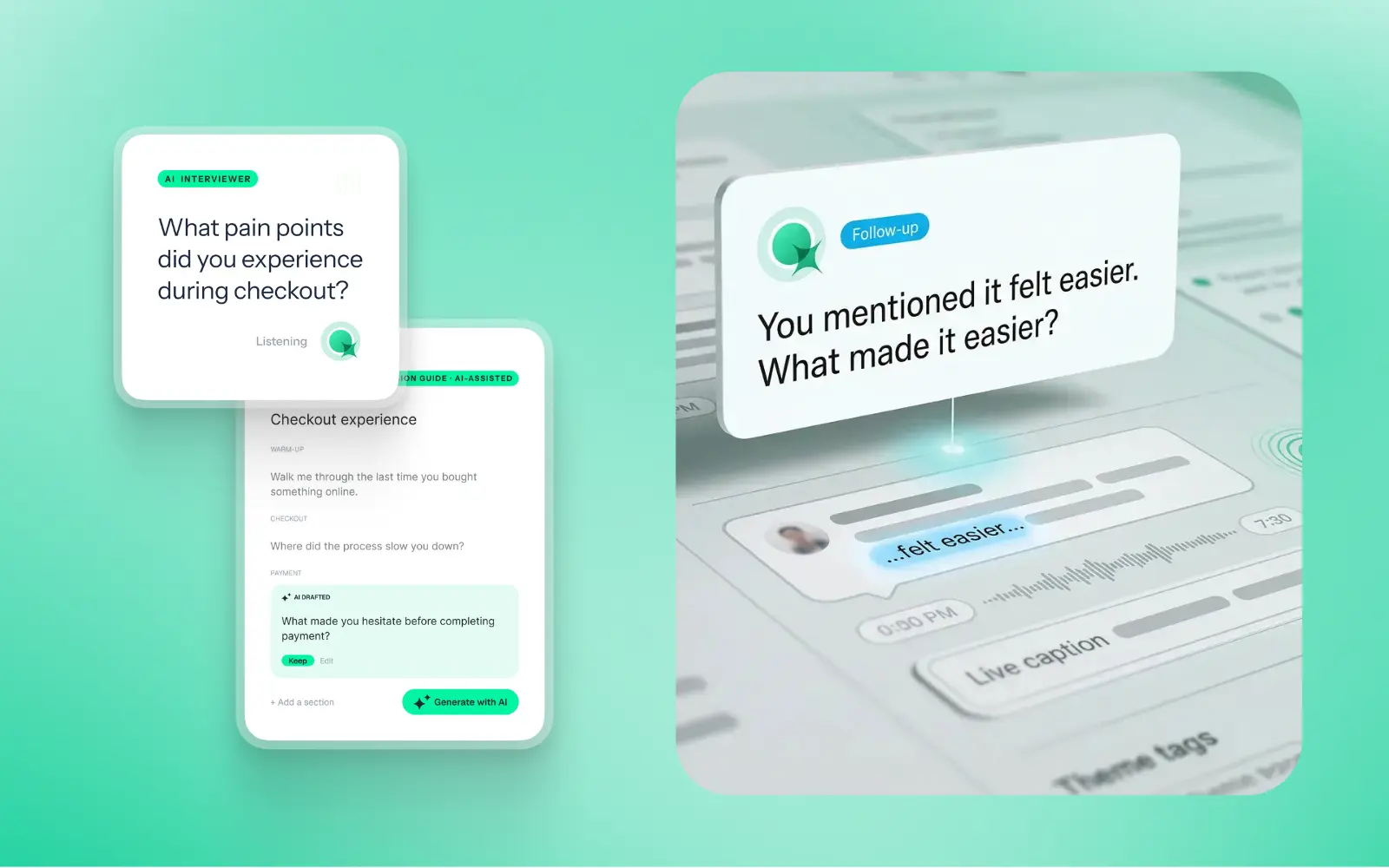
We built these lessons into Optimal’s AI Interviewer, an AI-moderated research tool designed to work with you, not instead of you. It helps teams run more interviews without losing the depth that makes qualitative research valuable.

‍

  1. Add your context. Research goals, audience details and supporting material guide every follow-up.
    ‍
  2. Build your discussion guide. Set sections, questions, goals and how deeply the AI should probe.
    ‍
  3. Let it run the interview. The AI listens, adapts and explores relevant threads while staying on your goals.
    ‍
  4. Get cited insights. An AI-generated summary and key themes, with citations at study, section and question level, plus highlight reels that jump to the moment behind each insight.

‍

Take this two-minute interactive tour to see it for yourself.

‍

‍

The bottom line

‍

AI interviews aren’t about replacing the human side of research. They give teams another way to listen, at a scale that used to need a lot more people and time. And when the experience is designed well, participants are happy to talk.

‍

Optimal’s AI Interviewer is now in Early Access, book a demo to learn more.

Share this article
Author
Optimal
Workshop

Related articles

View all blog articles
Header graphic for the article 'The AI Automation Breakthrough: Key Insights from Our Latest Community...'
Learn more
1 min read

The AI Automation Breakthrough: Key Insights from Our Latest Community Event

Last night, Optimal brought together an incredible community of product leaders and innovators for "The Automation Breakthrough: Workflows for the AI Era" at Q-Branch in Austin, Texas. This two-hour in-person event featured expert perspectives on how AI and automation are transforming the way we work, create, and lead.

‍

The event featured a lightning Talk on "Designing for Interfaces" featured Cindy Brummer, Founder of Standard Beagle Studio, followed by a dynamic panel discussion titled "The Automation Breakthrough" with industry leaders including Joe Meersman (Managing Partner, Gyroscope AI), Carmen Broomes (Head of UX, Handshake), Kasey Randall (Product Design Lead, Posh AI), and Prateek Khare (Head of Product, Amazon). We also had a fireside chat with our CEO, Alex Burke and Stu Smith, Head of Design at Atlassian. 

‍

Here are the key themes and insights that emerged from these conversations:

‍

Trust & Transparency: The Foundation of AI Adoption

‍

Cindy emphasized that trust and transparency aren't just nice-to-haves in the AI era, they're essential. As AI tools become more integrated into our workflows, building systems that users can understand and rely on becomes paramount. This theme set the tone for the entire event, reminding us that technological advancement must go hand-in-hand with ethical considerations.

‍

Automation Liberates Us from Grunt Work

‍

One of the most resonant themes was how AI fundamentally changes what we spend our time on. As Carmen noted, AI reduces the grunt work and tasks we don't want to do, freeing us to focus on what matters most. This isn't about replacing human workers, it's about eliminating the tedious, repetitive tasks that drain our energy and creativity.

‍

Enabling Creativity and Higher-Quality Decision-Making

‍

When automation handles the mundane, something remarkable happens: we gain space for deeper thinking and creativity. The panelists shared powerful examples of this transformation:

‍

Carmen described how AI and workflows help teams get to insights and execution on a much faster scale, rather than drowning in comments and documentation. Prateek encouraged the audience to use automation to get creative about their work, while Kasey shared how AI and automation have helped him develop different approaches to coaching, mentorship, and problem-solving, ultimately helping him grow as a leader.

‍

The decision-making benefits were particularly striking. Prateek explained how AI and automation have helped him be more thoughtful about decisions and make higher-quality choices, while Kasey echoed that these tools have helped him be more creative and deliberate in his approach.

‍

Democratizing Product Development

‍

Perhaps the most exciting shift discussed was how AI is leveling the playing field across organizations. Carmen emphasized the importance of anyone, regardless of their role, being able to get close to their customers. This democratization means that everyone can get involved in UX, think through user needs, and consider the best experience.

‍

The panel explored how roles are blurring in productive ways. Kasey noted that "we're all becoming product builders" and that product managers are becoming more central to conversations. Prateek predicted that teams are going to get smaller and achieve more with less as these tools become more accessible.

‍

Automation also plays a crucial role in iteration, helping teams incorporate customer feedback more effectively, according to Prateek.

‍

Practical Advice for Navigating the AI Era

‍

The panelists didn't just share lofty visions, they offered concrete guidance for professionals navigating this transformation:

‍

Stay perpetually curious. Prateek warned that no acquired knowledge will stay with you for long, so you need to be ready to learn anything at any time.

‍

Embrace experimentation. "Allow your process to misbehave," Prateek advised, encouraging attendees to break from rigid workflows and explore new approaches.

‍

Overcome fear. Carmen urged the audience not to be afraid of bringing in new tools or worrying that AI will take their jobs. The technology is here to augment, not replace.

‍

Just start. Kasey's advice was refreshingly simple: "Just start and do it again." Whether you're experimenting with AI tools or trying "vibe coding," the key is to begin and iterate.

‍

The energy in the room at Q-Branch reflected a community that's not just adapting to change but actively shaping it. The automation breakthrough isn't just about new tools, it's about reimagining how we work, who gets to participate in product development, and what becomes possible when we free ourselves from repetitive tasks.

‍

As we continue to navigate the AI era, events like this remind us that the most valuable insights come from bringing diverse perspectives together. The conversation doesn't end here, it's just beginning.

‍

Interested in joining future Optimal community events? Stay tuned for upcoming gatherings where we'll continue exploring the intersection of design, product, and emerging technologies.


‍

Header graphic for the article 'When Everyone’s a Researcher and it’s a Good Thing '
Learn more
1 min read

When Everyone's a Researcher and it's a Good Thing

Be honest. Are you guilty of being a gatekeeper? 

‍

For years, UX teams have treated research as a specialized skill that requires extensive training, advanced degrees, and membership in the researcher club. We’re guilty of it too! We've insisted that only "real researchers" can talk to users, conduct studies, or generate insights.

‍

But the problem with this is, this gatekeeping is holding back product development, limiting insights, and ironically, making research less effective.  As a result,  product and design teams are starting to do their own research, bypassing UX because they want to just get things done. 

‍

This shift is happening, and while we could view this as the downfall of traditional UX, we see it more as an evolution. And when done right, with support from UX, this democratization actually leads to better products, more research-informed organizations, and yes, more valuable research roles.

‍

The Problem with Gatekeeping 

‍

Product teams need insights constantly, making decisions daily about features, designs, and priorities. Yet dedicated researchers are outnumbered, often supporting 15-20 product team members each. The math just doesn't work. No matter how talented or efficient researchers are, they can't be everywhere at once, answering every question in real-time. This mismatch between insight demand and research capacity forces teams into an impossible choice: wait for formal research and miss critical decision windows or move forward without insights and risk building the wrong thing.

‍

Since product teams often don’t have the time to wait, teams make decisions anyway, without research. A Forrester study found that 73% of product decisions happen without any user input, not because teams don't value research, but because they can't wait weeks for formal research cycles.

‍

In organizations where this is already happening (it’s most of them!) teams have two choices, accept that their research to insight to development workflow is broken, or accept that things need to change and embrace the new era of research democratization. 

‍

In Support of  Research Democratization

‍

The most research-informed organizations aren't those with the most researchers, they're those where research skills are distributed throughout the team. When Product Managers and Designers talk directly to users, with researchers providing frameworks and quality control they make more research-informed decisions which result in better product performance and lower business risk. 

‍

When PMs and designers conduct their own research, context doesn't get lost in translation. They hear the user's words, see their frustrations, and understand nuances that don't survive summarization. But there is a right way to democratize, which not all organizations are doing. 

‍

Democratization as a consequence instead of as an intentional strategy, is chaos. Without frameworks and support from experienced researchers, it just won’t work. The goal isn't to turn everyone into researchers, it's to empower more teams to do their own research, while maintaining quality and rigor. In this model, the researcher becomes an advisor instead of a gatekeeper and the researcher's role evolves from conducting all studies to enabling teams to conduct their own. 

‍

Not all questions need expert researchers. Intercom uses a three-tier model:

‍

  • Tier 1 (70% of questions): Teams handle with proven templates
  • Tier 2 (20% of questions): Researcher-supported team execution
  • Tier 3 (10% of questions): Researcher-led complex studies

‍

This model increased research output by 300% while improving quality scores by 25%.

‍

In a model like this, the researcher becomes more important than ever because democratization needs quality assurance. 

‍

Elevating the Role of Researchers 

‍

Democratization requires researchers to shift from "protectors of methodology" to "enablers of insight." It means:

‍

  • Not seeking perfection because an imperfect study done today beats a perfect study done never.
  • Acknowledging that 80% confidence on 100% of decisions beats 100% confidence on 20% of decisions.
  • Measuring success by the "number of research-informed decisions made” instea dof the "number of studies conducted" 
  • Deciding that more research happening is good, even if researchers aren't doing it all.

‍

By enabling teams to handle routine research, professional researchers focus on:

‍

  • Complex, strategic research that requires deep expertise
  • Building research capabilities across the organization
  • Ensuring research quality and methodology standards
  • Connecting insights across teams and products
  • Driving research-informed culture change

‍

In truly research-informed organizations, everyone has user conversations. PMs do quick validation calls. Designers run lightweight usability tests. Engineers observe user sessions. Customer success shares user feedback.

‍

And researchers? They design the systems, ensure quality, tackle complex questions, and turn this distributed insight into strategic direction.

‍

Research democratization isn't about devaluing research expertise, it's about scaling research impact. It's recognizing that in today's product development pace, the choice isn't between formal research and democratized research. It's between democratized research and no research at all.

‍

Done right, democratization isn't the end of UX research as a profession. It's the beginning of research as a competitive advantage.

‍

Header graphic for the article 'When AI Meets UX: How to Navigate the Ethical Tightrope'
Learn more
1 min read

When AI Meets UX: How to Navigate the Ethical Tightrope

As AI takes on a bigger role in product decision-making and user experience design, ethical concerns are becoming more pressing for product teams. From privacy risks to unintended biases and manipulation, AI raises important questions: How do we balance automation with human responsibility? When should AI make decisions, and when should humans stay in control?

‍

These aren't just theoretical questions they have real consequences for users, businesses, and society. A chatbot that misunderstands cultural nuances, a recommendation engine that reinforces harmful stereotypes, or an AI assistant that collects too much personal data can all cause genuine harm while appearing to improve user experience.

‍

‍

‍

The Ethical Challenges of AI

‍

Privacy & Data Ethics

‍

AI needs personal data to work effectively, which raises serious concerns about transparency, consent, and data stewardship:

‍

  • Data Collection Boundaries – What information is reasonable to collect? Just because we can gather certain data doesn't mean we should.
    ‍
  • Informed Consent – Do users really understand how their data powers AI experiences? Traditional privacy policies often don't do the job.
    ‍
  • Data Longevity – How long should AI systems keep user data, and what rights should users have to control or delete this information?
    ‍
  • Unexpected Insights – AI can draw sensitive conclusions about users that they never explicitly shared, creating privacy concerns beyond traditional data collection.

‍

A 2023 study by the Baymard Institute found that 78% of users were uncomfortable with how much personal data was used for personalized experiences once they understood the full extent of the data collection. Yet only 12% felt adequately informed about these practices through standard disclosures.

‍

‍

Bias & Fairness

‍

AI can amplify existing inequalities if it's not carefully designed and tested with diverse users:

‍

  • Representation Gaps – AI trained on limited datasets often performs poorly for underrepresented groups.
    ‍
  • Algorithmic Discrimination – Systems might unintentionally discriminate based on protected characteristics like race, gender, or disability status.
    ‍
  • Performance Disparities – AI-powered interfaces may work well for some users while creating significant barriers for others.
    ‍
  • Reinforcement of Stereotypes – Recommendation systems can reinforce harmful stereotypes or create echo chambers.

‍

Recent research from Stanford's Human-Centered AI Institute revealed that AI-driven interfaces created 2.6 times more usability issues for older adults and 3.2 times more issues for users with disabilities compared to general populations, a gap that often goes undetected without specific testing for these groups.

‍

‍

User Autonomy & Agency

‍

Over-reliance on AI-driven suggestions may limit user freedom and sense of control:

‍

  • Choice Architecture – AI systems can nudge users toward certain decisions, raising questions about manipulation versus assistance.
    ‍
  • Dependency Concerns – As users rely more on AI recommendations, they may lose skills or confidence in making independent judgments.
    ‍
  • Transparency of Influence – Users often don't recognize when their choices are being shaped by algorithms.
    ‍
  • Right to Human Interaction – In critical situations, users may prefer or need human support rather than AI assistance.

‍

A longitudinal study by the University of Amsterdam found that users of AI-powered decision-making tools showed decreased confidence in their own judgment over time, especially in areas where they had limited expertise.

‍

‍

Accessibility & Digital Divide

‍

AI-powered interfaces may create new barriers:

‍

  • Technology Requirements – Advanced AI features often require newer devices or faster internet connections.
    ‍
  • Learning Curves – Novel AI interfaces may be particularly challenging for certain user groups to learn.
    ‍
  • Voice and Language Barriers – Voice-based AI often struggles with accents, dialects, and non-native speakers.
    ‍
  • Cognitive Load – AI that behaves unpredictably can increase cognitive burden for users.

‍

‍

Accountability & Transparency

‍

Who's responsible when AI makes mistakes or causes harm?

‍

  • Explainability – Can users understand why an AI system made a particular recommendation or decision?
    ‍
  • Appeal Mechanisms – Do users have recourse when AI systems make errors?
    ‍
  • Responsibility Attribution – Is it the designer, developer, or organization that bears responsibility for AI outcomes?
    ‍
  • Audit Trails – How can we verify that AI systems are functioning as intended?

‍

‍

How Product Owners Can Champion Ethical AI Through UX

‍

At Optimal, we advocate for research-driven AI development that puts human needs and ethical considerations at the center of the design process. Here's how UX research can help:

‍

User-Centered Testing for AI Systems

‍

AI-powered experiences must be tested with real users to identify potential ethical issues:

‍

  • Longitudinal Studies – Track how AI influences user behavior and autonomy over time.
    ‍
  • Diverse Testing Scenarios – Test AI under various conditions to identify edge cases where ethical issues might emerge.
    ‍
  • Multi-Method Approaches – Combine quantitative metrics with qualitative insights to understand the full impact of AI features.
    ‍
  • Ethical Impact Assessment – Develop frameworks specifically designed to evaluate the ethical dimensions of AI experiences.

‍

‍

Inclusive Research Practices

‍

Ensuring diverse user participation helps prevent bias and ensures AI works for everyone:

‍

  • Representation in Research Panels – Include participants from various demographic groups, ability levels, and socioeconomic backgrounds.
    ‍
  • Contextual Research – Study how AI interfaces perform in real-world environments, not just controlled settings.
    ‍
  • Cultural Sensitivity – Test AI across different cultural contexts to identify potential misalignments.
    ‍
  • Intersectional Analysis – Consider how various aspects of identity might interact to create unique challenges for certain users.

‍

‍

Transparency in AI Decision-Making

‍

UX teams should investigate how users perceive AI-driven recommendations:

‍

  • Mental Model Testing – Do users understand how and why AI is making certain recommendations?
    ‍
  • Disclosure Design – Develop and test effective ways to communicate how AI is using data and making decisions.
    ‍
  • Trust Research – Investigate what factors influence user trust in AI systems and how this affects experience.
    ‍
  • Control Mechanisms – Design and test interfaces that give users appropriate control over AI behavior.

‍

‍

The Path Forward: Responsible Innovation

‍

As AI becomes more sophisticated and pervasive in UX design, the ethical stakes will only increase. However, this doesn't mean we should abandon AI-powered innovations. Instead, we need to embrace responsible innovation that considers ethical implications from the start rather than as an afterthought.

‍

AI should enhance human decision-making, not replace it. Through continuous UX research focused not just on usability but on broader human impact, we can ensure AI-driven experiences remain ethical, inclusive, user-friendly, and truly beneficial.

‍

The most successful AI implementations will be those that augment human capabilities while respecting human autonomy, providing assistance without creating dependency, offering personalization without compromising privacy, and enhancing experiences without reinforcing biases.

‍

‍

‍

A Product Owner's Responsibility: Leading the Charge for Ethical AI

‍

As UX professionals, we have both the opportunity and responsibility to shape how AI is integrated into the products people use daily. This requires us to:

‍

  • Advocate for ethical considerations in product requirements and design processes
    ‍
  • Develop new research methods specifically designed to evaluate AI ethics
    ‍
  • Collaborate across disciplines with data scientists, ethicists, and domain experts
    ‍
  • Educate stakeholders about the importance of ethical AI design
    ‍
  • Amplify diverse perspectives in all stages of AI development

‍

‍

By embracing these responsibilities, we can help ensure that AI serves as a force for positive change in user experience enhancing human capabilities while respecting human values, autonomy, and diversity.

‍

The future of AI in UX isn't just about what's technologically possible; it's about what's ethically responsible. Through thoughtful research, inclusive design practices, and a commitment to human-centered values, we can navigate this complex landscape and create AI experiences that truly benefit everyone.

‍

‍

Seeing is believing

Explore our tools and see how Optimal makes gathering insights simple, powerful, and impactful.