

November 17, 2026
—
5 mins

Understanding AI Interviewers and AI Moderation in User Research

AI moderation is often framed as a question of replacement: can an AI interviewer do what a human moderator does, and if so, when should teams use one instead of the other? That framing misses the nuances and context of a study. 

‍

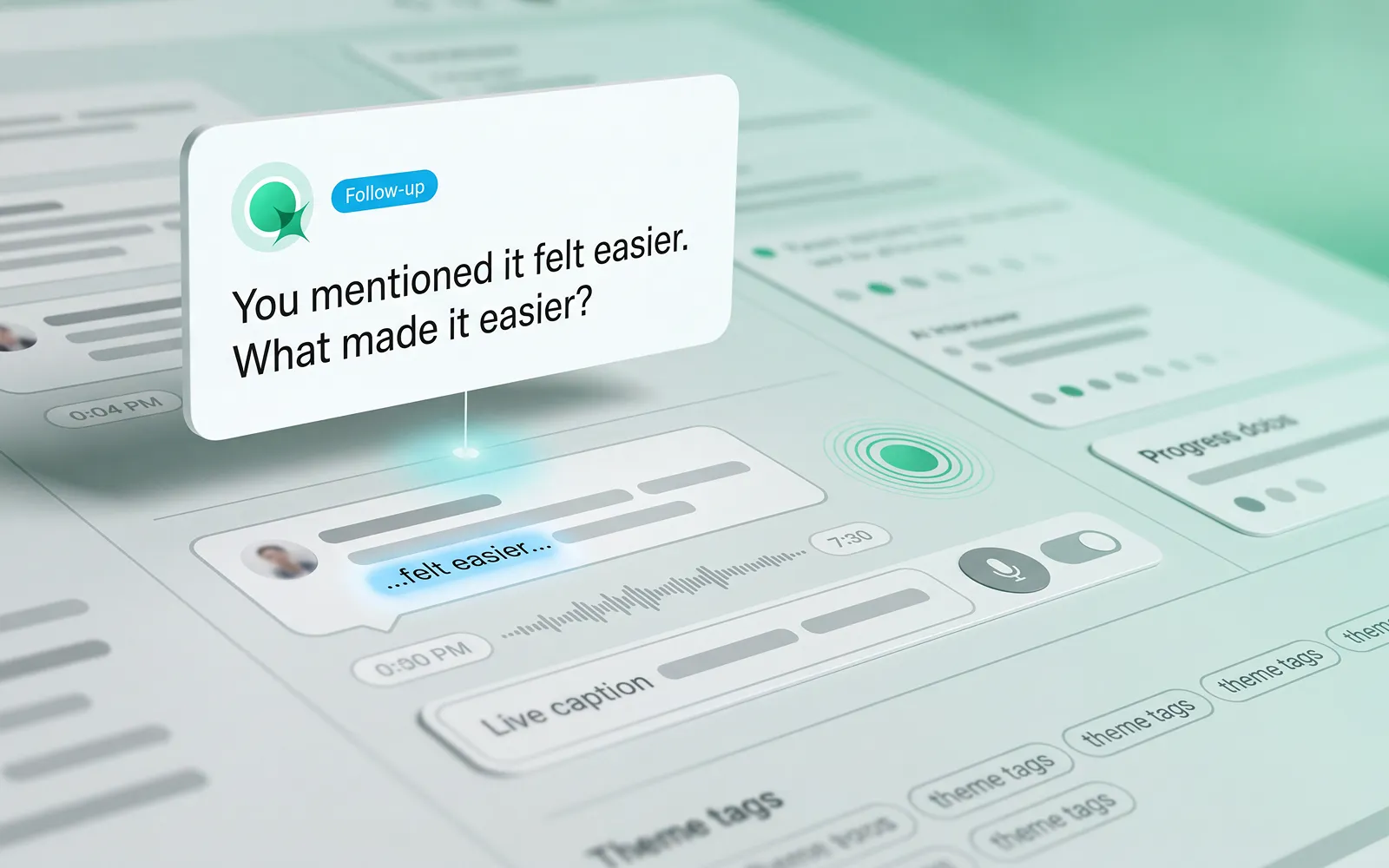
AI interviewers introduce another way to conduct research, one that sits somewhere between the scale of unmoderated research and the adaptability of a semi-structured moderated session. An AI interviewer can lead a research conversation on its own, asking questions, following up in real time, and adapting to what a participant says, without a human moderator present. Where that approach fits depends on the research question, the participants, the subject matter, and the stage of the product or idea.

‍

 To understand how people who do research are actually thinking about and using AI moderation, and what they see as its value and limitations, we surveyed 80 researchers and product managers across the US, Europe, the UK, and Canada.

‍

‍

‍

What you'll learn

‍

‍

  • How teams are actually splitting moderated vs. unmoderated work today
  • Which research methods are most common, and where AI moderation shows up in that mix
  • What teams expect from an AI interviewer in terms of oversight and control
  • Where AI moderation isn't the right fit and where it starts to behave like its own hybrid method

‍

‍

‍

What research teams are actually running in 2026

‍

‍

Before asking where AI interviewers fit, it's worth looking at what teams are running in 2026. Among the teams we surveyed:

‍

  • 90% Interviews
  • 85% Usability testing
  • 75% Surveys
  • 71.3% Concept testing
  • 40% Card sorting / tree testing
  • 31.3% Diary studies

‍

Interviews and usability testing are the most common methods in our data. Both allow you to understand not just what participants do, but the reasoning and context behind their behavior. Choosing a research approach means connecting the question you want to answer with the kind of data you need to answer it, and understanding how that data will lead you to the answer. It also depends on the time and resources you have. 

‍

‍

‍

The tradeoff between depth and scale

‍

‍

Half of the teams we surveyed lean to moderated research, while 38.8% run an approximately 50/50 split between moderated and unmoderated research. Notably, zero participants said they run fully unmoderated research. A live moderator gives you the ability to respond, ask why, probe deeper when a participant says something unexpected or interesting, describe a problem you didn't anticipate, and spend more time on an answer that deserves further exploration.  But it also comes with practical constraints. You need to recruit participants, coordinate calendars, manage time zones, attend sessions, and find time to review them afterward. The number of sessions a team can conduct is ultimately limited by the team’s availability and capacity. 

‍

Unmoderated research removes much of that friction. A study can scale. Teams can reach more participants and run studies in parallel. AI moderation sits between these approaches. It introduces the ability to respond to participants without requiring a researcher to be present for every conversation.

‍

‍

‍

A new approach for gathering qualitative data: AI-moderated research

‍

‍

AI-moderated research uses an AI interviewer to conduct a research conversation without a human moderator present. Instead of presenting participants with a fixed set of questions, the AI can ask a question, interpret the response, and decide what to ask next based on the participant's answer and the goals you set. For instance,  you want to understand how users solve a particular problem. One participant might use a third-party tool, another might have developed a manual workaround, while someone else might have a different workflow altogether. The AI can conduct a semi-structured interview, following up differently with each participant, exploring what they do, why they do it, and what they're trying to accomplish so you can really grasp their motivations and behaviors based on your research goals.

‍

60% of participants said they see AI interviewers as a way to conduct significantly more research. That doesn't mean replacing human moderators with an AI interviewer for every study. It means making more sessions possible with the right people in situations where a researcher wouldn't otherwise have the time or resources to moderate every conversation. 

‍

Beyond scale, AI interviewers also reduce researcher bias by providing a more consistent interviewing experience. In a pilot study of Optimal’s AI Interviewer, participants also noted the AI interview is easier to talk to than a traditional interview and the on-screen text was helpful for accessibility. Curious what we learned? Read the full study write-up.

‍

‍

‍

Setting parameters and control while using an AI Interviewer

‍

‍

AI interviewers don't automatically add value to a study or help your team gather meaningful insights on their own. The quality of those conversations depends on how well you configure the AI interviewer, the context they provide, and the goals they define.

‍

To get the most out of an AI interviewer, you should begin by providing clear context about the study, the company, its participants, and the product being researched. You can define specific goals at different levels, including the overall study, individual sections, and specific questions. These goals guide the AI in determining which follow-up questions to ask and where to probe more deeply. You can also adjust how actively the AI interviewer probes participants, allowing them to control the depth of follow-up questions when responses are unexpected, unclear, or lack detail.

‍

‍

‍

Limitations of AI Interviewers

‍

‍

Even with thoughtful setup and clear parameters, AI interviewers aren't the right fit for every study. Human moderators will always play an essential role, especially in cases like:

‍

  • Sensitive topics or research with vulnerable populations which requires trauma-informed training
  • Trust-building conversations and client engagement where the value of the conversation extends beyond data collection and insights
  • Early exploratory research, where you don't yet know what you're looking for (AI moderation works best when the research team can provide clear goals and context).

‍

AI interviewers are best understood as an expansion of researchers' capabilities and a new approach to gathering qualitative insight, not a universal replacement for existing methods and approaches.

‍

‍

‍

Insight doesn’t come from AI alone

‍

‍

One of the clearest themes from our research is that people who do research want visibility into how AI-generated research is produced. Teams want to scrutinize the data themselves. They want access to conversations, raw recordings, transcripts, and the ability to sense-check findings against what participants actually said. That matters because AI moderation changes the role of the researcher. Instead of being present for every conversation, researchers can focus on identifying the right people to talk to, developing research questions, organizing priorities, engaging with and aligning cross-functional teams, weighing insights and seeing what requires further exploration, and crafting the bigger story.

‍

AI can conduct more conversations and accelerate the time to insight.

‍

Research teams still need to determine what those insights mean within the context of the market, the business, and everything that surrounds a decision.

‍

‍

‍

AI moderation makes more possible

‍

‍

AI interviewer changes the tradeoff between depth, scale, speed, and the team involved. It is still an emerging approach, and teams are figuring out where it belongs. Its value comes from what it makes possible like more opportunities to ask, follow up, and understand.

‍

More than any single feature, what we're building toward with Optimal Intelligence is a research experience that uplifts human expertise. Technology can accelerate the work. It can't weigh nuanced risk, define ethics, or build relationships. That's still on us.

‍

AI moderation is a new methodology, not a replacement for the ones that came before it. It earns its place in your workflow because of what it makes possible. Discover what our AI Interviewer taught us about conversational AI.

‍

Share this article
Author
Optimal
Workshop

Related articles

View all blog articles
Learn more
1 min read

What Do Participants Think About AI Interviewers? Insights from a Recent Study

AI is opening up new possibilities for qualitative research. But for researchers, it’s not enough for an AI Interviewer to ask relevant questions. An effective AI Interviewer needs to create an experience where participants feel comfortable sharing their perspectives, have the space to explain their thinking and explore their answers in more depth.

‍

To find out more, we ran a study using Optimal’s AI Interviewer to look at general attitudes towards AI, better understand what participants valued about an AI Interviewer experience, and what worked well and where they saw room for improvement.

‍

One theme stood out: the value of AI interviews depends not just on the technology, but on the experience it creates for the people taking part.

‍

‍

What do people think about interacting with AI?

‍

As AI becomes more familiar in everyday life, the conversation is shifting from whether people will use it to when, why and under what circumstances they find it useful. In a survey of 1,005 US consumers led by Adobe Express, 61% said they were comfortable having conversations with AI-powered systems.

‍

Another survey of more than 1,000 participants across six countries found that people who knew they were interacting with AI reported satisfaction rates 34% higher than those who weren't informed.

‍

These findings suggest that interacting with AI isn't inherently uncomfortable for everyone. But comfort with AI doesn't automatically translate into a positive research experience. A quick customer-service interaction is different from a qualitative research interview, where people need to reflect on their experiences, explain their reasoning and sometimes share sensitive or complicated perspectives.

‍

For researchers, the more useful question is: what makes an AI-led conversation feel comfortable, natural and valuable for participants? 

‍

‍

What makes an AI-moderated research experience successful?

‍

In qualitative research, the quality of the conversation matters just as much as the number of responses collected.

‍

A good AI-moderated interview should give participants the freedom to express themselves in their own words, ask relevant follow-up questions and create opportunities to explore an answer beyond the initial response, and go beyond simply moving people through a series of questions.

‍

Here are considerations that stood out from participants interacting with Optimal’s AI Interviewer for the first time.

‍

‍

‍

1. Making AI interviews feel natural and conversational

‍

Qualitative research aims to uncover the reasoning behind people's choices, not just capture their first response. Relevant follow-up questions can encourage participants to elaborate, clarify an opinion or explore an experience in more depth. The ability to answer in their own words, rather than select from predefined options, is also central to gathering richer feedback.

‍

In our study, the majority of participants described their experience with Optimal’s AI Interviewer as “seamless,” “smooth”, “natural”, and even "fun". Several were pleasantly surprised by how the interaction felt, including participants who had reservations beforehand. One participant said, "I have no problems speaking freely."

‍

‍

Automated highlight reel: "The overall experience was widely rated as positive and enjoyable"

‍

On participant remarked, "It was pleasant and I enjoyed it. And you were great." Others described the AI interview format as something they had “come to expect,” framing it as routine rather than novel. 

‍

Automated highlight reel: "Overall satisfaction with the AI interview experience was high"

‍

These responses offer an encouraging perspective on what AI-moderated research can feel like for participants with the right cadence and context. Multiple participants also highlighted that the AI Interviewer’s replies were clearly based on what they had just said, rather than following a rigid script.

‍

One participant noted it felt like talking to a real person because responses were grounded in their own words: "I really felt like I was talking to a real person and that the responses were based off of what I what I said."

‍

Automated highlight reel: "Contextual follow-up questions made the conversation feel natural and responsive."

‍

Another participant highlighted how the AI concisely summarized their points before moving on, without asking the same question in different ways — something they’d found frustrating when using other AI interview tools.

‍

‍

2. Helping participants feel comfortable and confident

‍

People are more likely to engage when they understand what to expect and feel comfortable taking part. Several participants found the AI interview easier to talk to than a traditional interview. For some, the absence of a human interviewer reduced the pressure of the interaction, making it easier to share their thoughts. 

‍

Automated highlight reel: "Talking to an AI felt easier than a live human interview"

‍

The experience wasn't just about how the conversation sounded either. Participants also found the on-screen text helpful for following along with the spoken interaction. One participant who experiences auditory processing difficulties specifically highlighted this as a useful accessibility feature.

‍

These observations suggest that small details in the participant experience can make a meaningful difference. Clear instructions, the ability to follow a conversation in more than one way, and a format that feels comfortable can all help people engage with a study.

‍

One participant noted that they felt a person would more deeply grasp the feelings and emotions behind their answers, but overall rated their experience with the AI Interviewer positively.

‍

Comfort will vary by person and research context, so the goal isn't to assume AI moderation will suit everyone and every situation, but to provide another considered way for people to share their perspectives. 

‍

‍

‍

3. Giving participants control over their experience

‍

A positive AI interview experience doesn't mean every participant will prefer the same format.

With Optimal’s experience, participants appreciated the ability to choose a preferred conversational style that works best for them. One participant, who preferred greater control, initially chose the “submit response” mode. This allowed them to decide when to submit an answer and move on to the AI Interviewer's next question or follow-up.

‍

After a positive experience with the AI Interviewer, they said they would be willing to try the “free form” option. In this mode, the AI Interviewer responds naturally when the participant finishes speaking. This highlights the value of offering choice and helping participants gain familiarity and comfort.

‍

Clip: New comfort and willingness to try "free form"

‍

‍

A new way to engage with participants

‍

For UX research, design, and product teams, AI Interviews offer another option for gathering qualitative feedback, creating more flexibility in how conversations take place, and supporting gathering evidence at scale.

‍

The opportunity isn't to replace the human aspect of research. It's to give researchers more ways to listen, learn and make informed decisions.

‍

Ready to explore AI interviews? Get in touch for a demo or find out how to access Optimal’s AI Interviewer in Early Access.

Learn more
1 min read

Understanding AI Interviewers and AI Moderation in User Research

AI moderation is often framed as a question of replacement: can an AI interviewer do what a human moderator does, and if so, when should teams use one instead of the other? That framing misses the nuances and context of a study. 

‍

AI interviewers introduce another way to conduct research, one that sits somewhere between the scale of unmoderated research and the adaptability of a semi-structured moderated session. An AI interviewer can lead a research conversation on its own, asking questions, following up in real time, and adapting to what a participant says, without a human moderator present. Where that approach fits depends on the research question, the participants, the subject matter, and the stage of the product or idea.

‍

 To understand how people who do research are actually thinking about and using AI moderation, and what they see as its value and limitations, we surveyed 80 researchers and product managers across the US, Europe, the UK, and Canada.

‍

‍

‍

What you'll learn

‍

‍

  • How teams are actually splitting moderated vs. unmoderated work today
  • Which research methods are most common, and where AI moderation shows up in that mix
  • What teams expect from an AI interviewer in terms of oversight and control
  • Where AI moderation isn't the right fit and where it starts to behave like its own hybrid method

‍

‍

‍

What research teams are actually running in 2026

‍

‍

Before asking where AI interviewers fit, it's worth looking at what teams are running in 2026. Among the teams we surveyed:

‍

  • 90% Interviews
  • 85% Usability testing
  • 75% Surveys
  • 71.3% Concept testing
  • 40% Card sorting / tree testing
  • 31.3% Diary studies

‍

Interviews and usability testing are the most common methods in our data. Both allow you to understand not just what participants do, but the reasoning and context behind their behavior. Choosing a research approach means connecting the question you want to answer with the kind of data you need to answer it, and understanding how that data will lead you to the answer. It also depends on the time and resources you have. 

‍

‍

‍

The tradeoff between depth and scale

‍

‍

Half of the teams we surveyed lean to moderated research, while 38.8% run an approximately 50/50 split between moderated and unmoderated research. Notably, zero participants said they run fully unmoderated research. A live moderator gives you the ability to respond, ask why, probe deeper when a participant says something unexpected or interesting, describe a problem you didn't anticipate, and spend more time on an answer that deserves further exploration.  But it also comes with practical constraints. You need to recruit participants, coordinate calendars, manage time zones, attend sessions, and find time to review them afterward. The number of sessions a team can conduct is ultimately limited by the team’s availability and capacity. 

‍

Unmoderated research removes much of that friction. A study can scale. Teams can reach more participants and run studies in parallel. AI moderation sits between these approaches. It introduces the ability to respond to participants without requiring a researcher to be present for every conversation.

‍

‍

‍

A new approach for gathering qualitative data: AI-moderated research

‍

‍

AI-moderated research uses an AI interviewer to conduct a research conversation without a human moderator present. Instead of presenting participants with a fixed set of questions, the AI can ask a question, interpret the response, and decide what to ask next based on the participant's answer and the goals you set. For instance,  you want to understand how users solve a particular problem. One participant might use a third-party tool, another might have developed a manual workaround, while someone else might have a different workflow altogether. The AI can conduct a semi-structured interview, following up differently with each participant, exploring what they do, why they do it, and what they're trying to accomplish so you can really grasp their motivations and behaviors based on your research goals.

‍

60% of participants said they see AI interviewers as a way to conduct significantly more research. That doesn't mean replacing human moderators with an AI interviewer for every study. It means making more sessions possible with the right people in situations where a researcher wouldn't otherwise have the time or resources to moderate every conversation. 

‍

Beyond scale, AI interviewers also reduce researcher bias by providing a more consistent interviewing experience. In a pilot study of Optimal’s AI Interviewer, participants also noted the AI interview is easier to talk to than a traditional interview and the on-screen text was helpful for accessibility. Curious what we learned? Read the full study write-up.

‍

‍

‍

Setting parameters and control while using an AI Interviewer

‍

‍

AI interviewers don't automatically add value to a study or help your team gather meaningful insights on their own. The quality of those conversations depends on how well you configure the AI interviewer, the context they provide, and the goals they define.

‍

To get the most out of an AI interviewer, you should begin by providing clear context about the study, the company, its participants, and the product being researched. You can define specific goals at different levels, including the overall study, individual sections, and specific questions. These goals guide the AI in determining which follow-up questions to ask and where to probe more deeply. You can also adjust how actively the AI interviewer probes participants, allowing them to control the depth of follow-up questions when responses are unexpected, unclear, or lack detail.

‍

‍

‍

Limitations of AI Interviewers

‍

‍

Even with thoughtful setup and clear parameters, AI interviewers aren't the right fit for every study. Human moderators will always play an essential role, especially in cases like:

‍

  • Sensitive topics or research with vulnerable populations which requires trauma-informed training
  • Trust-building conversations and client engagement where the value of the conversation extends beyond data collection and insights
  • Early exploratory research, where you don't yet know what you're looking for (AI moderation works best when the research team can provide clear goals and context).

‍

AI interviewers are best understood as an expansion of researchers' capabilities and a new approach to gathering qualitative insight, not a universal replacement for existing methods and approaches.

‍

‍

‍

Insight doesn’t come from AI alone

‍

‍

One of the clearest themes from our research is that people who do research want visibility into how AI-generated research is produced. Teams want to scrutinize the data themselves. They want access to conversations, raw recordings, transcripts, and the ability to sense-check findings against what participants actually said. That matters because AI moderation changes the role of the researcher. Instead of being present for every conversation, researchers can focus on identifying the right people to talk to, developing research questions, organizing priorities, engaging with and aligning cross-functional teams, weighing insights and seeing what requires further exploration, and crafting the bigger story.

‍

AI can conduct more conversations and accelerate the time to insight.

‍

Research teams still need to determine what those insights mean within the context of the market, the business, and everything that surrounds a decision.

‍

‍

‍

AI moderation makes more possible

‍

‍

AI interviewer changes the tradeoff between depth, scale, speed, and the team involved. It is still an emerging approach, and teams are figuring out where it belongs. Its value comes from what it makes possible like more opportunities to ask, follow up, and understand.

‍

More than any single feature, what we're building toward with Optimal Intelligence is a research experience that uplifts human expertise. Technology can accelerate the work. It can't weigh nuanced risk, define ethics, or build relationships. That's still on us.

‍

AI moderation is a new methodology, not a replacement for the ones that came before it. It earns its place in your workflow because of what it makes possible. Discover what our AI Interviewer taught us about conversational AI.

‍

Seeing is believing

Explore our tools and see how Optimal makes gathering insights simple, powerful, and impactful.