Subscribe to OW blog for an instantly better inbox
Oops! Something went wrong while submitting the form.

Articles and Podcasts on Customer Service, AI and Automation, Product, and more
.webp)
Great research has never been about speed alone. It’s about asking the right questions, understanding the context behind them, and uncovering insights that help teams make better decisions.
Optimal's AI Interviewer is designed to support that process. It’s designed to work alongside researchers and teams, so you can move faster without losing the depth and human nuance that makes research valuable.
Before building AI Interviewer, we spoke with and surveyed researchers, designers, and product teams to how they approach interviews today and where AI could genuinely help.
What we heard was consistent:
AI isn’t useful if it ignores how your team works. So instead of building a generic interviewer, we focused on building an AI Interviewer that fits into your current workflows and keeps researchers and teams in the driver's seat.
Here’s what we learned and how we brought it to life with Optimal’s AI Interviewer.
The best interviews start with a clear understanding of what you’re trying to uncover. With the AI Interviewer, you can add your research goals, audience details, company and product context, and additional context you want the AI to consider. This means the AI doesn’t just ask questions; it understands what you’re trying to learn and helps guide conversations in the right direction.
The same context also powers AI insights, helping ensure summaries, key themes, and citations are relevant, accurate, and aligned with what you're trying to learn.
One of the concerns with AI-led interviews is not having enough control. We’ve designed the AI Interviewer with this in mind.
For each question, you can choose how deeply you would like the AI Interviewer to probe and follow-up. You decide when deeper exploration is valuable, how the conversation flows, and the AI can then carry this out on your behalf.
AI Interviewer helps remove some of the barriers that make qualitative research difficult to scale. Use it to:
This isn’t about replacing researchers. It’s about removing operational work so you can focus on higher-value work, like synthesis, storytelling, and decision-making.
Every session comes with recordings, key summaries, and AI-generated insights with clear detailed evidence. Instead of reviewing hours of footage, you can quickly find what matters and confidently back it up. Review insights across your full study, or dive deeper into individual sessions and specific questions.
On the roadmap: Once your interviews are complete, you can use AI Chat to go further with your data and explore patterns across sessions, ask follow-up questions, and validate assumptions with real evidence.
Let’s address the elephant in the room. AI-led interviews aren’t something everyone is immediately comfortable with, and that’s fair. There are real limitations.
Some research scenarios require human sensitivity and judgment. Nuance, emotion, and edge cases still benefit from a human touch. Vulnerable populations and complex topics should always be handled with care. Optimal values a human-in-the-loop approach and know an AI Interviewer isn’t always suitable. With that in mind, we made sure that:
The AI Interviewer supports your work. It doesn’t replace your expertise.
AI Interviewer is now available in early access, and we’re continuing to learn from the teams using it. If you’re looking to scale your research without scaling your workload, run interviews across time zones, and spend less time on logistics and more time on insights, we’d love for you to try it.
👉 Book a demo to see how it fits into your workflow.
Already with Optimal? Register your interest for early access.
The pace of product development has never been faster, and the cost of building on assumptions has never been higher. At Optimal, we've spent nearly two decades helping teams get closer to their users, and what we're seeing right now is a fundamental shift in how research gets done. More teams are running research than ever before and timelines to act on findings are tighter, while the expectations for what research needs to deliver keep rising.
That shift is exactly what's driving Optimal 3.0, our most ambitious reinvention of the platform yet, designed to give every team the speed, depth, and flexibility that modern research demands. Today's release is the next step in that journey.
Optimal's new mixed-methods research tool tears down the boundaries between methods. It brings prototype testing, live site testing, and surveys into a single, end-to-end study workflow. And grounded in our product principles: speed to insights, access for all, and communication.
Optimal’s new Usability Testing tool marks the next step in the evolution of Optimal 3.0, giving teams the flexibility to evaluate experiences in whatever form they exist today.
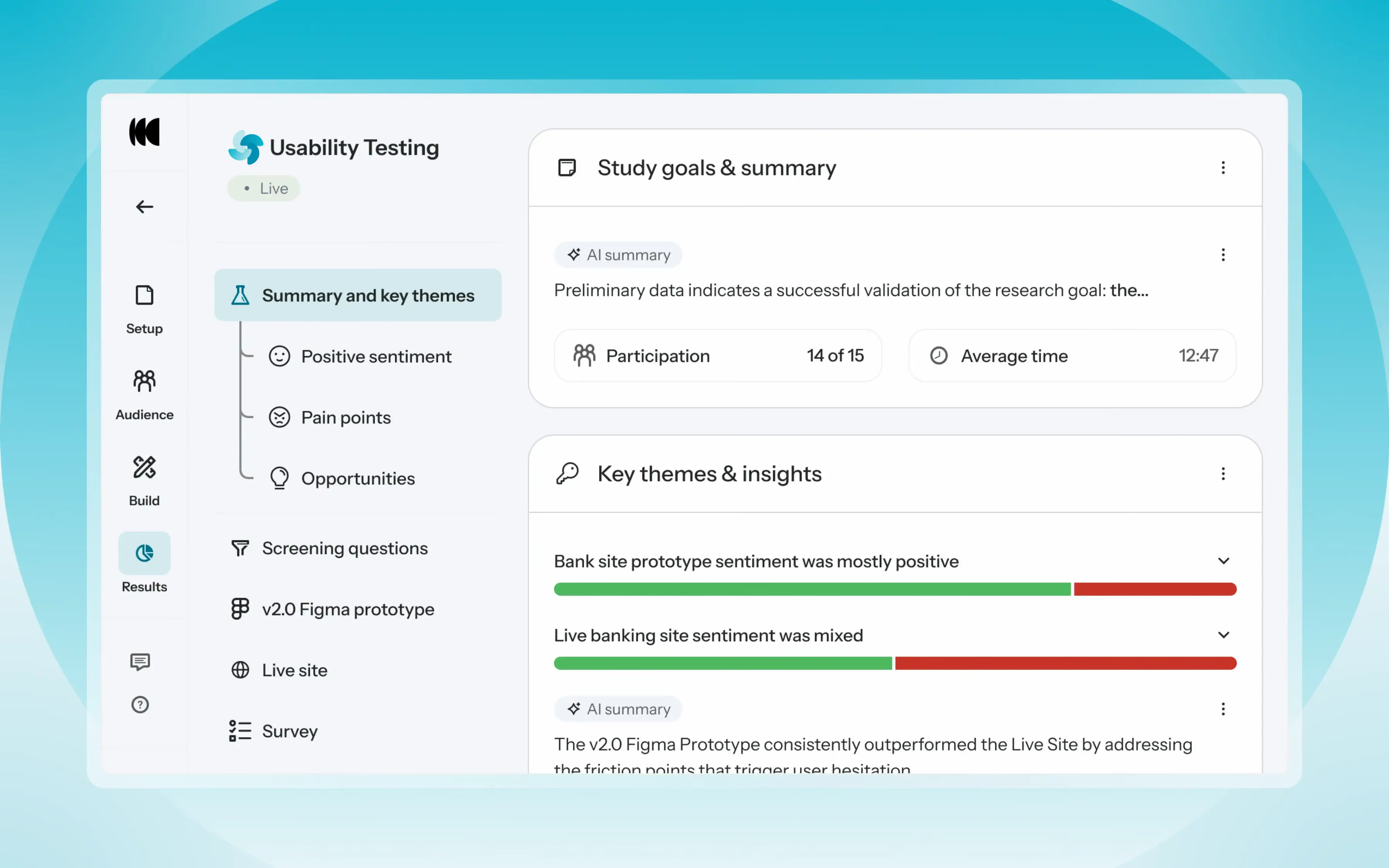
Combine prototype testing, AI prototype testing, live site testing, and surveys in a single study. Test multiple prototypes side by side, compare different live URLs, or mix prototype and live site tasks together all in one workflow. Research can now mirror how products actually evolve, from early concept to shipped experience.
New speak-aloud question types, custom message blocks, auto-generated transcripts and insights, citations and highlight clips help you capture the context and reasoning behind every action. AI-assisted analysis then helps you make sense of it all fast and communicate with impact.
Review a study overview surfacing key themes, pain points, and sentiment analysis combining insights across all your study methods along with detailed results, task analysis and recordings, transcripts, key quotes, and automatically generated citations and video clips.
Coming soon: you can also use AI Chat to chat with your data directly, asking questions and pulling new insights and evidence across all your qualitative and quantitative inputs.
Modern product development is no longer linear. Teams continuously move between:
Traditional usability testing tools were not built for this fluidity. Optimal’s Usability Testing brings the flexibility to match how teams actually work today.
By combining multiple methods into a single study and pairing it with AI-powered synthesis, Usability Testing helps teams reduce setup and analysis time, recruit once, capture richer qualitative context, compare experiences more easily, move faster from feedback to action, and tell clearer, more compelling insight stories.
Learn how to get started with Usability Testing in Optimal and accelerate your path from idea to insight. Book a meeting, start exploring in your account, or join our live training webinar on June 24th to see it in action.

User interviews have always been one of the most trusted and powerful UX research methods. They give you something beyond dashboards or written surveys: real, in-depth conversations and context.
But they’ve historically come with a cost – time, coordination, and a heavy lift to review recordings and turn videos into insights. Sometimes insights get buried. Recordings sit unused and research becomes challenging to revisit.
In our recent webinar, we explored how that’s changing and how you can reduce the heavy lift of interview review, while building a research repository.
A research repository is a centralized system for storing, analyzing, and reusing research data, especially qualitative data like user interviews. It helps teams answer questions like what users said, what patterns emerged, and how past research can inform future decisions.
For interviews, this means:
Optimal Interviews brings this to life by automatically capturing recordings, generating transcripts, structuring insights from the start, and making everything searchable so teams can easily revisit, build on, and continuously learn from their research.
So what did we learn? Here are some key takeaways from this webinar, plus answers to the most common questions we heard.
Running interviews isn’t just about talking to users. It’s everything before and after:
That overhead adds up quickly. There’s opportunity in automating these workflows and removing the friction around them. Optimal Interviews solves this by:
Research isn’t slowing down. Product cycles are getting faster, and teams expect insights just as quickly.
What stood out most:
One team told us that a few years ago it took them three weeks to analyze user interviews for an initiative. When they replicated the same study in Optimal Interviews, they were able to generate usable insights in about five minutes.
That shift from lagging insight to near real-time understanding is where the real impact lies.
Interview scheduling sounds simple, but it’s often where things break down.
You can use Optimal Interviews to ensure:
When done right, scheduling fades into the background so teams can focus on conversations, not coordination.
AI is already proving its value in the analysis phase:
But one point came through clearly: AI accelerates analysis but it doesn’t replace human judgment and sensitivity.
Researchers still play a critical role in validating insights, interpreting nuance, and deciding what matters for the business. Think of AI as getting you to 80% faster, while you own the final 20%.
Here’s what you can achieve with Optimal Interviews:
This turns research from static storage into something dynamic, something you can continuously mine and build on.
Both. You can extract insights from individual interviews, but the real value often comes from patterns across multiple sessions. Aggregation helps surface stronger, more reliable themes, while still preserving standout moments from single participants.
Privacy is a core focus and consideration with Optimal Interviews. Some of the key protections include automatic redaction of personally identifiable information (PII) and enterprise-grade AI infrastructure with strict data isolation. We're also looking to expand Optimal Interviews anonymized scheduling and communication and manual redaction controls before analysis.
Integrations are available for Google Meet, Microsoft Teams, and Zoom.
You can still run everything without integrations:
Integrations are helpful but not required.
Today, teams often bring relevant interviews into one project for analysis. Looking ahead, the goal is broader. Optimal’s looking into how the platform can search and query across all research, use AI chat to explore insights across studies, and surface insights at a Workspace level.
Yes. You can search transcripts directly and use AI-powered chat to explore themes, generate summaries, or even turn findings into shareable outputs like Slack posts or reports.
Interviews aren’t new. But the way we run them and what we can get out of them is changing fast.
By removing operational overhead and reducing time to insight, teams can talk to users more often, share insights faster, and build a research repository that becomes part of everyday product decision-making.
If you want to experience the full walkthrough, demo, and Q&A from the session, we encourage you to watch the full webinar.
👉 You can watch the full training webinar here.

We spent Research Week in San Francisco listening, taking notes, and talking with the UX and market researchers, research managers, human factors engineers, research operations program managers, and product designers who gathered coast to coast. Sessions covered Advanced Market Research, Growth UXR, Great Research, AI and UXR, Up Up and Away!, and Moonshot Research.
The gap in research most teams face right now is translation. Every function hears research differently. Each has a completely different "so what," as Apurva Luty puts it, so you need to respond and hear different ways, hearing data science in questions, design in critique, marketing in frameworks, engineering in constraints, and leadership in confidence. No one wants to hear: "we need to do more research”, but when you feel rushed for insights, you can always ask upfront if it’s a quick directional and recognize when you need more time for a comprehensive answer.
Building that bridge doesn’t mean you’re a gatekeeper. Rachel Ousley has seen democratizing access to data play out through more conversations and approaches with better questions. Map your stakeholders' "so what" and foster an open line of communication because you are working towards the same goal in the end.
Influence isn't a moment, it's a structure. Jess Holbrook breaks down direct influence versus indirect influence where direct influence is the central mechanism you present to senior leadership, and indirect influence is about setting the stage. Get ahead of it: know what your organization needs to understand in three months, six months, nine months, and how do we set ourselves up now to do that?
Build a culture of influence by giving credit loudly and often, saying people's names in the room by sharing wins and shoutouts. At Optimal, we do this through a celebrations Slack channel and quarterly value awards with open nominations through the company. Bring stakeholders, even ones you might not see eye-to-eye with upfront, into conversations where their perspective is genuinely valued, and anticipate what your team needs.
The value of research is clear: to build better experiences, you must listen to the people who are using the product, service, the thing you’re making, and are affected by it. It is in discovery where you, well, discover what users actually want. As Andrew Chamberlain says, those hack projects and rapid prototypes can scale and become new products, and beyond that, research is how you elevate your brand and get invited into new spaces.
In discovery, know when to screen for behavior and when to screen for demographics. Maybe you’re looking at how people us mobile devices in homes, where one phone does not necessarily mean one owner or one user and in this case, your questions need to be framed openly and intuitively to get insight into your users’ mental models and actions, often different from your own, with people assigning different meanings to the same words. Nicole Naurath uses the example of asking “Do you share a device?” instead of, “How does someone else access this device?” to capture richer, more accurate insights into actual behavior.
Research reporting is socialization. Your decks don't have to change, but the artifacts around it do. A compelling clip, a sharp stat, a well-chosen verbatim – nothing hits like it. Nicole Zeng explains UX research as the thing that silences rooms, changes minds, and redirects roadmaps.
Format your findings and discussion for the spaces people already work. Lauren Lin describes sharing insights as stackable and shareable clips on Slack as well as data cards that are downloadable as Figma components.
AI is enabling large-scale data processing that used to take months, which means you can spend less time in the weeds and more time on the work that moves the needle – the judgment, translation, organizational, goal setting, and influence-building work. AI can handle the volume and scale of your data. However, everyone has a different comfort level with new tools. Nicole Zeng uses the analogy of a lake: maybe you’re diving in headfirst, maybe you’re watching from the shore, or maybe you’re paddling through the waves.
Break your workflow and explore novel ways of leveraging AI in UX research, then share out your findings and flows, because that's how we make progress as teams, get deeper customer insights, and ultimately make better decisions. It's why we're constantly evolving Optimal, and Optimal 3.0 is built for exactly this: helping product teams discover, validate, and continuously optimize user experiences that drive real business results.
We're in an exciting time and it's moments like this when our industry comes together that we never forget. Stay connected with us on LinkedIn to get the latest updates on our upcoming events!
A well-maintained participant panel is more than a time-saver. It sets your team up for better research from day one. The people you recruit and how you track, segment, and manage those relationships over time directly shapes how reliable your findings are.
With the right setup in place, you can move forward with confidence, knowing that these participants meet your criteria, aren’t overused, and can bring fresh perspectives to each study.
Tools like Rally UXR bring that structure to participant recruitment. It helps you build and manage your own participant panel, keep track of consent and contact history, coordinate logistics, and stay on top of all the moving parts. You can also see things like incentive history and email engagement, making it much easier to decide who to invite and when.
But recruitment is just the starting point. The real value comes next: running the research and turning participant feedback into insights you can actually use.
Whether you’re running unmoderated studies, testing designs, navigation, or content, or conducting usability testing calls, having the right research tools in place is critical. If you’re already using Rally, pairing it with Optimal can connect the dots from recruitment through to insights, without adding friction to your workflow.
You can also use Optimal’s on-demand or custom managed recruitment services, though Rally’s strength lies in building your own custom panel and database.
Here’s how to combine Rally and Optimal into a smooth, efficient research workflow.
Define your participant criteria in Rally. Use screening questions not just to qualify participants. Think beyond “does this person qualify?” and start building segments you can reuse: power users vs. casual users, returning users vs. first-timers, people familiar with the old design vs. new. These segments can make it easier to run focused studies and compare results over time.
A simple shift that makes a big difference: don’t wait. Build your study in Optimal before sending invites from Rally. This ensures that when participants are ready, the link can be dropped into Rally, and distribution happens the moment you're ready.
Rally handles the relationship and profile management: who's been invited, who's confirmed, who needs a reminder, screener and survey history, consent forms, and more. Optimal handles the research: collecting quantitative and qualitative data, visualising patterns, quantifying usability issues, automating insights with AI, and surfacing the metrics and insights that actually answer your research question.
With Optimal, you can immediately put Rally-recruited participants into studies including:
When it comes to research, scattered insights = lost impact. Using Optimal as your central hub for results, recordings, and analysis makes it easier to share findings with your team and stakeholders, track progress over time, and back up decisions with real evidence.
The tools you use for recruitment and the tools you use for research aren't just operational choices. They shape your research culture. When recruitment and research are both well-structured, everything runs more smoothly. Teams that invest in structure on both ends of the workflow tend to produce research that's faster, more credible, and more likely to influence decisions.
Rally and Optimal are powerful on their own. Together, they create a workflow that’s scalable, insight-driven, and built for continuous discovery.
If you're not yet using Optimal, you can start a free trial or book a demo.

Artificial intelligence offers remarkable capabilities for UX research. It can process massive datasets, identify patterns humans might miss, and accelerate insights that traditionally took weeks to uncover. But as the adage goes: with great power comes great responsibility.
As research teams increasingly adopt AI-powered tools, we're facing critical questions about data privacy, algorithmic bias, and ethical use of user information. These aren't just philosophical concerns, they're practical challenges that every research team needs to address.
AI thrives on data. The more information it can access, the better its pattern recognition and predictive capabilities become. For researchers, this creates a fundamental tension. To gain meaningful insights, you need comprehensive user data, but collecting and processing this data creates privacy risks that traditional research methods didn't face at the same scale.
Think about a typical AI-powered analysis:
Each of these activities involves handling sensitive user information. Each creates potential exposure points where data could be misused, breached, or processed in ways users didn't anticipate. The question isn't whether you should use AI but rather how to use it responsibly.
Privacy can't be an afterthought. It needs to be foundational to how you approach AI-powered research. Collect only the data you actually need. This seems obvious, but AI's hunger for information can encourage overcollection. Before implementing any AI tool, ask: What's the minimum data required to achieve our research goals? Just because you can collect comprehensive behavioral data doesn't mean you should. Be intentional about what you gather and why.
Data security basics also become even more critical when AI is involved. Encryption, secure storage, access controls, these aren't optional. But security goes beyond technology. It includes policies around who can access data, how long it's retained, and what happens when a project concludes. AI systems often retain data to improve their algorithms. Make sure you understand your tools' data retention policies and ensure they align with your privacy commitments. A good example of this is how some tools, like Optimal, offer PII redaction on user interviews to ensure data security and privacy.
Users deserve to know how their data is being used. This goes beyond the standard privacy policy checkbox. When conducting research with AI-powered tools, you need to clearly communicate:
Give users meaningful control. If they're uncomfortable with AI analysis, offer alternatives. If they want their data deleted, make that process straightforward. Transparency builds trust. And trust is the foundation of good research.
Something that all teams who incorporate AI into their research practices need to be aware of is that AI systems can perpetuate and amplify bias. Machine learning algorithms learn from training data. If that data contains biased patterns, and most data does, the AI will replicate those biases in its analysis. This can lead to research insights that systematically overlook certain user groups or misinterpret their needs. For researchers, this creates a serious challenge. You're using AI to understand users, but the AI itself might have blind spots that skew your understanding. Eliminating bias entirely is probably impossible. But you can take concrete steps to minimize its impact.
Most research teams don't build their own AI systems. They use third-party tools that come with built-in AI capabilities. This creates an additional layer of privacy and ethical considerations. Before adopting any AI-powered research tool you need to understand the vendor's data practices. Not all vendors handle data the same way. Choose partners who take privacy seriously.
Data privacy regulations are evolving rapidly. GDPR, CCPA, and emerging laws around AI governance create complex compliance requirements.nEnsure your AI-powered research practices align with relevant regulations in the jurisdictions where you operate. This isn't just about legal compliance, it's about respecting user rights.
Here's what ties all of these considerations together: Human judgment must remain central to AI-powered research. AI can process data faster than any human, but it can't recognize when an algorithm is producing biased results or understand the ethical implications of a particular insight. These responsibilities fall to human researchers. And they can't be automated.
At Optimal, we believe AI should enhance research capabilities while respecting user privacy and maintaining ethical standards. That's why we're committed to transparent data practices, secure infrastructure, and tools that put researchers in control. Because the goal isn't just better insights. It's better insights achieved responsibly.

Since launching Optimal Interviews in December, we've been tracking closely as research, product, and design teams put it to the test. The tool is driving a real transformation in workflows, and we’re energized by the feedback so far.
Optimal Interviews was built to remove the friction from one of research's most time-intensive steps: analyzing interview recordings. With automated transcription, AI-generated insights, highlight reels, summaries, and citations, the tool transforms hours of manual review into something that happens in minutes.
But we’re not done yet. We’re constantly building and evolving based on your feedback. With the latest releases like automatic recording, every session can now be captured and stored automatically, helping teams build a centralized user research repository and supporting continuous research.
Here’s a look at how teams are using Optimal Interviews, the latest work in this space, and where we’re headed.
Researchers across industries are leveraging Optimal Interviews in a variety of ways. Here are just a few examples from current users:
It’s been a busy few months, and we’ve shipped several meaningful updates over the past few months. Here’s what’s new:
Optimal Interviews now supports 13 languages, automatically detecting and transcribing interviews in their original languages. AI Chat is also ready to assist your team in these languages, ensuring a seamless experience no matter what language your team is using.
Sync Optimal Interviews with your Google Meet, Zoom, or Microsoft Teams account to automatically generate and attach meeting links to sessions scheduled with the Optimal scheduler.
You can choose to automatically record and upload sessions scheduled through Optimal, eliminating the need for manual uploads. Sessions can now be captured and stored automatically, enabling teams to conduct continuous research. Accumulate insights over time in a central repository, where they remain always accessible and ready to be explored further with AI Chat.
Custom topics allow you to define specific areas of interest for AI to focus on for interview insights. As more recordings are added, the tool will automatically generate insights based on these topics, so you can easily filter and focus on the data that matters most to you.
Our ultimate goal? To keep finding ways to reduce manual effort. Let Optimal streamline your research workflow, automate time-consuming tasks, and help you build out your qualitative research repository.
We have a number of significant additions in development, including:
Sync you and your team’s calendars (Google and Microsoft) with Optimal Interviews so you can easily schedule and sync you and your team’s interview availability. Avoid double booking and get scheduled sessions automatically added to your calendar.
Interviewers and participants will be able to message each other directly through Optimal. This helps protect personal contact details e.g. email addresses and reduces unintended bias, such as revealing the study creator’s organization. Teams can coordinate, add clarifications, and follow up more efficiently without exposing personal information.
How are you using Optimal Interviews in your research? What's working well, and what would you like to see us build next?
And if you're just getting started, our Interviews 101 guide is a great place to begin.
Want to learn more about how to harness the full potential of Optimal Interviews and AI Chat? Register for this live training.
Optimal Interviews is updated continuously and shaped with feedback from users. Follow our release notes or share your thoughts via live chat or feature request form to give your feedback and stay in the loop.
