
September 1, 2025
—
2

Entering a New Era for Insights: Easier, Faster, More Delightful for Everyone

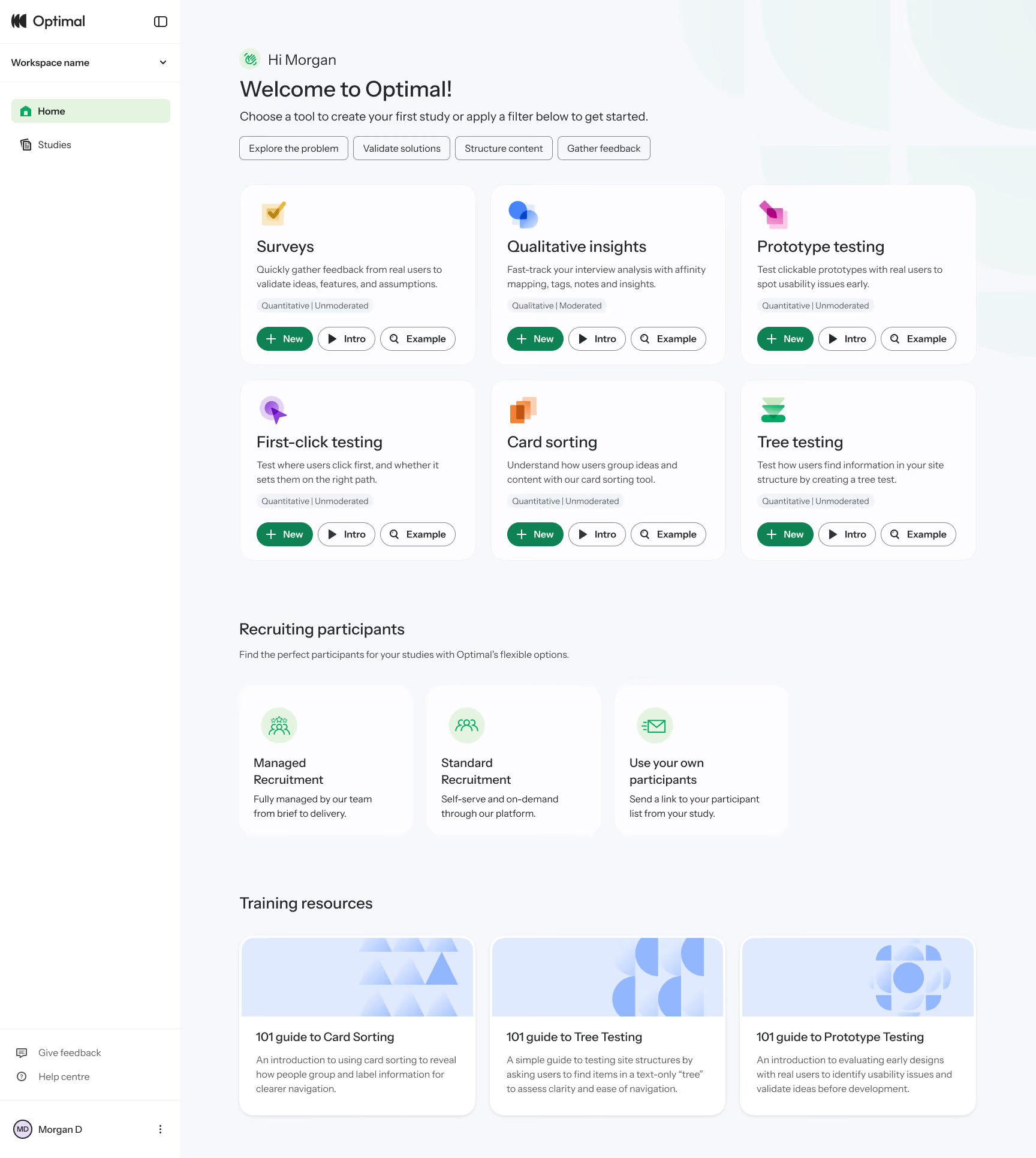
Header graphic for the article 'Entering a New Era for Insights: Easier, Faster, More Delightful...'

When people come to us, we often hear the same story. The platforms they’ve used are clunky. Outdated. Confusing. Like navigating a maze of tabs, jargon, and complexity. Just to run a simple study.

‍

That’s not what user testing should feel like.

‍

At Optimal, we believe finding insights should feel energizing, not exhausting. So we’ve been working hard to make our platform easier than ever for anyone – no matter their experience level – to run meaningful research, fast.

‍

We also know that the industry is changing. Teams want to do more with less, and platforms need to be able to empower more roles to run their own tests and find answers fast.

‍

As pioneers in UX research, Optimal has always led the way. Today, Optimal is more powerful, intuitive, and impactful than ever, built to meet the needs of today’s teams and future-proofed for what’s next.

‍

Our Vision is Built on Three Pillars


Access for All
We believe research should be accessible. Whether you’re a seasoned researcher or just getting started, you should be able to confidently run studies and uncover the “why” behind user behavior without facing a steep learning curve. All our latest plans include unlimited users, giving your whole team the ability to run research and find insights.


Speed to Insight
Time and budget shouldn't stand in your way. With smart automation and AI-powered insights, our tools help you go from question to clarity in days, not weeks.


Communicate with Impact
Great insights are only powerful if they’re shared. We help you translate data into clear, actionable stories that influence the right decisions across your team.

What’s New


We’re entering a new era at Optimal, one that’s even faster, smoother, and more enjoyable to use. 
‍

Here’s what’s new:

  • A refreshed, modern homepage that’s clean, focused, and easier to navigate
  • Interactive demos and videos to help you learn how to get set up quickly, recruit, and gather insights faster
  • One-click study creation so you can get started instantly
  • Streamlined navigation with fewer tabs and clearer pathways

‍


This year, we also launched our new study flow to reduce friction with study creation. It helps you easily visualize and understand the participant experience, from the welcome message to the final thank-you screen, every step of the way. Learn more about the Study Flow. 


Our refreshed designs reduces mental load, minimizes unnecessary scrolling, and helps you move from setup to insight faster than ever before.
‍

Haven’t Looked at Optimal in a While?


We’ve gone well beyond a new homepage and design refresh. Now’s the perfect time to take another look. We’ve made big changes to help you get up and running quickly and get more time uncovering the insights that matter.
‍

Using Optimal already? Log in to see what’s new.

New to Optimal? Start a free trial and experience it for yourself.
‍

This is just the beginning. We can’t wait to bring you even more. Welcome to a simpler, faster, more delightful way to find insights.

‍

Share this article
Author
Optimal
Workshop

Related articles

View all blog articles
Learn more
1 min read

Optimal is now on the UK Government's G-Cloud 15 framework

We are delighted to announce that Optimal has been named as a supplier on Government Commercial Agency's (GCA) G-Cloud 15 framework, making our full research platform available to public sector teams across central government, local authorities and the NHS.

‍

GCA is the UK's central commercial and procurement organisation, connecting public and private sectors to achieve the best outcomes for the UK and its citizens. GCA uses its commercial expertise to create a simpler procurement experience that redirects valuable resources into essential public services – creating value for the nation.

‍

Optimal is listed under Lot 2b: Software as a Service (SaaS), where public sector buyers can access our UX Research Platform – a self-service, cloud-hosted platform covering usability and prototype testing, interviews, live-site testing, surveys, card sorting, tree testing, first click testing, and built-in participant recruitment.

‍

As a GCA supplier, Optimal can be procured by government teams through the same framework they already use, without new supplier onboarding or a separate tender process. G-Cloud is how the UK public sector buys cloud software, so for research and service teams working under tight timelines and Cloud First policies, being listed removes a step that usually slows things down.

‍

‍

Already a trusted partner across UK government

‍

This isn't Optimal's first time supporting public sector work. Optimal is used by government and public sector teams around the world, including across the UK. 

‍

When the NHS team needed to turn Covid-19 guidance into clear, accessible information at national scale, they turned to Optimal – recruiting 100 research participants within 48 hours and moving from concept to launch in four weeks. The resulting Covid-19 information hub served approximately 80 million visitors at its peak.

‍

That's the kind of pace public sector teams need, and it's what Optimal is built for.

‍

‍

Everything a government research team needs, from discovery to live service

‍

Optimal is an enterprise, end-to-end research platform supporting the full range of UX research and testing methods government teams rely on: usability and prototype testing, interviews, live-site testing, surveys, card sorting, tree testing, first click testing, mixed methods and qualitative insights. Participant recruitment is built in, with access to multiple panel providers to find niche and hard-to-reach audiences – the specific communities, first-time service users and specialist groups that public sector research so often depends on. 

‍

It's everything a government research or service team needs, from early discovery through to live service, in a single platform rather than a patchwork of separate tools.

‍

‍

Security and compliance built in

‍

Optimal complies with the requirements of the Cyber Essentials scheme, the UK government-backed certification that validates foundational security controls across firewalls, secure configuration, access control, malware protection, and patch management. Independently assessed by an IASME-certified assessor and certified across our whole organisation since September 2026, this recognised standard gives our customers, partners, and stakeholders confidence in how we protect our systems and handle their data.

‍

Alongside Cyber Essentials, Optimal holds ISO/IEC 27001 for information security and ISO/IEC 27701 for privacy, and maintains a SOC 2 Type II report on our controls. Data is encrypted in transit and at rest, and our infrastructure is penetration-tested annually by independent auditors. You can review all of our certifications in our security center.

‍

For information governance teams, that means the security review is largely done before the conversation starts.

‍

‍

Find us

‍

Public sector teams can find Optimal’s Digital Marketplace listing, or talk to us directly about working with your team.

‍

Header graphic for the article '2024: A Year of Transformation at Optimal Workshop'
Learn more
1 min read

2024: A Year of Transformation at Optimal Workshop

As we approach the end of 2024, it’s a great time to reflect on the progress we’ve made as a community and at Optimal. This year, Optimal users launched over 100,000 studies with over 1.2 million participants sharing insights to drive better business decisions and experiences.

Here's how we’ve worked to make research more accessible, speed up insight discovery, empower enterprise teams, and grow our platform’s capabilities in 2024.

‍

Democratizing Research

‍

Research for All
Research shouldn’t be limited to specialists or select teams—it should be accessible to everyone. In 2024, we focused on breaking down barriers to user research so that individuals across all divisions and teams can uncover actionable insights. Our tools are built to help anyone make confident, user-centered decisions, and this year, we’ve seen Optimal users from across all different types of teams, including product, marketing, content, research, design, information architecture, and education. We work to make our platform easy to use and learn, ensuring everyone can dive into research without barriers, regardless of their role or experience.

‍

A Milestone Year for UX Maturity
Understanding and improving UX maturity became a key focus for organizations this year. We launched our comprehensive UX Maturity Framework, complete with assessment tools that help teams identify their current state and plot a path forward. To support this journey, we developed detailed playbooks for each maturity level, offering practical guidance for teams looking to level up their UX practice. ‍‍‍

‍

Demonstrating the Value of UX
The conversation around UX value also took center stage in 2024. Our groundbreaking research into quantifying UX impact provided organizations with concrete data to support their UX investments. Through our popular webinar and blog series, we explored different approaches to communicating UX value to stakeholders, giving practitioners the tools they need to advocate for user-centered design.

‍

Accelerating Insight Discovery

‍

Prototype Testing
This year, we introduced Prototype Testing, enabling teams to test designs early and often. Teams can iterate quickly and ensure their ideas resonate with users before committing to development.

Video Recording (Beta)
We added a new feature to Prototype Testing that captures screen, audio and nonverbal cues—such as frustration—providing deeper insights into your users' experiences.

‍

Figma Integration
We also launched Figma integration for First-Click Testing and Prototype Testing, allowing users to connect design prototypes directly to Optimal studies. This integration makes it easier than ever to test, refine, and align designs with user needs—all without leaving Optimal.

‍

AI-Powered Insights
Our AI-Powered Insights help to uncover patterns and themes in qualitative and interview data. By analyzing large datasets, AI helps you discover key trends and accelerate decision-making.

‍

Optimal Recruitment
Recruiting high-quality participants can be a huge hassle and very time-consuming. That’s why we’ve relaunched Optimal Recruitment with expanded profiling capabilities, enhanced quality controls, and full-service support—to let you focus on what matters most: powerful insights to drive better business outcomes

Enabling Enterprise Teams

‍

Workspaces
For organizations with complex structures, we’ve introduced Workspaces and Projects to give admins greater control, improved organization, and increased privacy controls. Whether you're part of a large enterprise or a growing team, these enhancements simplify governance and amplify impact.

‍

Expanding Platform Capabilities in 2025

‍

Looking Ahead
As we head into 2025, our roadmap is packed with exciting features and improvements to make research more accessible, efficient, and impactful. Expect advancements across our platform, including video recording for prototype testing, a brand new survey tool with improved usability, advanced logic, and AI-powered capabilities to meet the evolving needs of teams worldwide. The best is yet to come - stay tuned and see you in 2025!

Header graphic for the article 'The Great Debate: Speed vs. Rigor in Modern UX Research'
Learn more
1 min read

The Great Debate: Speed vs. Rigor in Modern UX Research

Most product teams treat UX research as something that happens to them:  a necessary evil that slows things down or a luxury they can't afford. The best product teams flip this narrative completely. Their research doesn't interrupt their roadmap; it powers it.

‍

"We need insights by Friday."

‍

"Proper research takes at least three weeks."

‍

This conversation happens in product teams everywhere, creating an eternal tension between the need for speed and the demands of rigor. But what if this debate is based on a false choice?

‍

Research that Moves at the Speed of Product

‍

Product development has accelerated dramatically. Two-week sprints are standard. Daily deployment is common. Feature flags allow instant iterations. In this environment, a four-week research study feels like asking a Formula 1 race car to wait for a horse-drawn carriage.

‍

The pressure is real. Product teams make dozens of decisions per sprint, about features, designs, priorities, and trade-offs. Waiting weeks for research on each decision simply isn't viable. So teams face an impossible choice: make decisions without insights or slow down dramatically.

‍

As a result, most teams choose speed. They make educated guesses, rely on assumptions, and hope for the best. Then they wonder why features flop and users churn.

‍

The False Dichotomy

‍

The framing of "speed vs. rigor" assumes these are opposing forces. But the best research teams have learned they're not mutually exclusive, they require different approaches for different situations.

‍

We think about research in three buckets, each serving a different strategic purpose:

‍

Discovery: You're exploring a space, building foundational knowledge, understanding thelandscape before you commit to a direction. This is where you uncover the problems worth solving and identify opportunities that weren't obvious from inside your product bubble.

‍

Fine-Tuning: You have a direction but need to nail the specifics. What exactly should this feature do? How should it work? What's the minimum viable version that still delivers value? This research turns broad opportunities into concrete solutions.

‍

Delivery: You're close to shipping and need to iron out the final details: copy, flows, edge cases. This isn't about validating whether you should build it; it's about making sure you build it right.

‍

Every week, our product, design, research and engineering leads review the roadmap together. We look at what's coming and decide which type of research goes where. The principle is simple: If something's already well-shaped, move fast. If it's risky and hard to reverse, invest in deeper research.

‍

How Fast Can Good Research Be?

‍

The answer is: surprisingly fast, when structured correctly! 

‍

For our teams, how deep we go isn't about how much time we have: it's about how much it would hurt to get it wrong. This is a strategic choice that most teams get backwards.

‍

Go deep when the stakes are high, foundational decisions that affect your entire product architecture, things that would be expensive to reverse, moments where you need multiple stakeholders aligned around a shared understanding of the problem.

‍

Move fast when you can afford to be wrong,  incremental improvements to existing flows, things you can change easily based on user feedback, places where you want to ship-learn-adjust in tight loops.

‍

Think of it as portfolio management for your research investment. Save your "big research bets" for the decisions that could set you back months, not days. Use lightweight validation for everything else.

‍

And while good research can be fast, speed isn't always the answer. There are definitely situations where deep research needs to run and it takes time. Save those moments for high stakes investments like repositioning your entire product, entering new markets, or pivoting your business model. But be cautious of research perfectionism which is a risk with deep research. Perfection is the enemy of progress. Your research team shouldn’t be asking "Is this research perfect?" but instead "Is this insight sufficient for the decision at hand?"

‍

The research goal should always be appropriate confidence, not perfect certainty.

‍

The Real Trade-Off

‍

The choice shouldn’t be  speed vs. rigor, it's between:

‍

  • Research that matters (timely, actionable, sufficient confidence)
  • Research that doesn't (perfect methodology, late arrival, irrelevant to decisions)

‍

The best research teams have learned to be ruthlessly pragmatic. They match research effort to decision impact. They deliver "good enough" insights quickly for small decisions and comprehensive insights thoughtfully for big ones.

‍

Speed and rigor aren't enemies. They're partners in a portfolio approach where each decision gets the right level of research investment. The teams winning aren't choosing between speed and rigor—they're choosing the appropriate blend for each situation.

‍

Seeing is believing

Explore our tools and see how Optimal makes gathering insights simple, powerful, and impactful.