Subscribe to OW blog for an instantly better inbox
Oops! Something went wrong while submitting the form.

Articles and Podcasts on Customer Service, AI and Automation, Product, and more
.webp)
Great research has never been about speed alone. It’s about asking the right questions, understanding the context behind them, and uncovering insights that help teams make better decisions.
Optimal's AI Interviewer is designed to support that process. It’s designed to work alongside researchers and teams, so you can move faster without losing the depth and human nuance that makes research valuable.
Before building AI Interviewer, we spoke with and surveyed researchers, designers, and product teams to how they approach interviews today and where AI could genuinely help.
What we heard was consistent:
AI isn’t useful if it ignores how your team works. So instead of building a generic interviewer, we focused on building an AI Interviewer that fits into your current workflows and keeps researchers and teams in the driver's seat.
Here’s what we learned and how we brought it to life with Optimal’s AI Interviewer.
The best interviews start with a clear understanding of what you’re trying to uncover. With the AI Interviewer, you can add your research goals, audience details, company and product context, and additional context you want the AI to consider. This means the AI doesn’t just ask questions; it understands what you’re trying to learn and helps guide conversations in the right direction.
The same context also powers AI insights, helping ensure summaries, key themes, and citations are relevant, accurate, and aligned with what you're trying to learn.
One of the concerns with AI-led interviews is not having enough control. We’ve designed the AI Interviewer with this in mind.
For each question, you can choose how deeply you would like the AI Interviewer to probe and follow-up. You decide when deeper exploration is valuable, how the conversation flows, and the AI can then carry this out on your behalf.
AI Interviewer helps remove some of the barriers that make qualitative research difficult to scale. Use it to:
This isn’t about replacing researchers. It’s about removing operational work so you can focus on higher-value work, like synthesis, storytelling, and decision-making.
Every session comes with recordings, key summaries, and AI-generated insights with clear detailed evidence. Instead of reviewing hours of footage, you can quickly find what matters and confidently back it up. Review insights across your full study, or dive deeper into individual sessions and specific questions.
On the roadmap: Once your interviews are complete, you can use AI Chat to go further with your data and explore patterns across sessions, ask follow-up questions, and validate assumptions with real evidence.
Let’s address the elephant in the room. AI-led interviews aren’t something everyone is immediately comfortable with, and that’s fair. There are real limitations.
Some research scenarios require human sensitivity and judgment. Nuance, emotion, and edge cases still benefit from a human touch. Vulnerable populations and complex topics should always be handled with care. Optimal values a human-in-the-loop approach and know an AI Interviewer isn’t always suitable. With that in mind, we made sure that:
The AI Interviewer supports your work. It doesn’t replace your expertise.
AI Interviewer is now available in early access, and we’re continuing to learn from the teams using it. If you’re looking to scale your research without scaling your workload, run interviews across time zones, and spend less time on logistics and more time on insights, we’d love for you to try it.
👉 Book a demo to see how it fits into your workflow.
Already with Optimal? Register your interest for early access.
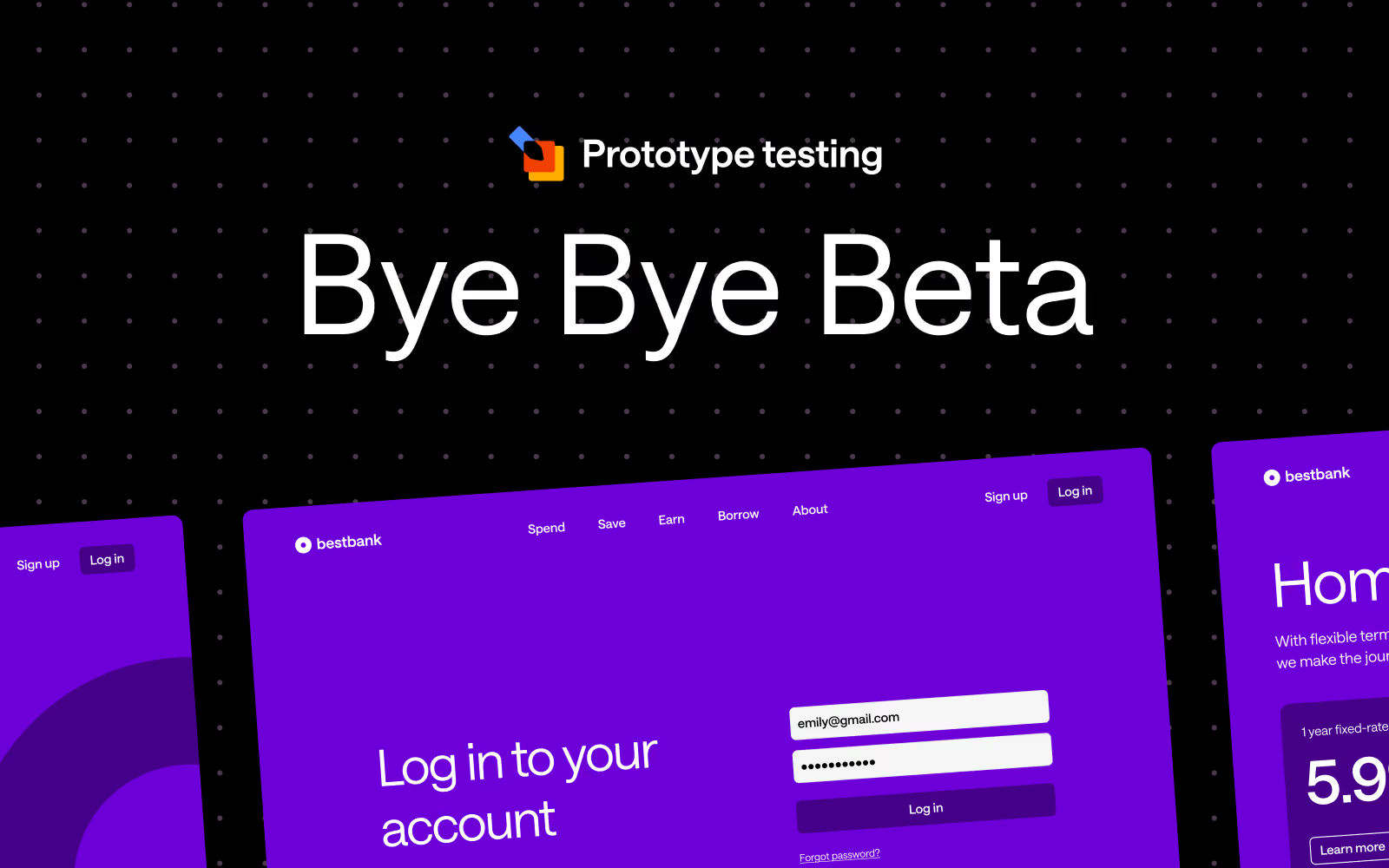
After months of invaluable collaboration with our incredible community, we're thrilled to announce that Prototype Testing has officially graduated from beta and is now available to everyone on the Individual+, Team, and Enterprise plans!
The Prototype Testing Beta was launched with a singular mission: to gather feedback from our community to help shape the future of the tool. Over the past few months, we've been privileged to work alongside a diverse group of customers and UX leaders— who provided invaluable feedback, completed many Usability Tests, and helped us refine the tool.
From the initial rollout to the most recent updates, your input has shaped our decisions, from design tweaks to functional improvements. Together, we’ve tackled challenges, explored creative solutions, and built something that truly aligns with user needs.
We're thrilled to announce our most requested feature is coming to Prototype Testing: seamless video recording that captures the full depth of user experiences.
Video recording transforms your research by:
Your feedback during the beta has shaped an exciting roadmap for 2025 and beyond. While we can't reveal everything just yet, know that every feature and enhancement planned has been inspired by your needs and suggestions.
To our incredible beta participants: your partnership has been invaluable. You've shared your expertise, challenged our assumptions, and helped us build something truly special. Every piece of feedback, every suggestion, and every bug report has contributed to making Prototype Testing a tool that truly serves the UX research community.
This is just the beginning of our mission to make expert research accessible to all. Stay tuned for regular updates as we continue to evolve Prototype Testing based on your needs and feedback. Here's to the next chapter of creating exceptional digital experiences together!
.avif)
Recruiting high quality participants can be a hassle and time-consuming. That’s why we’ve relaunched Optimal Recruitment with expanded profiling capabilities, enhanced quality controls, and full-service support—to let you focus on what matters most: powerful insights to drive better business outcomes.
With Optimal Recruitment, our in-house team makes it easy to connect with participants. We take care of all the details—from feasibility checks, recruitment, reminders, confirmations, and admin.
Thanks to our four award-winning panel providers, we can tailor recruitment to every recruitment need, giving you access to a vast pool of high-quality participants from across 150+ countries.
And this is just the beginning—our network will continue to grow, offering even greater targeting capabilities and expanded reach in the future.
All you need to do is provide your participant criteria and our team will handle the rest! We’ll select the best panel for your needs and ensure everything in your study is set up perfectly so you can sit back and watch the results flow in.
To get started, head over to the Recruit tab under an Optimal study.
Need more info? Find out more about getting started or reach out to Support or your account team for more details.

User experience (UX) research, or user research as it’s commonly referred to, is an important part of the product design process. Primarily, UX research involves using different research methods to gather information about how your users interact with your product. It is an essential part of developing, building and launching a product that truly meets the requirements of your users.
UX research is essential at all stages of a products' life cycle:
While there is no one single time to conduct UX research it is best-practice to continuously gather information throughout the lifetime of your product. The good news is many of the UX research methods do not fit just one phase either, and can (and should) be used repeatedly. After all, there are always new pieces of functionality to test and new insights to discover. We introduce you to best-practice UX research methods for each lifecycle phase of your product.
While the planning phase it is about creating a product that fits your organization, your organization’s needs and meeting a gap in the market it’s also about meeting the needs, desires and requirements of your users. Through UX research you’ll learn which features are necessary to be aligned with your users. And of course, user research lets you test your UX design before you build, saving you time and money.
One of the best ways to learn about your users and how they interact with your product is to observe them in their own environment. Watch how they accomplish tasks, the order they do things, what frustrates them, and what makes the task easier and/or more enjoyable for your subject. The data can be collated to inform the usability of your product, improving intuitive design, and what resonates with users.
Reviewing products already in the market can be a great start to the planning process. Why are your competitors’ products successful and how well do they behave for users. Learn from their successes, and even better build on where they may not be performing the best and find your niche in the market.
Surveys are useful for collecting feedback or understanding attitudes. You can use the learnings from your survey of a subset of users to draw conclusions about a larger population of users.
There are two types of survey questions:
Closed questions are designed to capture quantitative information. Instead of asking users to write out answers, these questions often use multi-choice answers.
Open questions are designed to capture qualitative information such as motivations and context. Typically, these questions require users to write out an answer in a text field.
Once you've completed your product planning research, you’re ready to begin the build phase for your product. User research studies undertaken during the build phase enable you to validate the UX team’s deliverables before investing in the technical development.
Generally involve 5-10 participants and include demographically similar individuals. The study is set up so that members of the group can interact with one another and can be carried out in person or remotely.
Besides learning about the participants’ impressions and perceptions of your product, focus group findings also include what users believe to be a product’s most important features, problems they might encounter while using the product, as well as their experiences with other products, both good and bad.
Card sorting gives insight into how users think. Tools like card sorting reveal where your users expect to find certain information or complete specific tasks. This is especially useful for products with complex or multiple navigations and contributes to the creation of an intuitive information architecture and user experience.
Tree testing gives insight into where users expect to find things and where they’re getting lost within your product. Tools like tree testing help you test your information architecture.
Card sorting and tree testing are often used together. Depending on the purpose of your research and where you are at with your product, they can provide a fully rounded view of your information architecture.
You’ve launched your product, wahoo! And you’re ready for your first real life, real time users. Now it’s time to optimize your product experience. To do this, you’ll need to understand how your new users actually use your product.
Usability testing involves testing a product with users. Typically it involves observing users as they try to follow and complete a series of tasks. As a result you can evaluate if the design is intuitive and if there are any usability problems.
User Interviews - A user interview is designed to get a deeper understanding of a particular topic. Unlike a usability test, where you’re more likely to be focused on how people use your product, a user interview is a guided conversation aimed at better understanding your users. This means you’ll be capturing details like their background, pain points, goals and motivations.
A/B Testing is a way to compare two versions of a design in order to work out which is more effective. It’s typically used to test two versions of the same webpage, for example, using a different headline, image or call to action to see which one converts more effectively. This method offers a way to validate smaller design choices where you might not have the data to make an informed decision, like the color of a button or the layout of a particular image.
Flick-click testing shows you where people click first when trying to complete a task on a website. In most cases, first-click testing is performed on a very simple wireframe of a website, but it can also be carried out on a live website using a tool like first-time clicking.
If you’ve reached the growth stage, fantastic news! You’ve built a great product that’s been embraced by your users. Next on your to-do list is growing your product by increasing your user base and then eventually reaching maturity and making a profit on your hard work.
Growing your product involves building new or advanced features to satisfy specific customer segments. As you plan and build these enhancements, go through the same research and testing process you used to create the first release. The same holds true for enhancements as well as a new product build — user research ensures you’re building the right thing in the best way for your customers.
User interviews will focus on how your product is working or if it’s missing any features, enriching your knowledge about your product and users.
It allows you to test your current features, discover new possibilities for additional features and think about discarding existing ones. If your customers aren’t using certain features, it might be time to stop supporting them to reduce costs and help you grow your profits during the maturity stage.
Surveys and questionnaires can help gather information around which features will work best for your product, enhancing and improving the user experience.
A/B testing during growth and maturity occurs within your sales and onboarding processes. Making sure you have a smooth onboarding process increases your conversion rate and reduces wasted spend — improving your bottom line.
UX research testing throughout the lifecycle of your product helps you continuously evolve and develop a product that responds to what really matters - your users.
Talking to, testing, and knowing your users will allow you to push your product in ways that make sense with the data to back up decisions. Go forth and create the product that meets your organizations needs by delivering the very best user experience for your users.

We're thrilled to announce the re-launch of our Qualitative Insights tool, formerly known as Reframer. This powerful upgrade brings new features designed to revolutionize your qualitative data analysis process, making it faster, easier, and more insightful than ever before.
Qualitative Insights has always been your go-to tool to help you plan and organize interviews, take notes, tag, and analyze rich, unstructured data. Now, we've taken it to the next level with two game-changing additions:
The new Insights feature transforms how you work with qualitative data:
Manual insight creation
AI-Powered Insight Generation (Optional)
Our AI capabilities are designed to enhance your abilities, not replace them. Use AI to:
Remember, your expertise is crucial. Always review and refine AI-generated insights to ensure accuracy and capture nuances that only human understanding can provide.
We prioritize your privacy and data control:
Ready to experience the power of the new Qualitative Insights? Learn more and dive in. Upgrade your qualitative analysis workflow and uncover deeper insights faster than ever before with Qualitative Insights!
In today's digital landscape, delivering exceptional user experiences is no longer optional – it's essential for success. At Optimal, we're committed to empowering UX professionals and organizations with the best-in-class tools and methodologies to create outstanding digital products and experiences.
In this blog post, we'll explore practical use cases that demonstrate how Optimal's research platform can drive meaningful improvements across various UX scenarios.
Refining an existing product? Launching a new website? Rebranding? Optimal's user research platform empowers your team to make informed, collaborative decisions. Here's how to leverage our tools for impactful results:
By embedding user insights at every stage, your team can confidently design experiences that don’t just look good but work for real people. Optimal empowers you to make faster, more informed decisions that drive meaningful outcomes across your organization.
Developing a robust content strategy is crucial for intranets, help documents, websites, and product copy. Optimal's user research and insights platform empowers you to create content that resonates with your audience and drives engagement. Here's how to leverage our tools for effective content strategy development:
Expand your content strategy research by using Qualitative Insights to:
By systematically applying these research methods, you'll develop a content strategy that not only meets your organizational goals but also deeply resonates with your audience. Remember, content strategy is an ongoing process. Regularly use Optimal's tools to assess the effectiveness of your content, gather user feedback, and iteratively improve your approach for continued success.
Empower your team to boost conversion rates by leveraging Optimal's best-in-class user research and insights platform. Here's how you can unlock meaningful improvements:
By systematically applying these research methods, you'll gain the actionable insights needed to create a more intuitive, engaging, and conversion-friendly website. Optimal empowers you to make data-driven decisions that not only boost conversions but also enhance overall user satisfaction.
To truly unlock the power of user research, we recommend a mixed methods approach. By combining quantitative data from surveys and usability tests with qualitative insights from interviews and open-ended responses, you can gain a comprehensive understanding of your users' needs and behaviors.
For more information on mixed methods research and how it can enhance your UX strategy, check out our detailed guide: What is mixed methods research?
Optimal's user research and insights platform provides the tools and methodologies you need to deliver exceptional digital experiences. By leveraging these use cases and adopting a mixed methods approach, you can make data-driven decisions that resonate with your users and drive business success.
Remember, great UX is an ongoing journey. Regularly employ these research methods to stay attuned to your users' evolving needs and preferences. With Optimal as your partner, you're equipped to create digital products and experiences that truly stand out in today's competitive landscape.
Ready to elevate your UX research? Explore Optimal's platform and start unlocking actionable insights today!
We've been hard at work enhancing your research capabilities, and we're excited to share what's new at Optimal. Here's what we've shipped to help you uncover even deeper insights:
Since launching the Beta, we've been collaborating closely with hundreds of Optimal customers to gather feedback and run usability testing. Your support has been invaluable, and we’re excited to announce these latest updates for Prototype Testing:
Improved security with password management: A new "Password settings" button allows users to manage stored passwords, which participants receive before starting their Prototype Study. Additionally, users are prompted for a password when importing protected prototypes.
Improvements to usability: Your feedback was taken onboard, and we’ve updated the buttons, including "Re-sync to file" and "Change prototype," to improve usability.
Results sharing: You can now easily share specific sections (e.g., analysis, tasks, clickmaps) via a URL with your stakeholders in just a few clicks. With the added protection of a password for secure access.
Participant data view: To speed up your data analysis and improve your workflows we’ve added task metrics in the "Results > Participants" table, showing tasks completed, skipped, and success percentage.
Notes tab in analysis: Users can now take notes directly in the Analysis section for Task Results, Click Maps, Paths, and Questionnaires.
This release makes it easier for users to analyze data faster with flexible export options and an improved format for questionnaire and survey downloads. Find out more about the updates below.
To get started, navigate to the Downloads tab under Results. Results Downloads are available for all tools except for Qualitative Insights.
We’re just days away from the re-launch of our Qualitative Insights tool, previously known as Reframer. This upgrade brings powerful new features to streamline and enhance your qualitative data analysis, making it faster, easier, and more insightful than ever.
With the new Insights feature, you can capture and organize key takeaways from studies more efficiently. Each Insight — which includes a title, description, and linked observations — will live under the new Insights tab, allowing you to quickly gather and manage critical findings. You can create Insights directly from your observations or leverage AI to accelerate insight discovery, surfacing hidden themes within your data.
AI-Driven Insights with full control: You and your organization retain complete control over AI usage. All AI-generated results are fully editable, giving you the flexibility to adjust or even turn off AI support for your studies. Use AI as much or as little as needed, with peace of mind over your data management.
Enhanced usability
Our survey relaunch focuses on significantly improving usability, making creating, editing, and launching surveys easier than ever. Key releases coming late 2024 include:
By the end of the year, we’ll be adding Video Recording to our Prototype Testing tool. This new feature will allow you to better understand user experiences, and gain even deeper insights during a Prototype test. Video recording will be browser-based, with no plug-in required, eliminating setup complexities. Participant consent to record screen, face and voice is all taken care of by Optimal and captured upfront in the testing process.
Join our research panel and influence Optimal's future! You'll get early access to new features and thank-you gifts for your time. Interested?
Email product@optimalworkshop.com
