Subscribe to OW blog for an instantly better inbox
Oops! Something went wrong while submitting the form.


We love getting stuck into scary, hairy problems to make things better here at Trade Me. One challenge for us in particular is how best to navigate customer reaction to any change we make to the site, the app, the terms and conditions, and so on. Our customers are passionate both about the service we provide — an online auction and marketplace — and its place in their lives, and are rightly forthcoming when they're displeased or frustrated. We therefore rely on our Customer Service (CS) team to give customers a voice, and to respond with patience and skill to customer problems ranging from incorrectly listed items to reports of abusive behavior.
The CS team uses a Customer Relationship Management (CRM) system, Trade Me Admin, to monitor support requests and manage customer accounts. As the spectrum of Trade Me's services and the complexity of the public website have grown rapidly, the CRM system has, to be blunt, been updated in ways which have not always been the prettiest. Links for new tools and reports have simply been added to existing pages, and old tools for services we no longer operate have not always been removed. Thus, our latest focus has been to improve the user experience of the CRM system for our CS team.
And though on the surface it looks like we're working on a product with only 90 internal users, our changes will have flow on effects to tens of thousands of our members at any given time (from a total number of around 3.6 million members).
We face unique challenges designing customer service systems. Robert Schumacher from GfK summarizes these problems well. I’ve paraphrased him here and added an issue of my own:
1. Customer service centres are high volume environments — Our CS team has thousands of customer interactions every day, and and each team member travels similar paths in the CRM system.
2. Wrong turns are amplified — With so many similar interactions, a system change that adds a minute more to processing customer queries could slow down the whole team and result in delays for customers.
3. Two people relying on the same system — When the CS team takes a phone call from a customer, the CRM system is serving both people: the CS person who is interacting with it, and the caller who directs the interaction. Trouble is, the caller can't see the paths the system is forcing the CS person to take. For example, in a previous job a client’s CS team would always ask callers two or three extra security questions — not to confirm identites, but to cover up the delay between answering the call and the right page loading in the system.
4. Desktop clutter — As a result of the plethora of tools and reports and systems, the desktop of the average CS team member is crowded with open windows and tabs. They have to remember where things are and also how to interact with the different tools and reports, all of which may have been created independently (ie. work differently). This presents quite the cognitive load.
5. CS team members are expert users — They use the system every day, and will all have their own techniques for interacting with it quickly and accurately. They've also probably come up with their own solutions to system problems, which they might be very comfortable with. As Schumacher says, 'A critical mistake is to discount the expert and design for the novice. In contact centers, novices become experts very quickly.'
6. Co-design is risky — Co-design workshops, where the users become the designers, are all the rage, and are usually pretty effective at getting great ideas quickly into systems. But expert users almost always end up regurgitating the system they're familiar with, as they've been trained by repeated use of systems to think in fixed ways.
7. Training is expensive — Complex systems require more training so if your call centre has high churn (ours doesn’t – most staff stick around for years) then you’ll be spending a lot of money. …and the one I’ve added:
8. Powerful does not mean easy to learn — The ‘it must be easy to use and intuitive’ design rationale is often the cause of badly designed CRM systems. Designers mistakenly design something simple when they should be designing something powerful. Powerful is complicated, dense, and often less easy to learn, but once mastered lets staff really motor.
Our improvement of Trade Me Admin is focused on fixing the shattered IA and restructuring the key pages to make them perform even better, bringing them into a new code framework. We're not redesigning the reports, tools, code or even the interaction for most of the reports, as this will be many years of effort. Watching our own staff use Trade Me Admin is like watching someone juggling six or seven things.
The system requires them to visit multiple pages, hold multiple facts in their head, pattern and problem-match across those pages, and follow their professional intuition to get to the heart of a problem. Where the system works well is on some key, densely detailed hub pages. Where it works badly, staff have to navigate click farms with arbitrary link names, have to type across the URL to get to hidden reports, and generally expend more effort on finding the answer than on comprehending the answer.
The first thing that we did was to sit with CS and watch them work and get to know the common actions they perform. The random nature of the IA and the plethora of dead links and superseded reports became apparent. We surveyed teams, providing them with screen printouts and three highlighter pens to colour things as green (use heaps), orange (use sometimes) and red (never use). From this, we were able to immediately remove a lot of noise from the new IA. We also saw that specific teams used certain links but that everyone used a core set. Initially focussing on the core set, we set about understanding the tasks under those links.
The complexity of the job soon became apparent – with a complex system like Trade Me Admin, it is possible to do the same thing in many different ways. Most CRM systems are complex and detailed enough for there to be more than one way to achieve the same end and often, it’s not possible to get a definitive answer, only possible to ‘build a picture’. There’s no one-to-one mapping of task to link. Links were also often arbitrarily named: ‘SQL Lookup’ being an example. The highly-trained user base are dependent on muscle memory in finding these links. This meant that when asked something like: “What and where is the policing enquiry function?”, many couldn’t tell us what or where it was, but when they needed the report it contained they found it straight away.
Therefore, it came as little surprise that staff found the subsequent card sort task quite hard. We renamed the links to better describe their associated actions, and of course, they weren't in the same location as in Trade Me Admin. So instead of taking the predicted 20 minutes, the sort was taking upwards of 40 minutes. Not great when staff are supposed to be answering customer enquiries!
We noticed some strong trends in the results, with links clustering around some of the key pages and tasks (like 'member', 'listing', 'review member financials', and so on). The results also confirmed something that we had observed — that there is a strong split between two types of information: emails/tickets/notes and member info/listing info/reports.
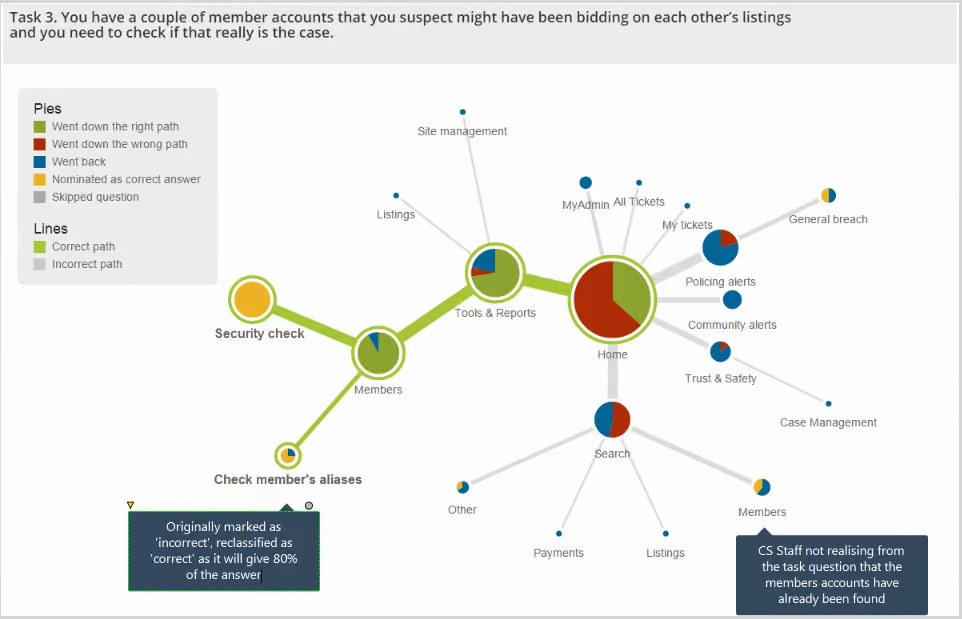
After card sorting, we created two new IAs, and then customized one of the IAs for each of the three CS teams, giving us IAs to test. Each team was then asked to complete two tree tests, with 50% doing one first and 50% doing the other first. At first glance, the results of the tree test were okay — around 61% — but 'Could try harder'. We saw very little overall difference between the success of the two structures, but definitely some differences in task success. And we also came across an interesting quirk in the results.
Closer analysis of the pie charts with an expert in Trade Me Admin showed that some ‘wrong’ answers would give part of the picture required. In some cases so much so that I reclassified answers as ‘correct’ as they were more right than wrong. Typically, in a real world situation, staff might check several reports in order to build a picture. This ambiguous nature is hard to replicate in a tree test which wants definitive yes or no answers. Keeping the tasks both simple to follow and comprehensive proved harder than we expected.
For example, we set a task that asked participants to investigate whether two customers had been bidding on each other's auctions. When we looked at the pietree (see screenshot below), we noticed some participants had clicked on 'Search Members', thinking they needed to locate the customer accounts, when the task had presumed that the customers had already been found. This is a useful insight into writing more comprehensive tasks that we can take with us into our next tests.
What’s clear from analysis is that although it’s possible to provide definitive answers for a typical site’s IAs, for a CRM like Trade Me Admin this is a lot harder. Devising and testing the structure of a CRM has proved a challenge for our highly trained audience, who are used to the current system and naturally find it difficult to see and do things differently. Once we had reclassified some of the answers as ‘correct’ one of the two trees was a clear winner — it had gone from 61% to 69%. The other tree had only improved slightly, from 61% to 63%.
There were still elements with it that were performing sub-optimally in our winning structure, though. Generally, the problems were to do with labelling, where, in some cases, we had attempted to disambiguate those ‘SQL lookup’-type labels but in the process, confused the team. We were left with the dilemma of whether to go with the new labels and make the system initially harder to use for staff but easier to learn for new staff, or stick with the old labels, which are harder to learn. My view is that any new system is going to see an initial performance dip, so we might as well change the labels now and make it better.
The importance of carefully structuring questions in a tree test has been highlighted, particularly in light of the ‘start anywhere/go anywhere’ nature of a CRM. The diffuse but powerful nature of a CRM means that careful consideration of tree test answer options needs to be made, in order to decide ‘how close to 100% correct answer’ you want to get.
It's great to see that our research is influencing the next stage of the CRM system, and we're looking forward to seeing it go live. Of course, our work isn't over— and nor would we want it to be! Alongside the redevelopment of the IA, I've been redesigning the key pages from Trade Me Admin, and continuing to conduct user research, including first click testing using Chalkmark.
This project has been governed by a steadily developing set of design principles, focused on complex CRM systems and the specific needs of their audience. Two of these principles are to reduce navigation and to design for experts, not novices, which means creating dense, detailed pages. It's intense, complex, and rewarding design work, and we'll be exploring this exciting space in more depth in upcoming posts.

UX, product and design teams face growing challenges with tool proliferation, relying on different options for surveys, usability testing, and participant recruitment before transferring data into analysis tools like Dovetail. This fragmented workflow creates significant data integration issues and reporting bottlenecks that slow down teams trying to conduct smart, fast UX research. The constant switching between platforms not only wastes time but also increases the risk of data loss and inconsistencies across research projects. Optimal addresses these operational challenges by unifying the entire research workflow within a single platform, enabling teams to recruit participants, run tests and studies, and perform analysis without the complexity of managing multiple tools.
Optimal's Streamlined Workflow: Optimal eliminates tool chain management by providing recruitment, testing, and analysis in one platform, enabling researchers to move seamlessly from study design to actionable insights.
Dovetail's Tool Chain Complexity: In contrast, Dovetail requires teams to coordinate multiple platforms, one for recruitment, another for surveys, a third for usability testing, then import everything for analysis, creating workflow bottlenecks and coordination overhead.
Optimal's Focused Research Flow: Optimal's unified interface keeps researchers in flow state, moving efficiently through research phases without context switching or tool coordination.
Context Switching Inefficiency: Dovetail users constantly switch between different tools with different interfaces, learning curves, and data formats, fragmenting focus and slowing research velocity.
Consistent Data Standards: Optimal's unified platform ensures consistent data collection standards, formatting, and quality controls across all research methods, delivering reliable insights from integrated data sources.
Fragmented Data Sources: Dovetail aggregates data from multiple external sources, but this fragmentation can create inconsistencies, data quality issues, and gaps in analysis that compromise insight reliability.
Automated Data Integration: Optimal automatically captures and integrates data across all research activities, enabling real-time analysis and immediate insight generation without manual data management.
Manual Data Coordination: Dovetail teams spend significant time importing, formatting, and reconciling data from different tools before analysis can begin, delaying insight delivery and increasing error risk.
Complete End-to-End Research Platform: Optimal provides a full suite of native research capabilities including live site testing, prototype testing, card sorting, tree testing, surveys, and more, all within a single platform. Optimal's live site testing allows you to test actual websites and web apps with real users without any code requirements, enabling continuous optimization post-launch.
Dovetail Requires External Tools: Dovetail focuses primarily on analysis and requires teams to use separate tools for data collection, adding complexity and cost to the research workflow.
AI-Powered Interview Analysis: Optimal's new Interviews tool transforms how teams extract insights from user research. Upload interview videos and let AI automatically surface key themes, generate smart highlight reels, create timestamped transcripts, and produce actionable insights in hours instead of weeks. Every insight comes with supporting video evidence, making it easy to back up recommendations with real user feedback.
Dovetail's Manual Analysis Process: While Dovetail offers analysis features, teams must still coordinate external interview tools and manually import data before analysis can begin, creating additional workflow steps.
Global Participant Network: Optimal's 10+ million verified participants across 150+ countries provide comprehensive recruitment capabilities with advanced targeting and quality assurance for any research requirement.
No Native Recruitment: Dovetail's beta participant recruitment add-on lacks the scale and reliability enterprise teams need, forcing dependence on external recruitment services with additional costs and complexity.
Complete Research ROI: Optimal delivers immediate value through integrated data collection and analysis capabilities, ensuring consistent ROI regardless of external research dependencies.
Analysis-Only Value: Dovetail's value depends entirely on research volume from external sources, making ROI uncertain for teams with moderate research needs or budget constraints.
Dovetail may slow teams because of challenges with:
Optimal becomes essential for:
Ready to move beyond basic feedback to strategic research intelligence? Experience how Optimal's analytical depth and comprehensive insights drive product decisions that create competitive advantage.

Many smaller product teams find newer research tools like Ballpark attractive due to their promises of being able to provide simple and quick user feedback tools. However, larger teams conducting UX research that drives product strategy need platforms capable of delivering actionable insights rather than just surface-level metrics. While Ballpark provides basic testing functionality that works for simple validation, Optimal offers the research depth, comprehensive analysis capabilities, and strategic intelligence that teams require when making critical product decisions.
Optimal is the best choice for teams looking for:
Ready to move beyond basic feedback to strategic research intelligence? Experience how Optimal's analytical depth and comprehensive insights drive product decisions that create competitive advantage.

Smaller research teams frequently gravitate toward lightweight tools like Useberry when they need quick user feedback. However, as product teams scale and tackle more complex challenges, they require platforms that can deliver both rapid insights and strategic depth. While Useberry offers basic prototype testing capabilities that work well for simple user feedback collection, Optimal provides the comprehensive feature set and flexible participant recruitment options that leading organizations depend on to make informed product and design decisions.
Useberry may be a good choice for teams who are happy with:
Optimal becomes essential for:
Ready to transform research from basic feedback to strategic intelligence? Experience how Optimal's enterprise platform delivers the comprehensive capabilities and global reach your research program demands.


The decision between specialized UX testing tools and comprehensive user insight platforms fundamentally shapes how teams generate, analyze, and act on user feedback. This choice affects not only immediate research capabilities but also long-term strategic planning and organizational impact. While UXTweak focuses primarily on basic usability testing with straightforward functionality, Optimal provides the robust capabilities, global participant reach, and advanced analytics infrastructure that the world's biggest brands rely on to build products users genuinely love. Optimal's platform enables teams to conduct sophisticated research, integrate insights across departments, and deliver actionable recommendations that drive meaningful business outcomes.
Optimal's Research Leadership: Optimal delivers complete research capabilities combining rapid study deployment with AI-powered insights, advanced participant targeting, and enterprise-grade analytics that transform user feedback into actionable business intelligence. This includes comprehensive live site testing that allows you to test actual websites and web apps without code, enabling continuous optimization and real-time user insights post-launch.
UXtweak's Limited Scope: In contrast, UXTweak operates primarily as a basic usability testing tool with simple click tracking and heat maps, lacking the sophisticated AI-powered analysis and comprehensive insights enterprise research programs demand for strategic impact.
Enterprise-Ready Platform: Optimal serves Fortune 500 clients including Lego, Nike, and Amazon with SOC 2 compliance, enterprise security protocols, and dedicated support infrastructure that scales with organizational growth.
Scalability Constraints: UXTweak's basic infrastructure and limited feature set restrict growth potential, making it unsuitable for enterprise teams requiring sophisticated research operations and global deployment capabilities.
Global Research Network: Optimal's 10+ million verified participants across 150+ countries enable sophisticated audience targeting, international market research, and reliable recruitment for any demographic or geographic requirement.
Limited Panel Access: UXTweak provides minimal participant recruitment options with basic targeting capabilities, restricting teams to simple demographic filters and limiting research scope for complex audience requirements.
AI-Powered Intelligence: Optimal includes sophisticated AI analysis tools that automatically generate insights, identify patterns, create statistical models, and deliver actionable recommendations that drive strategic decisions. Our new Interviews tool transforms research analysis, upload interview videos and let AI automatically surface key themes, generate smart highlight reels with timestamped evidence, and produce actionable insights in hours instead of weeks, eliminating manual analysis bottlenecks.
Surface-Level Analysis: UXTweak delivers basic click tracking and simple metrics without integrated AI tools or advanced statistical analysis, requiring teams to manually interpret raw data for insights.
Complete Research Suite: Optimal provides full-spectrum research capabilities including advanced card sorting, tree testing, prototype validation, surveys, and qualitative insights with integrated AI analysis across all methodologies.
Basic Tool Limitations: UXtweak offers elementary testing capabilities focused on simple click tracking and basic surveys, lacking the comprehensive research tools enterprise teams need for strategic product decisions.
Automated Research Operations: Optimal streamlines research workflows with automated participant matching, AI-powered analysis, integrated reporting, and seamless collaboration tools that accelerate insight delivery.
Manual Workflow Dependencies: UXtweak requires significant manual effort for study setup, participant management, and data analysis, creating workflow inefficiencies that slow research velocity and impact delivery timelines.
UXtweak may be a good choice for teams who are looking for:
Optimal becomes essential for:
Ready to see how leading brands including Lego, Netflix and Nike achieve better research outcomes? Experience how Optimal's platform delivers user insights that adapt to your team's growing needs.


The choice between comprehensive research platforms and tools designed for smaller teams becomes increasingly critical as research and product teams work to scale their user insight capabilities. This decision impacts not only immediate research outcomes but also long-term strategic planning and organizational growth. While platforms like Lyssna focus on rapid feedback collection and quick turnaround times which are valuable for teams needing fast validation, Optimal delivers the depth, reliability, and enterprise features that the world's biggest brands require to make strategic product decisions.
Optimal's Comprehensive Approach: Optimal combines speed with depth, delivering rapid study launch alongside AI-powered analysis, detailed reporting, and enterprise-grade insights that transform user feedback into actionable business intelligence. This includes live site testing capabilities that let you test actual websites and web apps without code, enabling continuous optimization post-launch.
Lyssna's Speed Focus: In contrast, Lyssna optimizes for quick feedback collection with simple testing workflows, but lacks AI-powered analysis, advanced reporting, and the sophisticated insights enterprise research programs require for strategic decision-making.
Trusted by Global Brands: Optimal serves enterprise clients including Lego, Nike, and Amazon with SOC 2 compliance, global security protocols, and dedicated enterprise support that meets Fortune 500 requirements.
Limited Enterprise Features: Lyssna operates as a testing tool rather than an enterprise platform, lacking the compliance, security, and support infrastructure global brands require for mission-critical research programs.
Global Participant Network: Optimal's 10+ million verified participants across 150+ countries enable sophisticated audience targeting, global market research, and reliable recruitment for any demographic or geographic requirement.
Limited Panel Reach: Lyssna's small participant panel restricts targeting options and geographic coverage, particularly for niche audiences or international research requirements.
Verified Participant Quality: Optimal implements comprehensive fraud prevention, advanced screening protocols, and quality assurance processes that ensure participant authenticity and criteria matching for reliable research results.
Quality Control Issues: Users report that Lyssna participants often don't match requested criteria, compromising study validity and requiring additional screening overhead.
AI-Powered Insights: Optimal includes sophisticated AI analysis tools that automatically generate insights, identify patterns, and create actionable recommendations from research data. Our new Interviews tool exemplifies this innovation, upload interview videos and let AI automatically surface key themes, generate smart highlight reels with timestamped evidence, and produce actionable insights in hours instead of weeks.
Manual Analysis Required: Lyssna provides basic reporting without integrated AI tools, requiring teams to manually analyze results and generate insights from raw data.
Full-Service Flexibility: Optimal provides both self-service and white-glove managed recruitment services, accommodating varying team resources and research complexity with dedicated support for challenging recruitment scenarios.
Self-Service Only: Lyssna operates exclusively as a self-service platform without managed recruitment options for teams requiring specialized audience targeting or complex demographic requirements.
Sophisticated Yet Accessible: Optimal balances powerful functionality with intuitive design, providing guided templates and automation features that enable complex research without overwhelming users.
Simple but Limited: While Lyssna offers a straightforward interface, this simplicity comes with functional limitations that restrict test design flexibility and advanced research capabilities.
Lyssna may suffice for teams with:
Optimal becomes essential for:
While Lyssna serves basic testing needs, enterprise research requires the depth, reliability, and global reach that only comprehensive platforms provide. Optimal delivers speed without sacrificing the sophisticated capabilities enterprise teams need for strategic decision-making. Don't compromise research quality for simple, quick tools.
Ready to see how leading brands including Lego, Netflix and Nike achieve better research outcomes? Experience how Optimal's platform delivers user insights that adapt to your team's growing needs.

