Optimal Blog
Articles and Podcasts on Customer Service, AI and Automation, Product, and more
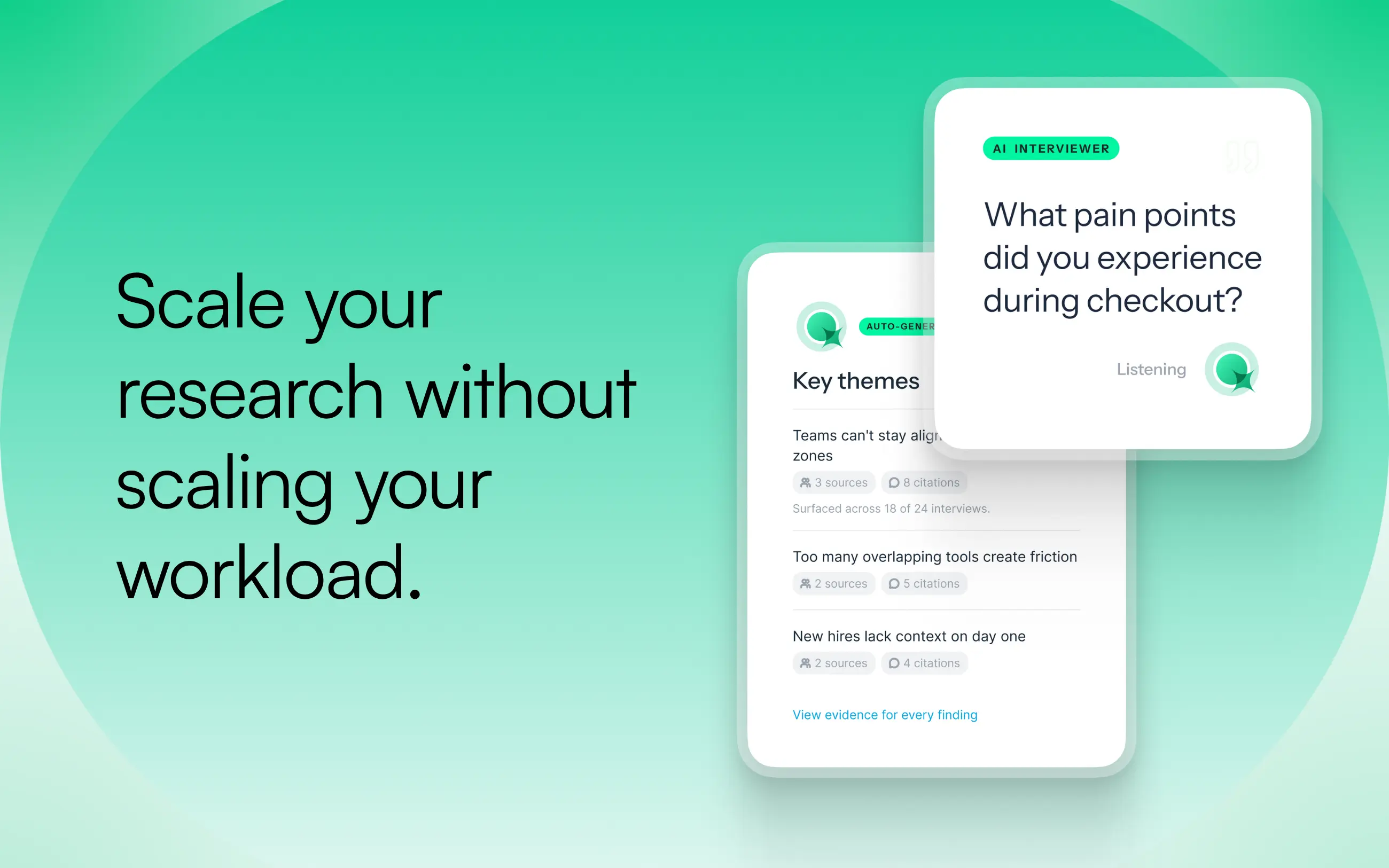
.webp)
Great research has never been about speed alone. It’s about asking the right questions, understanding the context behind them, and uncovering insights that help teams make better decisions.
Optimal's AI Interviewer is designed to support that process. It’s designed to work alongside researchers and teams, so you can move faster without losing the depth and human nuance that makes research valuable.
Shaped by discovery
Before building AI Interviewer, we spoke with and surveyed researchers, designers, and product teams to how they approach interviews today and where AI could genuinely help.
What we heard was consistent:
- Interviews are powerful, but time-intensive
- Scaling across time zones is challenging
- Synthesising conversations can take longer than running them
- And most importantly, context matters
AI isn’t useful if it ignores how your team works. So instead of building a generic interviewer, we focused on building an AI Interviewer that fits into your current workflows and keeps researchers and teams in the driver's seat.
Here’s what we learned and how we brought it to life with Optimal’s AI Interviewer.
Context matters
The best interviews start with a clear understanding of what you’re trying to uncover. With the AI Interviewer, you can add your research goals, audience details, company and product context, and additional context you want the AI to consider. This means the AI doesn’t just ask questions; it understands what you’re trying to learn and helps guide conversations in the right direction.
The same context also powers AI insights, helping ensure summaries, key themes, and citations are relevant, accurate, and aligned with what you're trying to learn.
Control the conversation
One of the concerns with AI-led interviews is not having enough control. We’ve designed the AI Interviewer with this in mind.
For each question, you can choose how deeply you would like the AI Interviewer to probe and follow-up. You decide when deeper exploration is valuable, how the conversation flows, and the AI can then carry this out on your behalf.
Scale your research without losing depth
AI Interviewer helps remove some of the barriers that make qualitative research difficult to scale. Use it to:
- Scale research without hiring additional moderators
- Run interviews across different geographies and time zones
- Keep research moving, even when your team is offline
- Encourage more honest, candid feedback with an AI interviewer that participants may find easier to open up to
This isn’t about replacing researchers. It’s about removing operational work so you can focus on higher-value work, like synthesis, storytelling, and decision-making.
Richer insights, backed by evidence
Every session comes with recordings, key summaries, and AI-generated insights with clear detailed evidence. Instead of reviewing hours of footage, you can quickly find what matters and confidently back it up. Review insights across your full study, or dive deeper into individual sessions and specific questions.
On the roadmap: Once your interviews are complete, you can use AI Chat to go further with your data and explore patterns across sessions, ask follow-up questions, and validate assumptions with real evidence.
Humans in the loop, by design
Let’s address the elephant in the room. AI-led interviews aren’t something everyone is immediately comfortable with, and that’s fair. There are real limitations.
Some research scenarios require human sensitivity and judgment. Nuance, emotion, and edge cases still benefit from a human touch. Vulnerable populations and complex topics should always be handled with care. Optimal values a human-in-the-loop approach and know an AI Interviewer isn’t always suitable. With that in mind, we made sure that:
- You define the context
- You control the structure
- You decide when and how to use it
The AI Interviewer supports your work. It doesn’t replace your expertise.
Early access: help shape what comes next
AI Interviewer is now available in early access, and we’re continuing to learn from the teams using it. If you’re looking to scale your research without scaling your workload, run interviews across time zones, and spend less time on logistics and more time on insights, we’d love for you to try it.
👉 Book a demo to see how it fits into your workflow.
Already with Optimal? Register your interest for early access.
Topics
Research Methods
Popular
All topics
Latest
4 options for running a card sort
This morning Ieavesdroppeda conversation between Amy Worley (@worleygirl) and The SemanticWill™ (@semanticwill) on "the twitters".Aside from recommending two books by Donna Spencer (@maadonna), I asked Nicole Kaufmann, one of the friendly consultants at Optimal Usability, if she had any advice for Amy about reorganising 404 books into categories that make more sense.I don't know Amy's email address and this is much too long for a tweet. In any case I thought it might be helpful for someone else too so here's what Nicole had to say:In general I would recommend having at least three sources of information (e.g. 1x analytics + 1 open card sort + 1 tree test, or 2 card sorts + 1 tree test) in order to come up with a useful and reliable categorisation structure.Here are four options for how you could consider approaching it (starting with my most preferred to least preferred):

Option A
- Pick the 20-25 cards you think will be the most difficult and 20-25 cards that you think will be the easiest to sort and test those in one open card sort.
- Based on the results create one or two sets of categories structures which you can test in a one or two closed card sorts. Consider replacing about half of the tested cards with new ones.
- Based on the results of those two rounds of card sorting, create a categorisation structure and pick a set of difficult cards which you can turn into tasks which you can test in a tree test.
- Plus: Categorisation is revised between studies. Relative easy analysis.
- Minus: Not all cards have been tested. Depending on the number of studies needs about 80-110 participants. Time intensive.
Option B
- Pick the 20-25 cards you think will be the most difficult and 20-25 cards that you think will be the easiest to sort and test those in one open card sort.
- Based on the results do a closed card sort(s) excluding the easiest cards and adding some new cards which haven't been tested before.
- Plus: Card sort with reasonable number of cards, only 40-60 participants needed, quick to analyse.
- Minus: Potential bias and misleading results if the wrong cards are picked.
Option C
- Create your own top level categories (5-8) (could be based on a card sort) and assign cards to these categories, then pick random cards within those categories and set up a card sort for each (5-8).
- Based on the results create a categorisation structure and a set of task which will be tested in a tree test.
- Plus: Limited set of card sorts with reasonable number of cards, quick to analyse. Several sorts for comparison.
- Minus: Potential bias and misleading results if the wrong top categories are picked. Potentially different categorisation schemes/approaches for each card sort, making them hard to combine into one solid categorisation structure.
Option D
- Approach: Put all 404 cards into 1 open card sort, showing each participant only 40-50 cards.
- Plus: All cards will have been tested
- Do a follow up card sort with the most difficult and easiest cards (similar to option B).
- Minus: You need at least 200-300 completed responses to get reasonable results. Depending on your participant sources it may take ages to get that many participants.

Best UserZoom Alternatives Compared
The Best Alternatives to UserZoom in 2026
The two strongest UserZoom alternatives are Optimal and Maze. Optimal is a user insights platform that gives every role in your business access to research-grade methods: mixed-methods usability testing, surveys, live site testing, prototype testing, interviews, card sorting and tree testing, with AI-powered analysis included and participants in 150+ countries. You can also invite as many of your own users as you need at no extra cost. Maze suits product teams running a high volume of fast, unmoderated prototype tests, with moderated and AI-moderated interviews on its Enterprise plan. UserZoom is now part of UserTesting, so most teams evaluating it are deciding whether to stay on the merged platform.
What Is UserZoom?
UserZoom merged with UserTesting in 2023 and now operates under the UserTesting name. Its benchmarking and quantitative UX capabilities have been folded into the UserTesting platform, and licensing and support run through UserTesting.
Many teams still use and search for it as UserZoom. The question of alternatives usually comes up at renewal, or when moving onto UserTesting's contract model is on the table.
Why Teams Look for UserZoom Alternatives
Teams moving away from UserZoom and UserTesting tend to raise the same issues:
- Too many tools. Recruitment, testing, analysis and reporting often end up spread across separate products, so insights get lost between them.
- Slow analysis. Reviewers on G2 and Capterra frequently mention slow manual analysis and time-consuming exports.
- Limitations on running concurrent studies. UserZoom only allows for one method/study type to be live and collecting responses at a time.
- Cost and access. Custom enterprise pricing makes it hard to budget, and access to capabilities are limited on most plans unless you go for the top tier.
UserZoom Alternatives: A Feature Comparison
| Feature | Optimal | UserZoom | Maze |
|---|---|---|---|
| Mixed-methods usability testing | ✓ | ✓ | ✓ |
| Live site testing | ✓ | ✓ | ✓ |
| Interviews | ✓ | ✓ | ✓ Enterprise plan only |
| Surveys | ✓ | ✓ | ✓ |
| Card sorting and tree testing | ✓ Industry-leading | ✓ | ✓ |
| AI-Powered Analysis | ✓ Included by default | ✓ Varies by plan | ✓ Themes, summaries |
| Participant panel global reach | ✓ 150+ countries | ✓ 15+ countries | ✓ 130+ countries |
| Bring your own participants | ✓ Free and unlimited | ✓ Free and unlimited | ✓ Free and unlimited |
| Figma Integration | ✓ | ✓ | ✓ |
| SOC 2, type II / GDPR | ✓ | ✓ | ✓ |
| ISO certifications | ✓ | ✓ | - |
Optimal: the end-to-end UserZoom alternative
We built Optimal so every team can run the research that matters most in one place: mixed-methods usability testing, live site testing, prototype testing, surveys, interviews, first-click testing, card sorting and tree testing. Recruitment, testing, analysis and sharing all happen in one user insights platform, so you're not stitching tools together to get from a question to an answer.
Where Optimal wins is research accessibility. Every method is available to designers, product managers and researchers alike, without needing to upgrade to reach the ones you need. With mixed-methods usability testing, you can combine prototype tasks, live site tasks and survey questions in a single study, so you see what people do and hear why they do it in one set of results. Optimal Interviews lets you schedule and record sessions or upload existing ones, and our built-in AI turns interviews, survey responses and behavioral data into summaries and highlight reels you can share with stakeholders. When a study points to a navigation or content problem, you have the tree testing and card sorting depth Optimal is known for in the same platform.
Optimal also gives teams access to verified participants across 150+ countries, compared with the 60+ countries UserTesting lists for its panel. When you want to test with your own customers, you can invite as many as you need into a study at no extra cost. And Optimal is certified to ISO 27001 and ISO 27701 alongside SOC 2 Type II, which makes enterprise security reviews simpler.
Maze: Built for Rapid, Unmoderated Product Research
Maze is a product research platform built around speed for unmoderated testing. It's designed for product and design teams that need fast feedback on prototypes and designs, with results that come in quickly and are easy to share.
Maze supports prototype testing, surveys, tree testing, card sorting and live website testing, and recruits through partner panels including Prolific and Respondent. Its AI capabilities include AI-moderated interviews, open question follow-ups, AI themes and suggested highlights. Maze integrates with Figma and Slack, holds SOC 2 Type II certification and is GDPR compliant.
Maze is a good fit for teams that need directional answers quickly. The trade-offs show up as research grows: moderated interviews and the AI moderator sit on Maze's Enterprise plan, paid plans are priced per seat, and lower plans limit how many responses you can collect per study. With Optimal, interviews, AI analysis and unlimited participants per study are part of the platform rather than an upgrade.
User Research Tools: Which Research Methods Does Your Team Need?
Not every team needs every research method. The right platform is the one that handles your core workflow well, not the one with the longest feature list.
- Research-grade methods for every role: Optimal gives designers, product managers and researchers access to the the same methods and AI analysis, so research isn't limited to specialists or top-tier plans.
- Fast, unmoderated prototype testing: Maze is built for teams that need rapid, directional feedback during design sprints.
- Broad enterprise programs with formal benchmarking: UserTesting, including UserZoom's QX Score, suits organizations with an existing enterprise agreement.
- Navigation and information architecture: All three support tree testing and card sorting. Optimal offers the deepest analysis for these methods.
Platforms Like UserZoom: What to Look for in 2026
Most platforms now support usability testing, surveys and interviews. The differences that matter are which methods are on the plan you'd buy, how analysis works, and who you can recruit and on what terms.
When evaluating tools like UserZoom, ask: Which methods and AI features are on your plan, not just the top tier? Can you recruit the right participants in the countries you need? What does it cost to test with your own users? Does the security coverage match your organization's requirements?
The Bottom Line on UserZoom Alternatives
UserZoom (now part of UserTesting), Maze and Optimal can all run usability research. The difference is who can use them and how far the insights travel. UserZoom is built around watching people use your product. Maze is built for speed on unmoderated prototype tests, with interviews and enterprise controls on its Enterprise plan.
Optimal puts research-grade methods in the hands of every designer, product manager and researcher in your business. Mixed-methods usability tests, live site tests, interviews, card sorts and tree tests all run in one user insights platform, with AI-powered analysis that turns results into evidence stakeholders act on.
If you're looking for a UserZoom alternative that brings research-grade depth to your whole team, with insights that influence decisions, Optimal is where we'd point you.

Digitalization and Customer-Centricity in the Utilities Sector
The utilities industry stands at a pivotal crossroads. With new generations of digitally-savvy consumers and mounting environmental pressures, the traditional utility business model is rapidly evolving. For UX professionals in this space, embracing digitalization isn't just about implementing new technologies, it's about fundamentally reimagining the customer experience to place users at the center of every decision.
The Changing Utility Landscape
Several forces are driving the urgent need for digital transformation in the utilities sector:
- Rising customer expectations: Today's consumers, accustomed to seamless digital experiences from retailers and service providers, expect the same from their utility companies.
- Environmental imperatives: The global push toward sustainability requires smarter resource management and customer engagement around conservation efforts.
- Generational shifts: Younger consumers interact with service providers differently, preferring digital touchpoints and self-service options.
- Competitive pressures: In deregulated markets, utilities that offer superior digital experiences gain a competitive advantage.
Defining Customer-Centric Digitalization
True customer-centricity in the utilities sector means more than simply adding digital channels, it requires a holistic approach that delivers value at every interaction point:
Digital Touchpoints That Matter
Successful utility digitalization focuses on creating meaningful customer connections across multiple channels:
- Mobile-first account management: Intuitive apps and responsive websites that allow customers to monitor usage, pay bills, and request services from any device.
- Self-service portals: Comprehensive knowledge bases and troubleshooting tools that empower customers to find answers and resolve issues independently.
- Smart home integration: Connecting utility services with smart home ecosystems to offer unprecedented convenience and control over resource usage.
- Personalized communications: Tailored outreach that reflects individual preferences, usage patterns, and needs rather than generic mass messaging.
- Interactive educational resources: Engaging digital content that helps customers understand their consumption and make informed decisions.
Technology Investments with Impact
For UX professionals advising on technology investments, prioritize solutions that directly enhance the customer experience:
High-Value Digital Investments
- Customer data platforms: Systems that unify customer information across touchpoints to create comprehensive profiles that inform personalization efforts.
- Advanced analytics: Tools that transform usage data into actionable insights for both customers and the business.
- Omnichannel communication systems: Platforms that ensure consistent experiences whether a customer reaches out via app, website, phone, or in person.
- IoT and smart metering infrastructure: Technologies that enable real-time monitoring and proactive service management.
- User experience research tools: Solutions that gather continuous feedback to drive ongoing experience improvements.
Implementation Strategies for Success
To maximize the impact of digitalization efforts, consider these strategic approaches:
- Begin with customer journey mapping: Thoroughly document every touchpoint in the customer lifecycle to identify pain points and opportunities for digital enhancement.
- Adopt human-centered design practices: Involve actual customers in the design process through testing, feedback sessions, and co-creation workshops.
- Implement agile delivery methods: Release digital improvements incrementally, gathering user feedback to refine features before full-scale deployment.
- Invest in internal digital literacy: Ensure staff across the organization understand and can leverage new digital capabilities to better serve customers.
- Measure what matters: Develop metrics that track not just adoption of digital tools but their impact on customer satisfaction and business outcomes.
Optimal is your Partner in Customer-Centric Digitalization
For utilities serious about creating exceptional digital experiences, Optimal's suite of UX research tools provides invaluable support throughout the digitalization journey:
Discovering Customer Needs with Card sorting
Before building new digital interfaces, understand how customers naturally organize information:
- Run card sorting exercises to determine how users expect utility services to be categorized
- Identify terminology that resonates with customers versus industry jargon that creates confusion
- Create information architectures that match customers' mental models, resulting in more intuitive navigation
Validating Navigation Structures with Tree testing
For complex utility portals with multiple services and functions:
- Test the navigability of your website structure before investing in development
- Identify where customers expect to find specific functions like usage monitoring, bill payment, or service requests
- Optimize menu structures to ensure customers can complete common tasks efficiently
Perfecting Page Layouts with First-click testing
When designing critical utility service interfaces:
- Test where users first click when trying to complete high-priority tasks
- Ensure important functions like outage reporting or emergency contacts are immediately discoverable
- Validate that key actions stand out visually on both desktop and mobile interfaces
Gathering Voice of Customer with Surveys
To ensure digitalization efforts address genuine customer needs:
- Run targeted surveys to understand customer preferences for digital versus traditional service channels
- Identify specific pain points in current service delivery that digitalization should address
- Segment feedback by customer type to develop targeted digital strategies for different user groups
Analyzing with Qualitative insights
During user testing of new digital platforms:
- Capture rich, contextual observations of how customers interact with digital interfaces
- Identify recurring themes in customer feedback that reveal improvement opportunities
- Transform qualitative insights into actionable design recommendations
Looking Ahead: The Future of Utility Customer Experience
The digitalization journey is ongoing. Forward-thinking utilities are already exploring:
- Predictive service models that address potential issues before customers experience problems
- AR/VR applications for helping customers visualize energy-saving home improvements
- Voice-activated service interfaces that make utility management effortless
- Blockchain-based solutions for peer-to-peer energy trading in communities
Optimal is Creating a Foundation for Digital Success
The path to successful digitalization in utilities requires a deep understanding of customer needs, expectations, and behaviors. Optimal's integrated platform provides the research foundation needed to build truly customer-centric digital experiences:
- Begin with discovery: Use Card sorting and Surveys to understand how customers conceptualize utility services and what they value most in digital interactions.
- Validate before building: Test information architectures with Tree testing to ensure customers can navigate intuitively through your digital services.
- Refine the experience: Use First-click testing to perfect interface designs and identify where users naturally look for key functions.
- Learn continuously: Implement Qualitative insights to gather ongoing feedback that inform continuous improvements to your digital experience.
Conclusion
For UX professionals in the energy and utilities sector, the mandate is clear: digitalization is no longer optional but essential for meeting customer expectations and addressing environmental challenges. By investing strategically in technologies that enhance the customer experience at every touchpoint, and using robust UX research platforms like Optimal to guide these investments, utilities can transform their relationship with consumers from basic service providers to valued partners in resource management.
The most successful utilities will be those that view digitalization not merely as a technology upgrade but as a fundamental shift toward customer-centricity, placing the user's needs, preferences, and experiences at the heart of every business decision. With Optimal as your research partner, you can ensure your digitalization efforts truly deliver on the promise of exceptional customer experiences.

Optimal vs Dovetail: Why Smart Product Teams Choose Unified Research Workflows

UX, product and design teams face growing challenges with tool proliferation, relying on different options for surveys, usability testing, and participant recruitment before transferring data into analysis tools like Dovetail. This fragmented workflow creates significant data integration issues and reporting bottlenecks that slow down teams trying to conduct smart, fast UX research. The constant switching between platforms not only wastes time but also increases the risk of data loss and inconsistencies across research projects. Optimal addresses these operational challenges by unifying the entire research workflow within a single platform, enabling teams to recruit participants, run tests and studies, and perform analysis without the complexity of managing multiple tools.
Why Choose Optimal over Dovetail?
Unified Research Operations vs. Fragmented Workflow
Optimal's Streamlined Workflow: Optimal eliminates tool chain management by providing recruitment, testing, and analysis in one platform, enabling researchers to move seamlessly from study design to actionable insights.
Dovetail's Tool Chain Complexity: In contrast, Dovetail requires teams to coordinate multiple platforms, one for recruitment, another for surveys, a third for usability testing, then import everything for analysis, creating workflow bottlenecks and coordination overhead.
Optimal's Focused Research Flow: Optimal's unified interface keeps researchers in flow state, moving efficiently through research phases without context switching or tool coordination.
Context Switching Inefficiency: Dovetail users constantly switch between different tools with different interfaces, learning curves, and data formats, fragmenting focus and slowing research velocity.
Integrated Intelligence vs. Data Silos
Consistent Data Standards: Optimal's unified platform ensures consistent data collection standards, formatting, and quality controls across all research methods, delivering reliable insights from integrated data sources.
Fragmented Data Sources: Dovetail aggregates data from multiple external sources, but this fragmentation can create inconsistencies, data quality issues, and gaps in analysis that compromise insight reliability.
Automated Data Integration: Optimal automatically captures and integrates data across all research activities, enabling real-time analysis and immediate insight generation without manual data management.
Manual Data Coordination: Dovetail teams spend significant time importing, formatting, and reconciling data from different tools before analysis can begin, delaying insight delivery and increasing error risk.
Comprehensive Research Capabilities vs. Analysis-Only Focus
Complete End-to-End Research Platform: Optimal provides a full suite of native research capabilities including live site testing, prototype testing, card sorting, tree testing, surveys, and more, all within a single platform. Optimal's live site testing allows you to test actual websites and web apps with real users without any code requirements, enabling continuous optimization post-launch.
Dovetail Requires External Tools: Dovetail focuses primarily on analysis and requires teams to use separate tools for data collection, adding complexity and cost to the research workflow.
AI-Powered Interview Analysis: Optimal's new Interviews tool transforms how teams extract insights from user research. Upload interview videos and let AI automatically surface key themes, generate smart highlight reels, create timestamped transcripts, and produce actionable insights in hours instead of weeks. Every insight comes with supporting video evidence, making it easy to back up recommendations with real user feedback.
Dovetail's Manual Analysis Process: While Dovetail offers analysis features, teams must still coordinate external interview tools and manually import data before analysis can begin, creating additional workflow steps.
Global Research Capabilities vs. Limited Data Collection
Global Participant Network: Optimal's 10+ million verified participants across 150+ countries provide comprehensive recruitment capabilities with advanced targeting and quality assurance for any research requirement.
No Native Recruitment: Dovetail's beta participant recruitment add-on lacks the scale and reliability enterprise teams need, forcing dependence on external recruitment services with additional costs and complexity.
Complete Research ROI: Optimal delivers immediate value through integrated data collection and analysis capabilities, ensuring consistent ROI regardless of external research dependencies.
Analysis-Only Value: Dovetail's value depends entirely on research volume from external sources, making ROI uncertain for teams with moderate research needs or budget constraints.
Dovetail Challenges:
Dovetail may slow teams because of challenges with:
- Multi-tool coordination requiring significant project management overhead
- Data fragmentation creating inconsistencies and quality control challenges
- Context switching between platforms disrupting research flow and focus
- Manual data import and formatting delaying insight delivery
- Complex tool chain management requiring specialized technical knowledge
When Optimal is the Right Choice
Optimal becomes essential for:
- Streamlined Workflows: Teams needing efficient research operations without tool coordination overhead
- Research Velocity: Projects requiring rapid iteration from hypothesis to validated insights
- Data Consistency: Studies where integrated data standards ensure reliable analysis and conclusions
- Focus and Flow: Researchers who need to maintain deep focus without platform switching
- Immediate Insights: Teams requiring real-time analysis and instant insight generation
- Resource Efficiency: Organizations wanting to maximize researcher productivity and minimize tool management
Ready to move beyond basic feedback to strategic research intelligence? Experience how Optimal's analytical depth and comprehensive insights drive product decisions that create competitive advantage.

Optimal vs Ballpark: Why Research Depth Matters More Than Surface-Level Simplicity

Many smaller product teams find newer research tools like Ballpark attractive due to their promises of being able to provide simple and quick user feedback tools. However, larger teams conducting UX research that drives product strategy need platforms capable of delivering actionable insights rather than just surface-level metrics. While Ballpark provides basic testing functionality that works for simple validation, Optimal offers the research depth, comprehensive analysis capabilities, and strategic intelligence that teams require when making critical product decisions.
Why Choose Optimal over Ballpark?
Surface-Level Feedback vs. Strategic Research Intelligence
- Ballpark's Shallow Analysis: Ballpark focuses on collecting quick feedback through basic surveys and simple preference tests, but lacks the analytical depth needed to understand why users behave as they do or what actions to take based on findings.
- Optimal's Strategic Insights: Optimal transforms user feedback into strategic intelligence through advanced analytics, behavioral analysis, and AI-powered insights that reveal not just what happened, but why it happened and what to do about it.
- Limited Research Methodology: Ballpark's toolset centers on simple feedback collection without comprehensive research methods like advanced card sorting, tree testing, or sophisticated user journey analysis.
- Complete Research Arsenal: Optimal provides the full spectrum of research methodologies needed to understand complex user behaviors, validate design decisions, and guide strategic product development.
Quick Metrics vs. Actionable Intelligence
- Basic Data Collection: Ballpark provides simple metrics and basic reporting that tell you what happened but leave teams to figure out the 'why' and 'what next' on their own.
- Intelligent Analysis: Optimal's AI-powered analysis doesn't just collect data—it identifies patterns, predicts user behavior, and provides specific recommendations that guide product decisions.
- Limited Participant Insights: Ballpark's 3 million participant panel provides basic demographic targeting but lacks the sophisticated segmentation and behavioral profiling needed for nuanced research.
- Deep User Understanding: Optimal's 100+ million verified participants across 150+ countries enable precise targeting and comprehensive user profiling that reveals deep behavioral insights and cultural nuances.
Startup Risk vs. Enterprise Reliability
- Unproven Stability: As a recently founded startup with limited funding transparency, Ballpark presents platform stability risks and uncertain long-term viability for enterprise research investments.
- Proven Enterprise Reliability: Optimal has successfully launched over 100,000 studies with 99.9% uptime guarantee, providing the reliability and stability enterprise organizations require.
- Limited Support Infrastructure: Ballpark's small team and basic support options cannot match the dedicated account management and enterprise support that strategic research programs demand.
- Enterprise Support Excellence: Optimal provides dedicated account managers, 24/7 enterprise support, and comprehensive onboarding that ensures research program success.
When to Choose Optimal
Optimal is the best choice for teams looking for:
- Actionable Intelligence: When teams need insights that directly inform product strategy and design decisions
- Behavioral Understanding: Projects requiring deep analysis of why users behave as they do
- Complex Research Questions: Studies that demand sophisticated methodologies and advanced analytics
- Strategic Product Decisions: When research insights drive major feature development and business direction
- Comprehensive User Insights: Teams needing complete user understanding beyond basic preference testing
- Competitive Advantage: Organizations using research intelligence to outperform competitors
Ready to move beyond basic feedback to strategic research intelligence? Experience how Optimal's analytical depth and comprehensive insights drive product decisions that create competitive advantage.


Optimal vs Useberry: Why Strategic Research Requires More Than Basic Prototype Testing

Smaller research teams frequently gravitate toward lightweight tools like Useberry when they need quick user feedback. However, as product teams scale and tackle more complex challenges, they require platforms that can deliver both rapid insights and strategic depth. While Useberry offers basic prototype testing capabilities that work well for simple user feedback collection, Optimal provides the comprehensive feature set and flexible participant recruitment options that leading organizations depend on to make informed product and design decisions.
Why Choose Optimal over Useberry?
Rapid Feedback vs. Comprehensive Research Intelligence
- Useberry's Basic Approach: Useberry focuses on simple prototype testing with basic click tracking and minimal analysis capabilities, lacking the sophisticated insights and enterprise features required for strategic research programs.
- Optimal's Research Excellence: Optimal combines rapid study deployment with comprehensive research methodologies, AI-powered analysis, and enterprise-grade insights that transform user feedback into strategic business intelligence.
- Limited Research Depth: Useberry provides surface-level metrics without advanced statistical analysis, AI-powered insights, or comprehensive reporting capabilities that enterprise teams require for strategic decision-making.
- Strategic Intelligence Platform: Optimal delivers deep research capabilities with advanced analytics, predictive modeling, and AI-powered insights that enable data-driven strategy and competitive advantage.
Enterprise Scalability
- Constrained Participant Options: Useberry offers limited participant recruitment with basic demographic targeting, restricting research scope and limiting access to specialized audiences required for enterprise research.
- Global Research Network: Optimal's 100+ million verified participants across 150+ countries enable sophisticated targeting, international market validation, and reliable recruitment for any audience requirement.
- Basic Quality Controls: Useberry lacks comprehensive participant verification and fraud prevention measures, potentially compromising data quality and research validity for mission-critical studies.
- Enterprise-Grade Quality: Optimal implements advanced fraud prevention, multi-layer verification, and quality assurance protocols trusted by Fortune 500 companies for reliable research results.
Key Platform Differentiators for Enterprise
- Limited Methodology Support: Useberry focuses primarily on prototype testing with basic surveys, lacking the comprehensive research methodology suite enterprise teams need for diverse research requirements.
- Complete Research Platform: Optimal provides full-spectrum research capabilities including advanced card sorting, tree testing, surveys, prototype validation, and qualitative insights with integrated analysis across all methods.
- Basic Security and Support: Useberry operates with standard security measures and basic support options, insufficient for enterprise organizations with compliance requirements and mission-critical research needs.
- Enterprise Security and Support: Optimal delivers SOC 2 compliance, enterprise security protocols, dedicated account management, and 24/7 support that meets Fortune 500 requirements.
When to Choose Optimal vs. Useberry
Useberry may be a good choice for teams who are happy with:
- Basic prototype testing needs without comprehensive research requirements
- Limited participant targeting without sophisticated segmentation
- Simple metrics without advanced analytics and AI-powered insights
- Standard security needs without enterprise compliance requirements
- Small-scale projects without global research demands
When Optimal Enables Research Excellence
Optimal becomes essential for:
- Strategic Research Programs: When insights drive product strategy and business decisions
- Enterprise Organizations: Requiring comprehensive security, compliance, and support infrastructure
- Global Market Research: Needing international participant access and cultural localization
- Advanced Analytics: Teams requiring AI-powered insights, statistical modeling, and predictive analysis
- Quality-Critical Studies: Where participant verification and data integrity are paramount
- Scalable Operations: Growing research programs needing enterprise-grade platform capabilities
Ready to transform research from basic feedback to strategic intelligence? Experience how Optimal's enterprise platform delivers the comprehensive capabilities and global reach your research program demands.