
Subscribe to OW blog for an instantly better inbox
Oops! Something went wrong while submitting the form.

Articles and Podcasts on Customer Service, AI and Automation, Product, and more
A year ago, we looked at the user research market and made a decision.
We saw product teams shipping faster than ever while research tools stayed stuck in time. We saw researchers drowning in manual work, waiting on vendor emails, stitching together fragmented tools. We heard "should we test this?" followed by "never mind, we already shipped."
The dominant platforms got comfortable. We didn't.
Today, we're excited to announce Optimal 3.0, the result of refusing to accept the status quo and building the fresh alternative teams have been asking for.
The gap between product velocity and research velocity has never been wider. The situation isn't sustainable. And it's not the researcher's fault. The tools are the problem. They’re:
These platforms haven't changed because they don't have to, so we set out to challenge them.
Optimal 3.0 isn't an incremental update to the old way of doing things. It's a fundamental rethinking of what a research platform should be.
Research For All, Not Just Researchers.
For 18 years, we've believed research should be accessible to everyone, not just specialists. Optimal 3.0 takes that principle further.
Unlimited seats. Zero gatekeeping.
Designers can validate concepts without waiting for research bandwidth. PMs can test assumptions without learning specialist tools. Marketers can gather feedback without procurement nightmares. Research shouldn't be rationed by licenses or complexity. It should be a shared capability across your entire team.
A Complete Ecosystem in One Place.
Stop stitching together point solutions.Optimal 3.0 gives you everything you need in one platform:
Recruitment Built In Access millions of verified participants worldwide without the vendor tag. Target by demographics, behaviors, and custom screeners. Launch studies in minutes, not days. No endless email chains. No procurement delays.
Testing That Adapts to You
Learn more about Live Site Testing
AI-Powered Analysis (With Control) Interview analysis used to take weeks. We've reduced it to minutes.
Our AI automatically identifies themes, surfaces key quotes, and generates summaries, while you maintain full control over the analysis.
As one researcher told us: "What took me 4 weeks to manually analyze now took me 5 minutes."
This isn't about replacing researcher judgment. It's about amplifying it. The AI handles the busywork, tagging, organizing, timestamping. You handle the strategic thinking and judgment calls. That's where your value actually lives.
Learn more about Optimal Interviews
Chat Across All Your Data Your research data is now conversational.
Ask questions and get answers instantly, backed by actual video evidence from your studies. Query across multiple Interview studies at once. Share findings with stakeholders complete with supporting clips.
Every insight comes with the receipts. Because stakeholders don't just need insights, they need proof.
A Dashboard Built for Velocity See all your studies, all your data, in one place. Track progress across your entire team. Jump from question to insight in seconds. Research velocity starts with knowing what you have.
Integration Layer
Optimal 3.0 fits your workflow. It doesn't dominate it. We integrate with the tools you already use, Figma, Slack, your existing tech stack, because research shouldn't force you to abandon how you work.
What Didn't Change: Methodological Rigor
Here's what we didn't do: abandon the foundations that made teams trust us.
Card sorting, tree testing, first-click tests, surveys, the methodologically sound tools that Amazon, Google, Netflix, and HSBC have relied on for years are all still here. Better than ever.
We didn't replace our roots. We built on them.
18 years of research methodology, amplified by modern AI and unified in a complete ecosystem.
Product development isn't slowing down. AI is accelerating everything. Competitors are moving faster. Customer expectations are higher than ever.
Research can either be a bottleneck or an accelerator.
The difference is having a platform that:
Optimal 3.0 is built for research that arrives before the decision is made. Research that shapes products, not just documents them. Research that helps teams ship confidently because they asked users first.
A Fresh Alternative
We're not trying to be the biggest platform in the market.
We're trying to be the best alternative to the clunky tools that have dominated for years.
Amazon, Google, Netflix, Uber, Apple, Workday, they didn't choose us because we're the incumbent. They chose us because we make research accessible, fast, and actionable.
"Overall, each release feels like the platform is getting better." — Lead Product Designer at Flo
"The one research platform I keep coming back to." — G2 Review
This launch represents our biggest transformation, but it's not the end. It's a new beginning.
We're continuing to invest in:
Our goal is simple: make user research so fast and accessible that it becomes impossible not to include users in every decision.
See What We've Built
If you're evaluating research platforms and tired of the same old clunky tools, we'd love to show you the alternative.
Book a demo or start a free trial
The platform that turns "should we?" into "we did."
Welcome to Optimal 3.0.
In 2009, Bob Bailey and Cari Wolfson published published findings that changed how we approach first click testing and usability testing. They analyzed 12 scenario-based user tests and found that if someone gets their first click right, they're about twice as likely to complete their task successfully. This finding was so compelling that we built First Click Testing (formerly Chalkmark) specifically to help teams test this. But we'd never actually validated their research using our own data, until now.
Turns out, we're sitting on one of the world's largest databases of tree testing results. So we analyzed millions of task responses to see if the "first click predicts success" hypothesis holds up.
It does. Convincingly.
Users who get their first click correct are nearly three times more likely to complete their task successfully (70% vs 24% success rate).
Here's how we validated the original study, what our data shows, and why first clicks matter more than you might think.
Bob and Cari analyzed data from twelve usability studies on websites and products with varying amounts and types of content, a range of subject matter complexity, and distinct user interfaces. They found that people were about twice as likely to complete a task successfully if they got their first click right, than if they got it wrong:
If the first click was correct, the chances of getting the entire scenario correct was 87% if the first click was incorrect, the chances of eventually getting the scenario correct was only 46%.
We analyzed millions of tree testing responses in our database. We've found that people who get the first click correct are almost three times as likely to complete a task successfully:
If the first click was correct, the chances of getting the entire scenario correct was 70% if the first click was incorrect, the chances of eventually getting the scenario correct was 24%
To give you another perspective on the same data, here's the inverse:
If the first click was correct, the chances of getting the entire scenario incorrect was 30% if the first click was incorrect, the chances of getting the whole scenario incorrect was 76%
Bob and Cari proved the usefulness of the methodology by linking two key metrics in scenario-based usability studies: first clicks and task success. First Click Testing doesn't measure task success — it's up to the researcher to determine as they're setting up the study what constitutes 'success', and then to interpret the results accordingly. Tree Testing (formerly Treejack) does measure task success — and first clicks.
In a tree test, participants are asked to complete a task by clicking though a text-only version of a website hierarchy, and then clicking 'I'd find it here' when they've chosen an answer. Each task in a tree test has a pre-determined correct answer — as was the case in Bob and Cari's usability studies — and every click is recorded, so we can see participant paths in detail.
Thus, every single time a person completes an individual tree testing task, we record both their first click and whether they are successful or not. When we came to test the 'correct first click leads to task success' hypothesis, we could therefore mine data from millions of task.
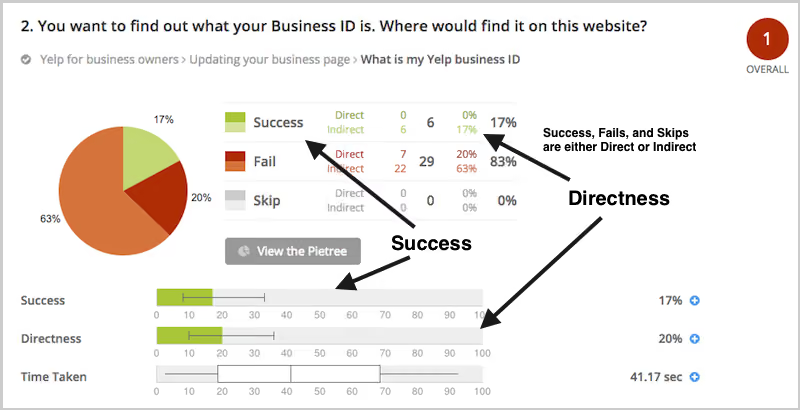
To illustrate this, have a look at the results for one task. The overall Task result, you see a score for success and directness, and a breakdown of whether each Success, Fail, or Skip was direct (they went straight to an answer), or indirect (they went back up the tree before they selected an answer):
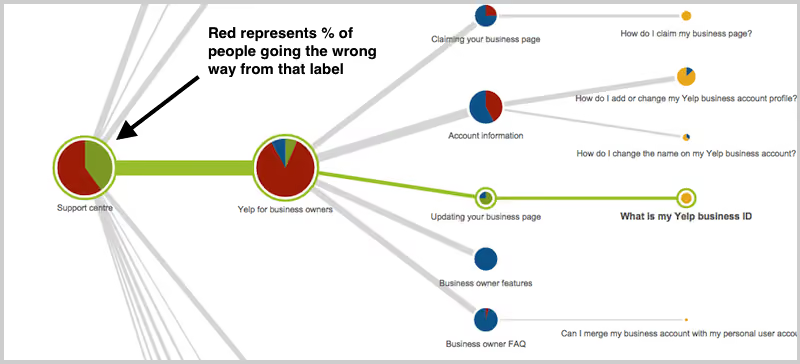
In the pie tree for the same task, you can look in more detail at how many people went the wrong way from a label (each label representing one page of your website):
In the First Click tab, you get a percentage breakdown of which label people clicked first to complete the task:
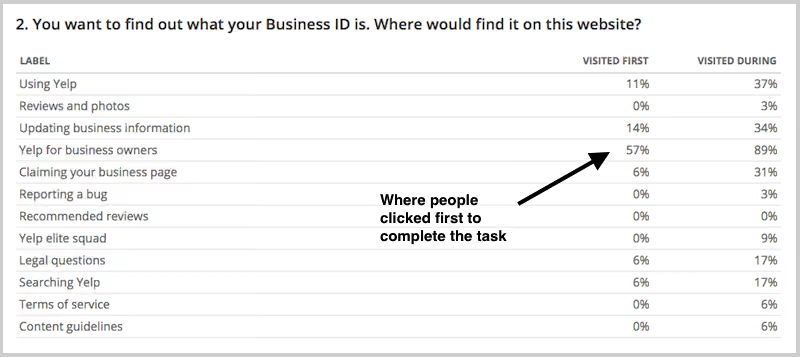
And in the Paths tab, you can view individual participant paths in detail (including first clicks), and can filter the table by direct and indirect success, fails, and skips (this table is only displaying direct success and direct fail paths):
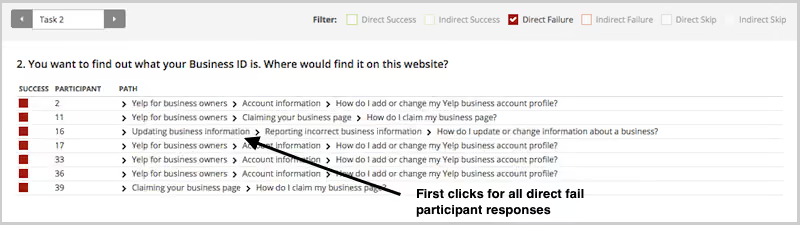
First click analysis is one of the most predictive metrics in usability testing. Whether you're testing wireframes, landing pages, or information architecture, measuring first click success gives you early insight into whether your design will work.
This analysis reinforces something we already knew: first clicks matter. It is worth your time to get that first impression right. You have plenty of options for measuring the link between first clicks and task success in your scenario-based usability tests. From simply noting where your participants go during observations, to gathering quantitative first click data via online tools, you'll win either way. And if you want quantitative first click data, Optimal has you covered. First Click Testing works for wireframes and landing pages, while Tree Testing validates your information architecture.
To finish, here are a few invaluable insights from other researchers on getting the most from first click testing:
About this study
This analysis was conducted in 2015 using millions of task responses from Optimal’s First Click and Tree Testing tools. While the dataset predates recent UI trends, the underlying behavioral principle, that a correct first click strongly predicts task success, remains consistent with modern usability research.
Wynyard Group is a market leader in risk management and crime fighting software used in investigations and intelligence operations by government agencies and financial crime organisations. Wynyard Group has recently joined the journey to incorporate a User Experience (UX) team into their family.
One of our first steps towards UX integration was to create a style guide that our web developers and UX designers can look to for styling, components and patterns. Our purpose was twofold: to help them create high-quality products that are visually and behaviourally consistent. And to free them up to focus on workflow, information architecture, and interaction design elements of the whole rather than the styling of individual parts.
Wynyard currently uses Confluence as an internal wiki for information, so we added a section to it called 'User Experience' which included the subsections 'User Experience Tools' and 'Style Guide'. It then occurred to us that how we group and arrange elements of our style guide might be (probably will be) completely different to our web developers. Thus, we decided to run a card sort to make sure our style guide meets the needs of the audience. And because we're always looking for a chance to test out new technologies, our journey into card sorting with OptimalSort began.
A great idea when starting up new testing projects is to go back to the basics. I’d heard of card sorts before but had never been directly involved in one. So I hit the books, and in particular, Donna Spencer’s book Card Sorting: Designing Usable Categories. After reading through this and researching a few tools we came across OptimalSort. Our developers were spread across Christchurch and Auckland, so having an online tool was definitely a requirement. Having tested it out, I found it was very quick, easy, and customisable. I was sold.
To pick our card sort participants, I went to our internal message board (Yammer) and looked at the members of our Engineering Guild — Web Guild. We had 50 members at the time, but this included a mix of marketers, UX designers, architects, front and back-end developers, and anyone else who was interested in the messages being posted up for this group. Of this I took a subset of 20 that were most likely to be involved in implementing our designs. So I recruited the people that would be taking our wireframes or prototypes and integrating them into current products or new products.
I kicked the process off by creating a card sort that I could test on colleagues to get feedback before I opened it up to our main participants. Some of the cards tested well, while others were a little confusing, and feedback was given. The bonus about this was that while they were completing the test online, I was able to stand in the room and watch, asking and answering questions around the cards.
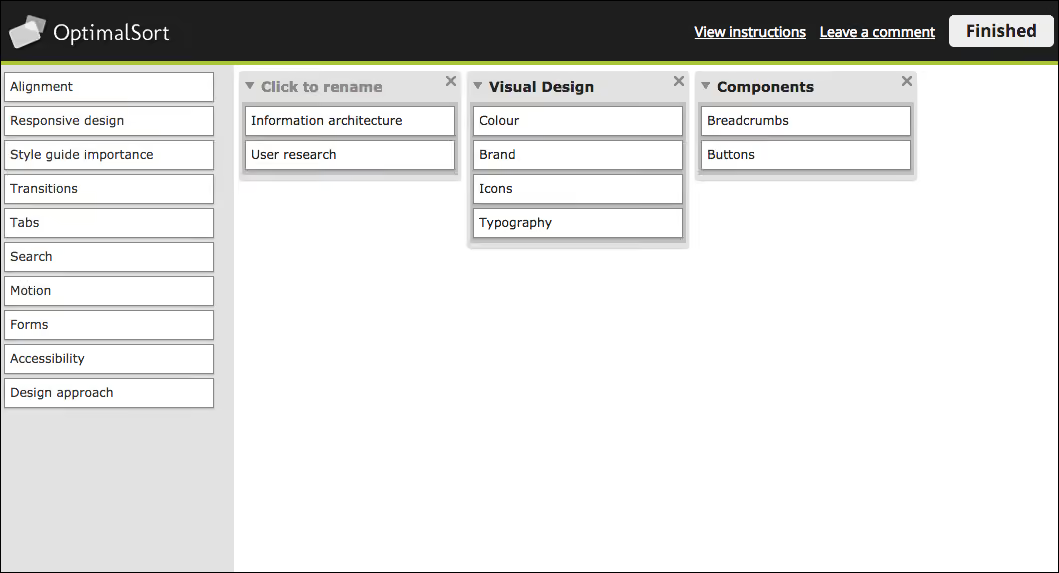
As with most things you try for the first time, my sort wasn’t ready. One point that came out quite quickly was that I had combined some cards that were process, such as Information Architecture and User Research, and others that could be explored through workplace education (style guide importance). Therefore, I could remove these as they clouded the areas that I wanted participants to group around.
I made changes to the cards based on the feedback I received, and decided to go with a very simple approach with a limited amount of cards. This was because our participants hadn’t completed a card sort before, the card concepts may have been relatively new, and I wanted to see if we got any convergence to start off with. It was also a double check to see if I had created the correct cards. So, my first official card sort looked like this:
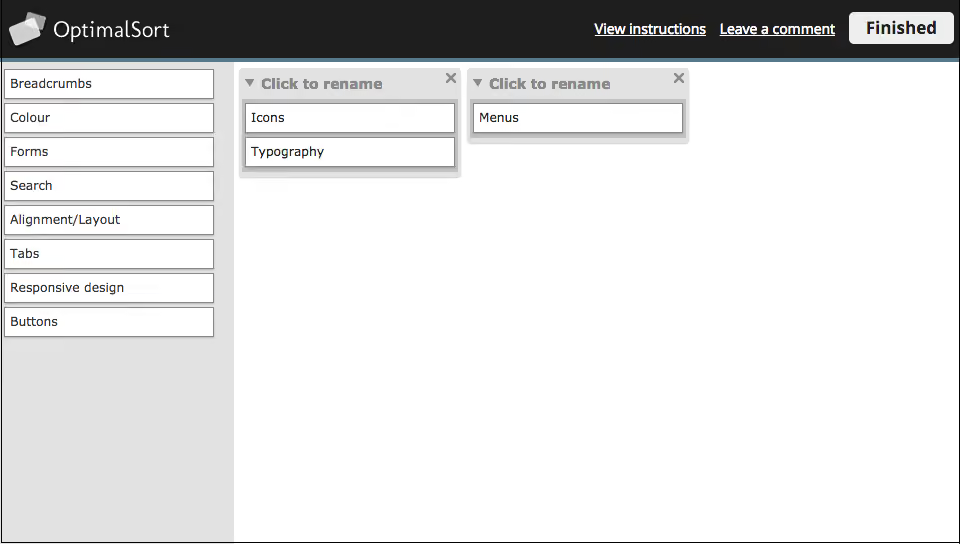
I published the sort, and emailed the link with an explanation out to our participants. And the results were … not what we had expected. To come up with this sort, I had ideated around base groups such as visual design, patterns, components and layout, then created cards to go under those categories. I was expecting very similar groupings and even category names to what I had come up with, but this was not quite the case.
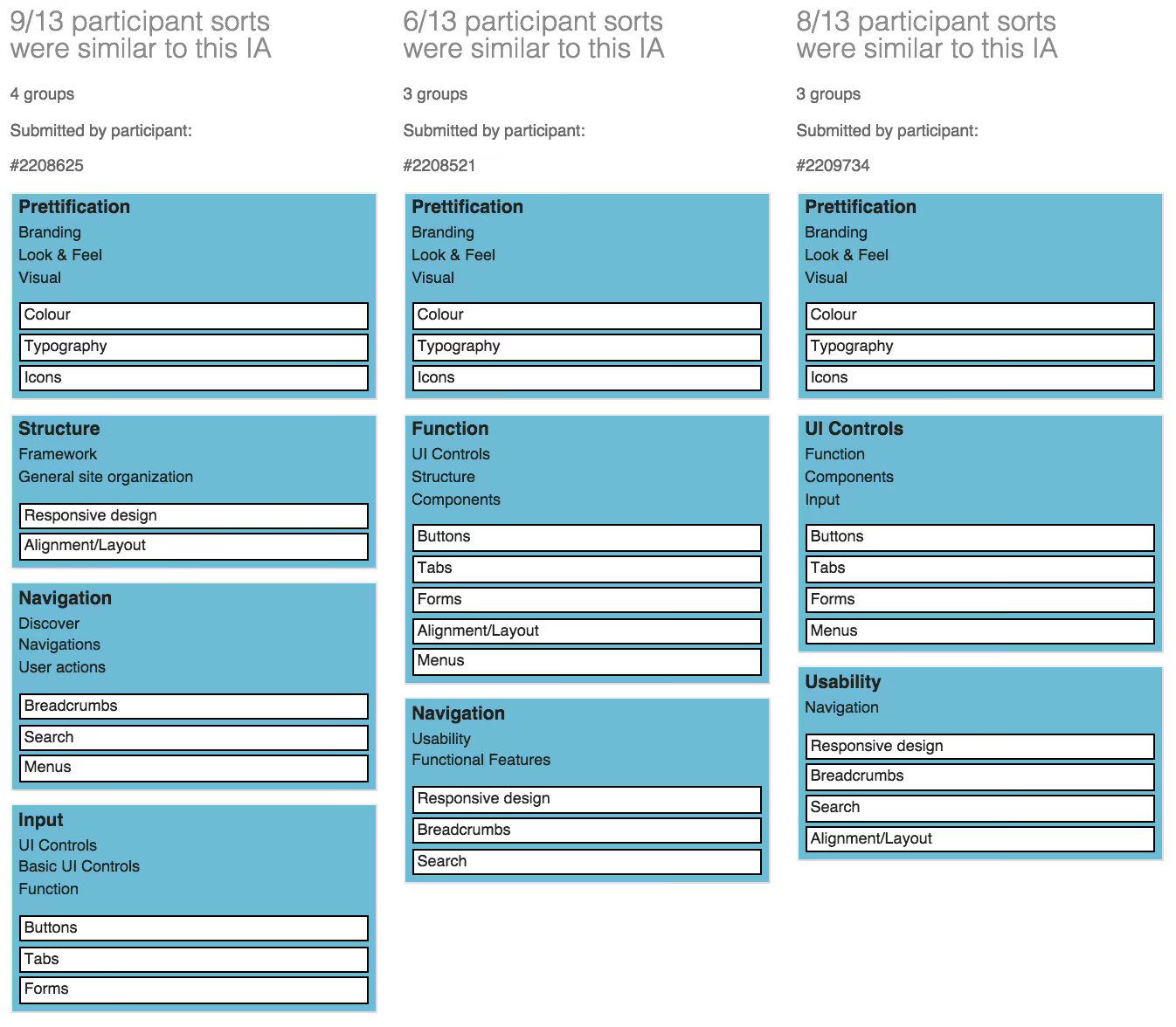
OptimalSort has some really good analysis tools that let you get into more detail behind how the participants grouped the cards. The two tools that we focused on were Participant-Centric Analysis (PCA), and the Similarity Matrix.This is the PCA, which displays common grouping among all participants, and some of the different labels.
And here's the Similarity Matrix:
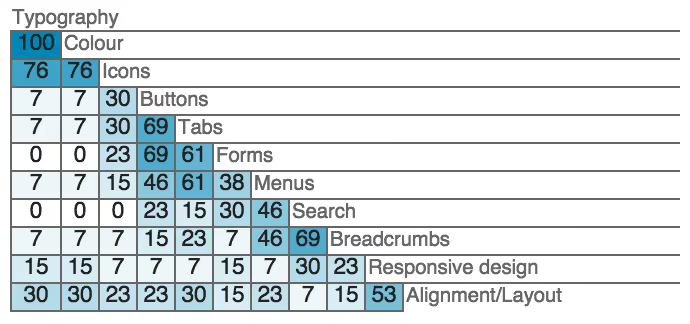
Overall we had 16 responses, with 4 abandoned. We ended up including 2 of the abandoned results as they were fully complete but were not submitted. So all together that made for 12 participants from our web development team.From these we re-grouped and discussed the results. The first word to jump out was 'Prettification'.
Although this was the main grouping across participants, we decided to use 'Look & Feel' as we felt it connected more with our goals. We also didn’t want to associate visual design with the limitations of prettification, as it is much more than that. It was interesting to see that the cards tended to be grouped by overarching concepts of what the cards were used for (such as 'Navigation'), although more specific concepts such as 'Components' were used. The groupings were a cross between what we would have done in User Experience, and what the developers would call things.
Then we decided to run a closed card sort. We decided to add more cards to see if there was convergence towards the categories they had made, and whether people could group what we believed were easier (ie. Buttons) versus the more difficult (ie Search) cards.
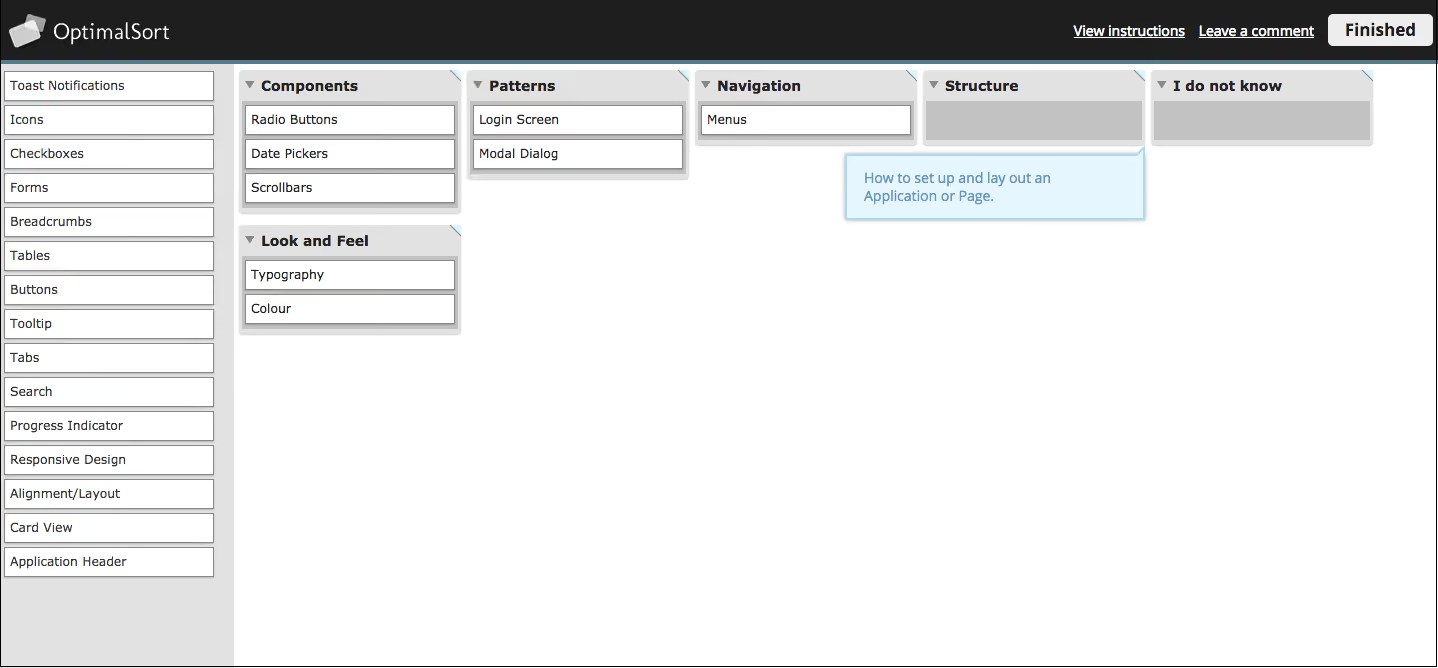
Most of the categories were taken from the results of the previous card sort, but patterns for us were also a very important concept that we wanted to include. By including definitions, we wanted to see if these group concepts were understandable:
The closed sort ended up with 10 completed responses and 4 abandoned. Below is a Popular Placement Matrix. It let us see very clearly where cards had been grouped, and the level of uncertainty around each.
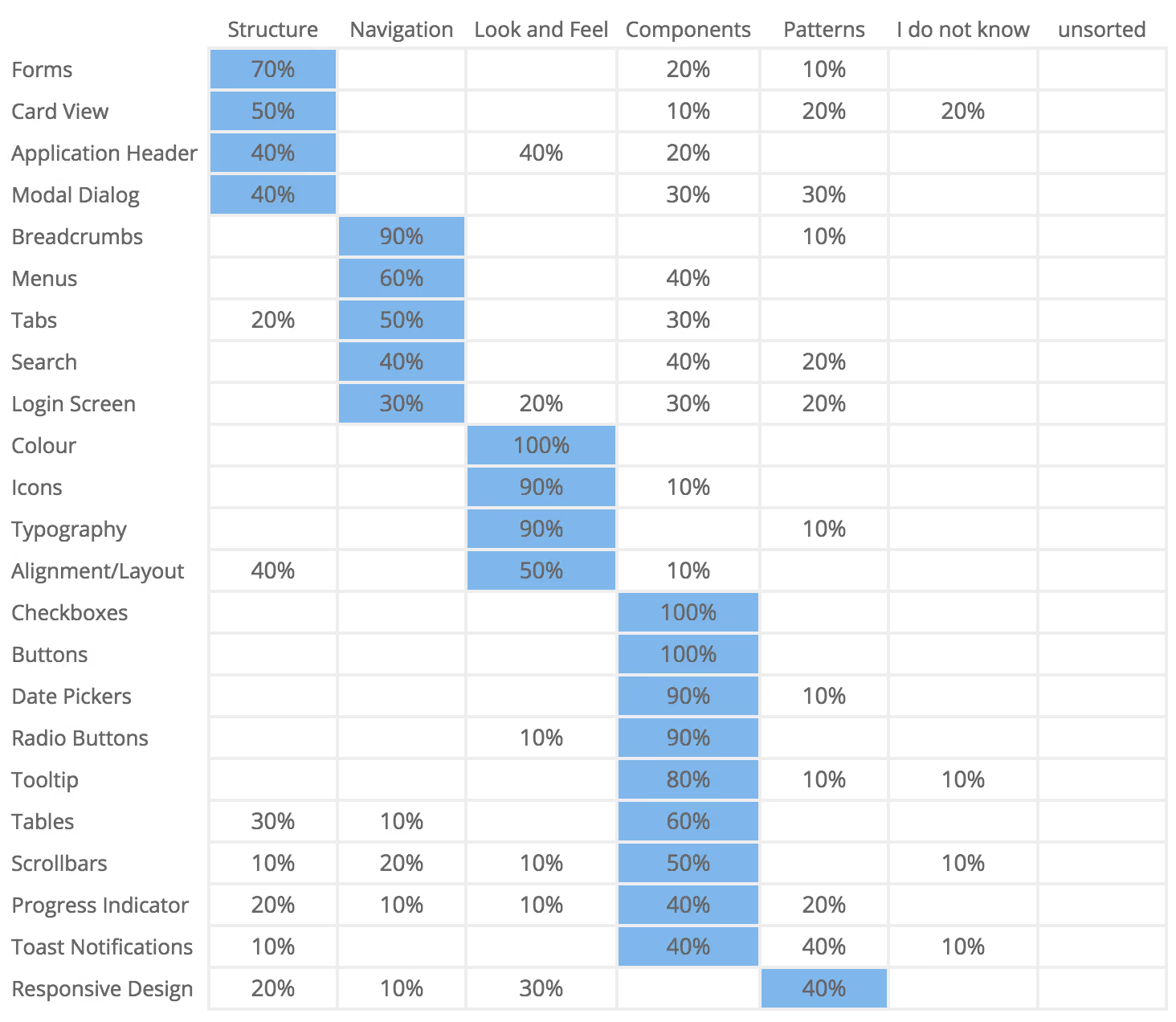
Our participants were relatively clear around what could be grouped under 'Components', such as Checkboxes (100%), and Buttons (100%). They also had high placement confidence around 'Look & Feel', such as Colour (100%), Icons and Typography (90%). The more complicated concept of Responsive Design, which we viewed as a more difficult card to sort, had a fairly even split leaning towards patterns.Some interesting points to note include that 40% thought that Search was part of 'Navigation', or 'Components', and only 20% thought it was a 'Pattern' (which is where we placed it).
The link to navigation could be because people associate search with navigation when they can’t find what they are looking for, or the information architecture has failed. It was also good to note that a majority of the cards were sorted into groups, instead of going into the 'I don’t know' category.Below is a Results Matrix which clearly shows how often cards were sorted into each category.
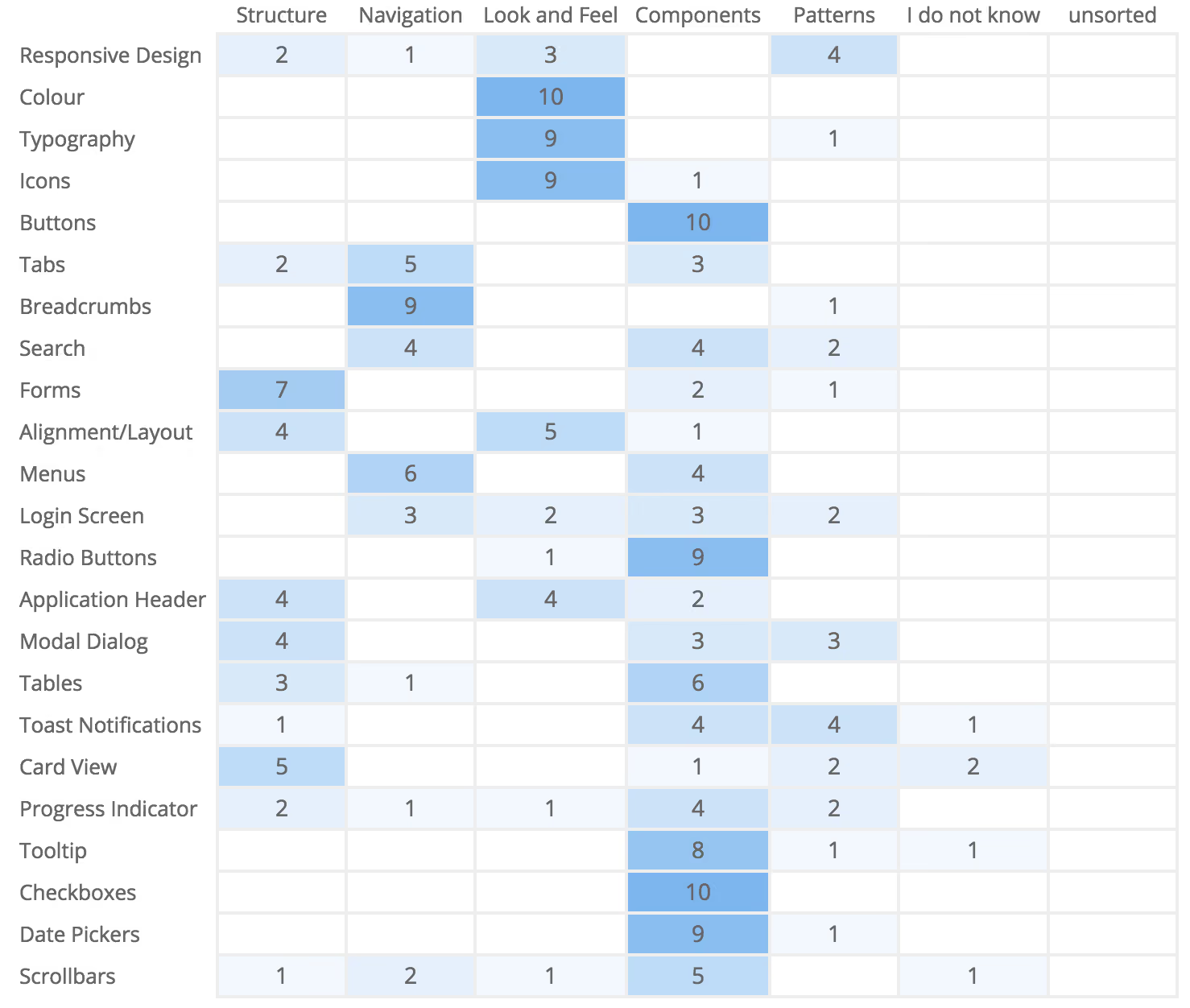
The Results Matrix also shows high confidence around the placement of components and visual elements. This gave us relatively good confidence that if we had an area called 'Visual Design - Look & Feel', and 'Components', our web developers would know what they might find within it. But we also had to acknowledge the uncertainty around some of the cards, shown by the low scores across a range of groups. We decided that 'Structure' was too complicated a concept, as some of the things that had been put under there were patterns, and there didn’t seem to be high confidence around placing cards in this category (other than forms). 'Patterns' was also not well understood, which validated the need to have workplace education and advocacy around them to raise awareness, as they were a grouping we wanted to keep.Overall we had some strong groupings, and some that would need changing or updating, and some that would involve further research and learning.
Overall the card sort was a great learning experience because it cemented the fact that our UX designers and our web developers have a crossover of terminology, but we also have differences. To get the best of both worlds, and to be able to present consistent groupings, we will have a mix from both, where some will require more description and learning than others.
Next steps when we pick up the style guide again will be to present what we have done internally to increase understanding. Then, depending on our direction, we'll run a tree test using Treejack to find out how our style guide structure is working, and if the same people can easily find what they are looking for.
Tweak, test, rinse and repeat.

“If storymapping could unearth patterns and bring together a cohesive story that engages audiences in the world of entertainment and film, why couldn’t we use a similar approach to engage our audiences?’Donna Lichaw and Lis Hubert
User Experience work makes the most sense to me in the context of storytelling. So when I saw Donna Lichaw and Lis Hubert’s presentation on storymapping at edUi recently, it resonated. A user’s path through a website can be likened to the traditional storytelling structure of crisis or conflict, exposition — and even a climax or two.
So just how can the same structure that suits fairytales help us to design a compelling experience for our customers? Well, storyboarding is an obvious example of how UX design and storytelling mesh. A traditional storyboard for a movie or TV episode lays out sequential images to help visualize what the final production will show. Similarly, we map out users' needs and journeys via wireframes, sketches, and journey maps, all the while picturing how people will actually interact with the product.
But the connection between storytelling and the user experience design process goes even deeper than that. Every time a user interacts with our website or product, we get to tell them a story. And a traditional literary storytelling structure maps fairly well to just how users interact with the digital stories we’re telling.Hence Donna and Lis’ conception of storymapping as ‘a diagram that maps out a story using a traditional narrative structure called a narrative arc.’ They concede that while ‘using stories in UX design...is nothing new’, a ‘narrative-arc diagram could also help us to rapidly assess content strengths, weaknesses, and opportunities.’
The edUi conference in Richmond, Virginia brought together an assembly of people who produce websites or web content for large institutions. I met people from libraries, universities, museums, various levels of government, and many other places. The theme of storytelling was present throughout, both explicitly and implicitly.Keynote speaker Matt Novak from Paleofuture talked about how futurists of the past tried to predict the future, and what we can learn from the stories they told. Matthew Edgar discussed what stories our failed content tell — what story does a 404 page tell? Or a page telling users they have zero search results? Two great presentations that got me thinking about storytelling in a different way.
Ultimately, it all clicked for me when I attended Donna and Lis’ presentation ‘Storymapping: A Macguyver Approach to Content Strategy’ (and yes, it was as compelling as the title suggests). They presented a case study of how they applied a traditional narrative structure to a website redesign process. The basic story structure we all learned in school usually includes a pretty standard list of elements. Donna and Lis had tweaked the definitions a bit, and applied them to the process of how users interact with web content.
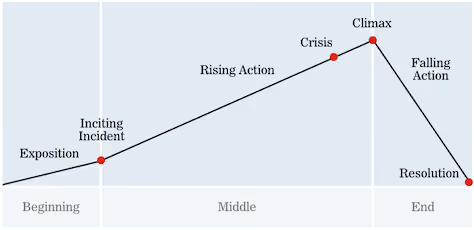
Donna and Lis pointed out that in the context of doing content strategy work, the inciting incident could be the problem that kicks off a development process. I think it can also be the need that brings users to a website to begin with.
Here I think the analogy is a little looser. While a story can sometimes be well-served by a long and winding rising action, it’s best to keep this part of the process a bit more straightforward in web work. If there’s too much opportunity for wandering, users may get lost or never come back.
The crisis is what leads users to your site in the first place — a problem to solve, an answer to find, a purchase to make. And to me the climax sounds like the aha! moment that we all aspire to provide, when the user answers their question, makes a purchase, or otherwise feels satisfied from using the site. If a user never gets to this point, their story just peters out unresolved. They’re forced to either begin the entire process again on your site (now feeling frustrated, no doubt), or turn to a competitor.
A confirmation of purchase is sent, or maybe the user signs up for a newsletter.
The user goes away with a hopefully positive experience, having been able to meet their information or product needs. If we’re lucky, they spread the word to others!Check out Part 2 of Donna and Lis' three-part article on storymapping. I definitely recommend exploring their ideas in more depth, and having a go at mapping your own UX projects to the above structure.
A word about crises. The idea of a ‘crisis’ is at the heart of the narrative arc. As we know from watching films and reading novels, the main character always has a problem to overcome. So crisis and conflict show up a few times through this process.While the word ‘crisis’ carries some negative connotations (and that clearly applies to visiting a terribly designed site!), I think it can be viewed more generally when we apply the term to user experience. Did your user have a crisis that brought them to your site? What are they trying to resolve by visiting it? Their central purpose can be the crisis that gives rise to all the other parts of their story.
Mapping a user interaction along the narrative arc makes it easy to spot potential points of frustration, and also serves to keep the inciting incident or fundamental user need in the forefront of our thinking. Those points of frustration and interaction are natural fits for testing and further development.
For example, if your site has a low conversion rate, that translates to users never hitting the climactic point of their story. It might be helpful to look at their interactions from the earlier phases of their story before they get to the climax. Maybe your site doesn’t clearly establish its reason for existing (exposition), or it might be too hard for users to search and explore your content (rising action).Guiding the user through each phase of the structure described above makes it more difficult to skip an important part of how our content is found and used.
We can ask questions like:
These questions bring up great objectives for qualitative testing — sitting down with a user and asking them to show us their story.
Many sessions at edUi also touched on analytics or user testing. In crafting a new story, we can’t ignore what’s already in place — especially if some of it is appreciated by users. So before we can start storymapping the user journey, we need to analyze our site analytics, and run quantitative and qualitative user tests. This user research will give us insights into what story we’re already telling (whether it’s on purpose or not).
What’s working about the narrative, and what isn’t? Even if a project is starting from scratch on a new site, your potential visitors will bring stories of their own. It might be useful to check stats to see if users leave early on in the process, during the exposition phase. A high bounce rate might mean a page doesn't supply that expositional content in a way that's clear and engaging to encourage further interaction.Looking at analytics and user testing data can be like a movie's trial advance screening — you can establish how the audience/users actually want to experience the site's content.
Since I returned from edUi, I've been thinking about the narrative structure constantly. I find it helps me frame user interactions in a new way, and I've already spotted gaps in storytelling that can be easily filled in. My attention instantly went to the many forms on our site. What’s the Rising Action like at that point? Streamlining our forms and using friendly language can help keep the user’s story focused and moving forward toward clicking that submit button as a climax.
I’m also trying to remember that every user is the protagonist of their own story, and that what works for one narrative might not work for another. I’d like to experiment with ways to provide different kinds of exposition to different users. I think it’s possible to balance telling multiple stories on one site, but maybe it’s not the best idea to mix exposition for multiple stories on the same page.And I also wonder if we could provide cues to a user that direct them to exposition for their own inciting incident...a topic for another article perhaps.What stories are you telling your users? Do they follow a clear arc, or are there rough transitions? These are great questions to ask yourself as you design experiences and analyze existing ones. The edUi conference was a great opportunity to investigate these ideas, and I can’t wait to return next year.
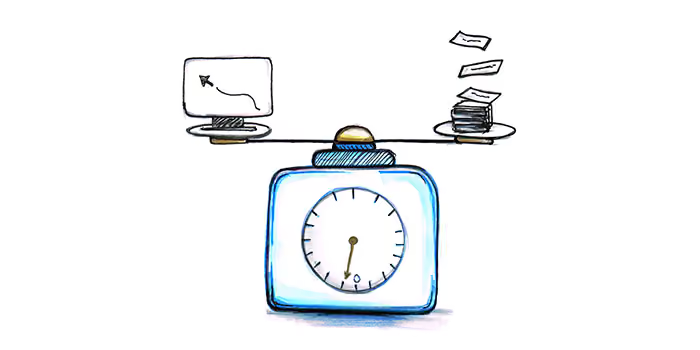
Have you ever suggested doing an online card sort and been told no 'because the conversation in the room is the most valuable part of a card sort'? I have.
Repeatedly.
I decided it was time someone actually tested that theory. So when the opportunity came up at work, I jumped on the chance to run this experiment. My research task was to determine the information architecture (IA) for a business line’s area of the workplace intranet. I ran an A/B test with five face-to-face moderated card sorts, each with 2-3 users, and I ran twenty-five online card sorts using OptimalSort. I chose OptimalSort because I’d never used it before, and since I enjoyed using Treejack so much I thought I’d try it out. There were forty-five cards in total. I conducted both tests using only the resources available, mostly of the human variety.
In this piece, I examine the benefits and challenges of both techniques.
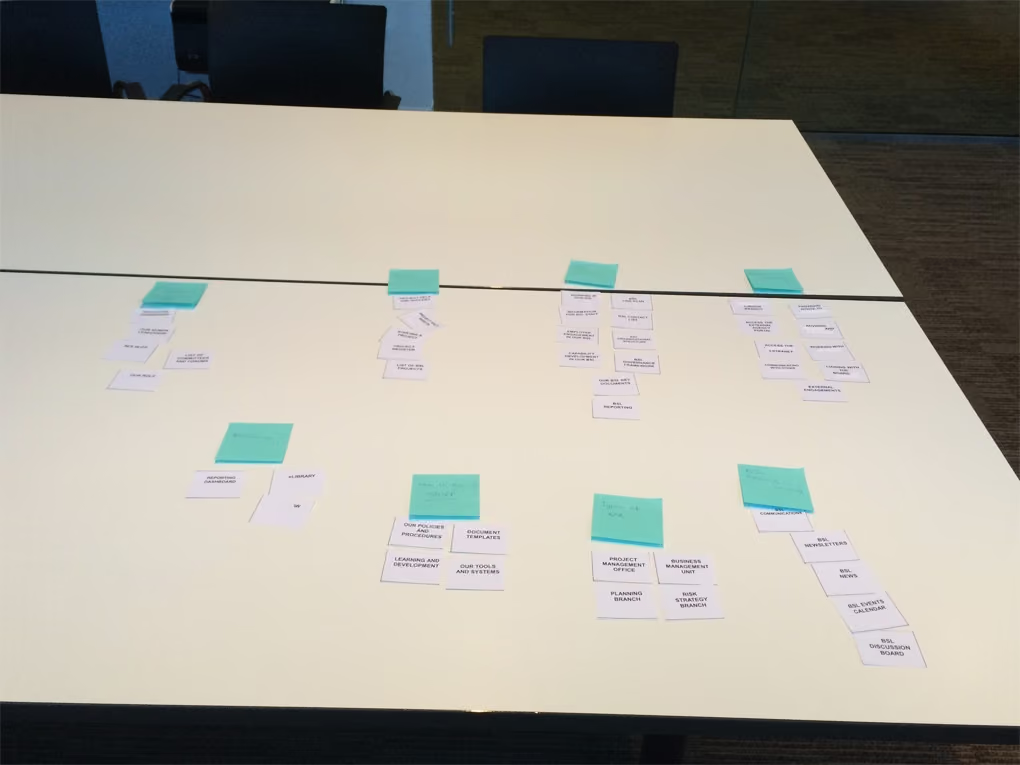
I love meeting users. It reminds me of why I do what I do and motivates me to continuously improve.
All five groups of 2-3 people worked well together and nobody had any reservations about sharing their thoughts. Each session was productive. I listened carefully and asked questions to help me understand why decisions were being made.
Working with paper. There’s something satisfying about moving pieces of paper around on a table and being able to cross things out and add new cards. The overall picture is so much clearer when the cards are all spread out in front of you. Users are more inclined to criticise the work at this early stage when it’s on paper and looks unresolved. It’s also inexpensive. Moderated card sorts allow you to spread all the cards out on the table in front of you and narrow it down from there.
Recruiting and organising users for the face to face card sort sessions took almost three days to complete! It was not easy trying to organise fifteen people into groups of three let alone book session times that everyone could agree upon! Even after all that, a few of the sessions still had no shows. I can forgive people their busy lives, but it’s still frustrating.
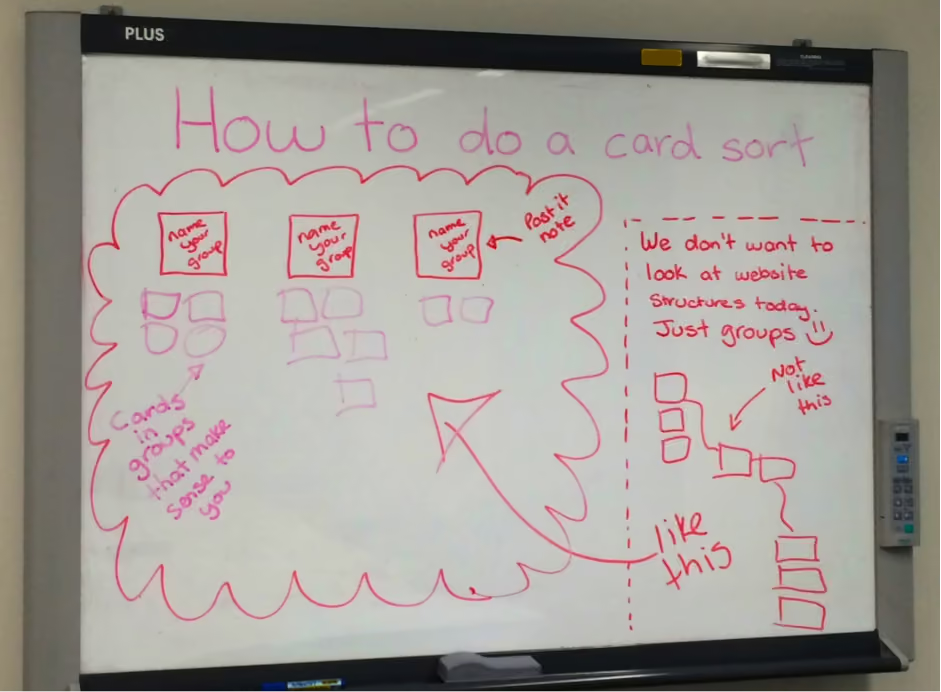
No matter how carefully and patiently I explained to the users that we were just grouping like things together, many felt the need to construct a tree structure. I chose to run this study with a flat hierarchy, for the purposes of understanding what belongs together and how users would name each high level group of information. It’s like as soon as users hear the word ‘website’ they have trouble detaching from what they know. Ultimately I solved this problem by sketching instructions on the whiteboard for each session. This gave users something visual to refer to and kept them focussed on what we all needed to achieve during the session.
I would have loved to have tried the moderated card sort the OptimalSort way with the barcode scanner, but unfortunately I just didn’t have access to one. As a result of this, I had to manually input the cards retrospectively from the moderated sorts into OptimalSort to take advantage of the amazing results graphs. That took a few hours. I know you can pick them up pretty cheap, so I’ll be prepared for next time.
This study received really positive comments from users that showed that they liked the activity were well and truly on board with the coming changes. Presenting positive feedback to executive staff is pretty powerful.
— 'This was an interesting exercise, thanks! I'm glad I got to do this individually via the online approach, rather than having to discuss it in a group: I much prefer solo activities to group ones, as it usually takes less time.'— 'Logical grouping is extremely important in finding information. I'm pleased you are looking at this.'
While it is entertaining to refresh the browser every five seconds to see if it has changed, OptimalSort really does take care of itself. The provided instructions are very useful and I did not receive a single phone call or email asking for help. This gave me time to start putting together the report and work on other projects, which saved both time and money.
You really can’t go past the beautiful yet useful way OptimalSort presents the results. These are charts that carry serious thud value when presented to management or executives because they back up your findings with actual numbers. The charts also make it incredibly easy to interpret the results and start iterating the next phase of the design. My personal favourite is the PCA (Participant-Centric Analysis) tab on the results dashboard. It provides advice on what you could do next when building your IA.
Basically, if OptimalSort had to pick a winning user submission, the first one would be it. It makes taking the next step in the design process that much easier.
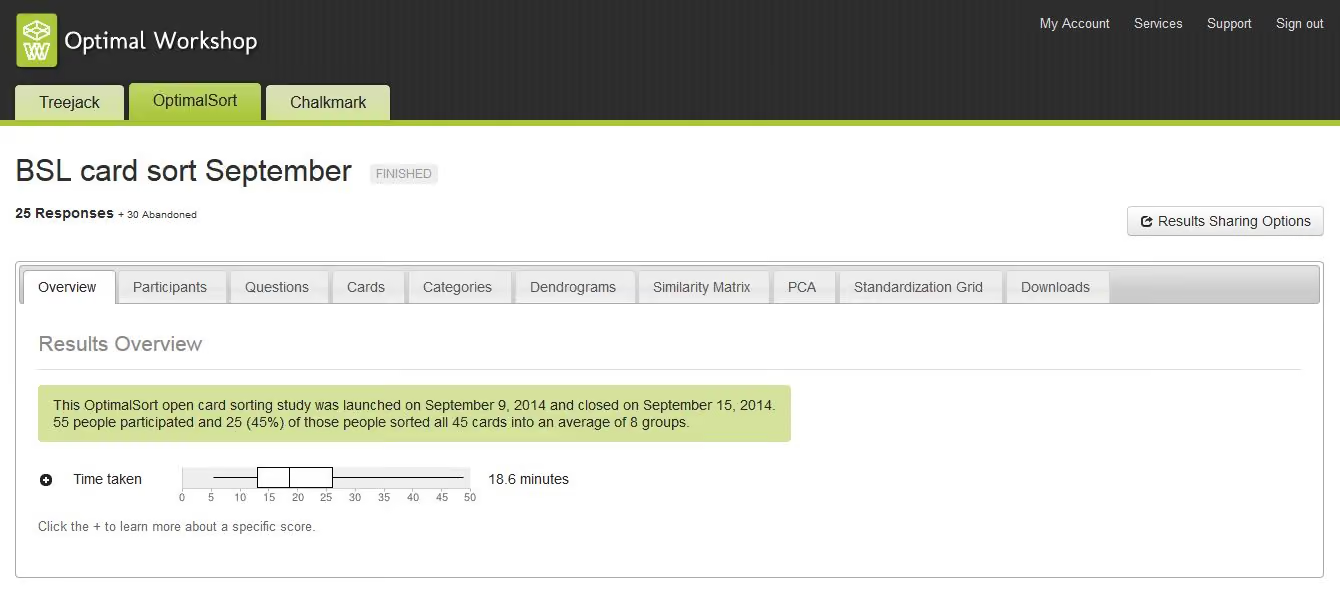
This study closed after one week with twenty-five completed responses and thirty abandoned responses. This is quite high; however I honestly don’t believe the tool itself to be the culprit. Of the thirty abandoned responses received, twenty-one of those participants ended the activity having sorted less than 5% of the cards. Of that number, twelve participants ended the task not having sorted any cards at all. This tells me that they may have been overwhelmed by the size of the task and felt unable to complete it, especially since they were at work after all and had competing priorities. Drawing on this experience, next time I will keep the survey short and sweet to avoid overwhelming the user.
I have a rule around online testing activities. All recorded responses are anonymous — even from me. I do this because I want users to feel comfortable and be willing to participate in future testing activities. I also feel that it preserves the integrity of the results and doesn’t allow for assumptions to come into play. Because of this, I don’t know who responded with what and I can’t ask questions if I’m not clear on something. Had I included some targeted post survey questions, this issue would have been avoided.
I always try to use softer colours to avoid scaring people on the opening screen, but you have to be careful with this one. The background colour is [Ed: was!] also the colour of the submit button on the card sorting screen and it appears against a black background. Choosing a colour that looks nice on your opening screen will not do you any favours when that same colour appears on the submit button and does not contrast well against the black background. Beyond the obvious accessibility issue, you also risk committing the crime of playing ‘Where’s Wally?’ with the user when they can’t find the button!This challenge does however have a happy ending. I mentioned this issue to Optimal Workshop and they fixed it! How awesome is that?!
They complemented each other! Despite the differences in delivery methods, both sets of card sort results told a similar story and each enriched the overall picture. There were no show-stopping differences or contradictions between the two. The themes of comments left in the online version also matched those overheard during the conversations in the moderated sorts.
— 'I was unsure what a couple of these actually meant; I would rename them to make their meaning explicit.' Comment left by a user from the online card sort— 'There’s too much jargon! Make it real and use language that people understand.' Comment made by a user during a moderated card sort
The biggest finding overall was that the user was grouping content by keywords and task related subjects. Not entirely groundbreaking information on its own, however it does break the current model which groups content by organisational structure and product owner. This study indicated that the users don’t see the organisational structure; they just want to solve a problem or find information without having to think about where it lives or who owns it. This research is valuable because we can now back up our design decisions with evidence. We can use this information to construct an IA that will actually work. It has also provided insights into user workflows and their understanding of the organisation as a whole.So, there you have it: mystery solved! But which card sorting activity wins?
Conduct a moderated card sort the OptimalSort way! This study has shown that on their own, moderated card sorts and online card sorts are both valuable in their own way. When combined, they join forces to create a powerful hybrid and it’s really easy to do. You still type your card labels into OptimalSort, but the difference is you print them out and each card has a barcode on it. The next step is to run your moderated card sort as you normally would. Then using a common barcode scanner, you would scan the cards back into OptimalSort and reap all the benefits of the result graphs and analysis tools. This approach gives you the qualitative face time with your users and the quantitative results to back up your thinking.
I really enjoyed running this experiment and I’m huge fan of A/B testing. I would love to hear your thoughts, and look forward to sharing my next discovery with you.

About six months ago, I came across aninteresting question on Stack Exchange headlined 'Should you concede to user demands that are clearly inferior?' It stuck in my mind because the question in itself is complex, and contains a few complicated assumptions.
In the world of user experience research and design, the users needs and wants are paramount. Dollars and hours are spent poring through data and interviewing and collating information into a cohesive explanation of what works and what doesn't for users. Designs are based on how users intuitively interact with products and websites. Organisations respond to suggestions that come through on support and on Twitter, and if a significant numbers of users want a particular change, chances are those organisations will act. But the question itself throws this most sacred of stances up in the air, because it contains the phrase 'user demands that are clearly inferior'. Now, that is a loaded statement.
I imagine it's sometimes hard for designers to get rid of the feeling that they know best. As a writer, I know what I like and don't like. I 'know' good writing from bad, and I have strong opinions about books and articles that aren't worth the pages or bandwidth it takes to publish them. But this stance often puts me in conflict with the huge amount of empirical evidence that certain writing I disdain is actually 'good': and that evidence is readers. For Fifty Shades of Lame, it's millions of them. Aggghh!
In the same way, I've never met a designer who didn't have strong opinions about what they adore and deplore in their own art forms. And I wonder how tough it sometimes is to implement changes that to a designers mind make no sense. Do any of you UX designers out there ever secretly think, when you discover what users are asking for, 'these people have no taste, they don't know what they want, how ridiculous!'? Is there a secret current of despair and frustration at user ignorance running deep and unspoken through the river of design?
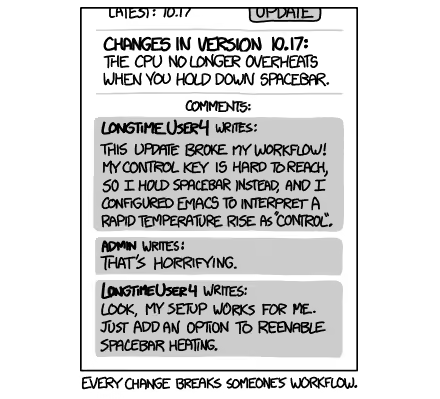
On Stack Exchange, Matt described how he and his team implemented a single tree view (75 items) with a scroll wheel, and because it was an internalchange,they were able to get quick feedback from existing users. The feedback wasn't positive, and many people wanted the change to be reversed. He explains: ‘To my mind, the way we redeveloped it is unambiguously better. But the user base was equally emphatic in rejecting it. So today, to the complaints of my fellow team members, I removed our new implementation and set it to work in the manner the users were used to.'
He then goes on to ask 'What was the right course of action here? Is there a point at which the user's fear of change becomes an important UX consideration in its own right?' The responses are varied and fascinating, and can be roughly broken into three camps:
One of the problems with the term 'User Experience' is the word 'user'. It's a depersonalised and generic way of describing who it is you're serving. Because there is a person at the heart of the enterprise who is trying to achieve something. They may not be trying to achieve what you expect them to. They certainly may not be trying to achieve what you want them to.
Context is everything.
Who is the person who is asking for a change, or asking for something to stay the same?We would argue that people aren't 'change-averse', but 'confusion/discomfort/inefficiency-averse' people want easier ways of doing things. So if by changing a feature you mess up a person's workflow, then potentially you didn't do your research.
If you look closely at the behavior of users — how people actually interact with a particular aspect of your design, rather than just hearing their opinions — then you'll be able to base your design on empirical evidence. So, we (roughly) come down on the side of the people who use the product. If they want to get something done, and they want to do that in a particular way, then they have right of way.
It's your job not to serve your tastes, but to give people the experience you promise them. And to the author of Fifty Shades of Grey, I say, 'Good on you EL James. You gave them what they wanted.'
What do you think?
Hi, I’m Martin. I work as a UX researcher at Trade Me having left Optimal Experience (Optimal Workshop's sister company) last year. For those of you who don’t know, Trade Me is New Zealand’s largest online auction site that also lists real estate to buy and rent, cars to buy, jobs listings, travel accommodation and quite a few other things besides. Over three quarters of the population are members and about three quarters of the Internet traffic for New Zealand sites goes to the sites we run.
Leaving a medium-sized consultancy and joining Trade Me has been a big change in many ways, but in others not so much, as I hadn’t expected to find myself operating in a small team of in-house consultants. The approach the team is taking is proving to be pretty effective, so I thought I’d share some of the details of the way we work with the readers of Optimal Workshop’s blog. Let me explain what I mean…
Over the last year or so, Trade Me has moved all of its development teams over to Agile following a model pioneered by Spotify. All of the software engineering parts of the business have been ‘squadified’. These people produce the websites & apps or provide and support the infrastructure that makes everything possible.Across Squads, there are common job roles in ‘Chapters’ (like designers or testers) and because people are not easy to force into boxes, and why should they be, there are interest groups called ‘Guilds’.The squads are self-organizing, running their own processes and procedures to get to where they need to. In practice, this means they use as many or as few of the Kanban, Scrum, and Rapid tools they find useful. Over time, we’ve seen that squads tend to follow similar practices as they learn from each other.
Our UX team of three sits outside the squads, but we work with them and with the product owners across the business.How does this work? It might seem counter-intuitive to have UX outside of the tightly-integrated, highly-focused squads, sometimes working with product owners working on stuff that might have little to do with what’s being currently developed in the squads. This comes down to the way Trade Me divides down the UX responsibilities within the organization. Within each squad there is a designer. He or she is responsible for how that feature or app looks, and, more importantly, how it acts — interaction design as well as visual design.Then what do we do, if we are the UX team?
By conducting research with Trade Me’s users we can validate the squads’ day-to-day decisions, and help frame decisions on future plans. We do this by wearing two hats. Wearing the pointy hats of structured, detailed researchers, we look into long-term trends: the detailed behaviours and goals of our different audiences. We’ve conducted lots of one-on-one interviews with hundreds of people, including top sellers, motor parts buyers, and job seekers, as well as running surveys, focus groups and user testing sessions of future-looking prototypes. For example, we recently spent time with a number of buyers and sellers, seeking to understand their motivations and getting under their skin to find out how they perceive Trade Me.
This kind of research enables Trade Me to anticipate and respond to changes in user perception and satisfaction.Swapping hats to an agile beanie (and stretching the metaphor to breaking point), we react to the medium-term, short-term and very short-term needs of the squads testing their ideas, near-finished work and finished work with users, as well as sometimes simply answering questions and providing opinion, based upon our research. Sometimes this means that we can be testing something in the afternoon having only heard we are needed in the morning. This might sound impossible to accommodate, but the pace of change at Trade Me is such that stuff is getting deployed pretty much every day, many of which affects our users directly. It’s our job to ensure that we support our colleagues to do the very best we can for our users.
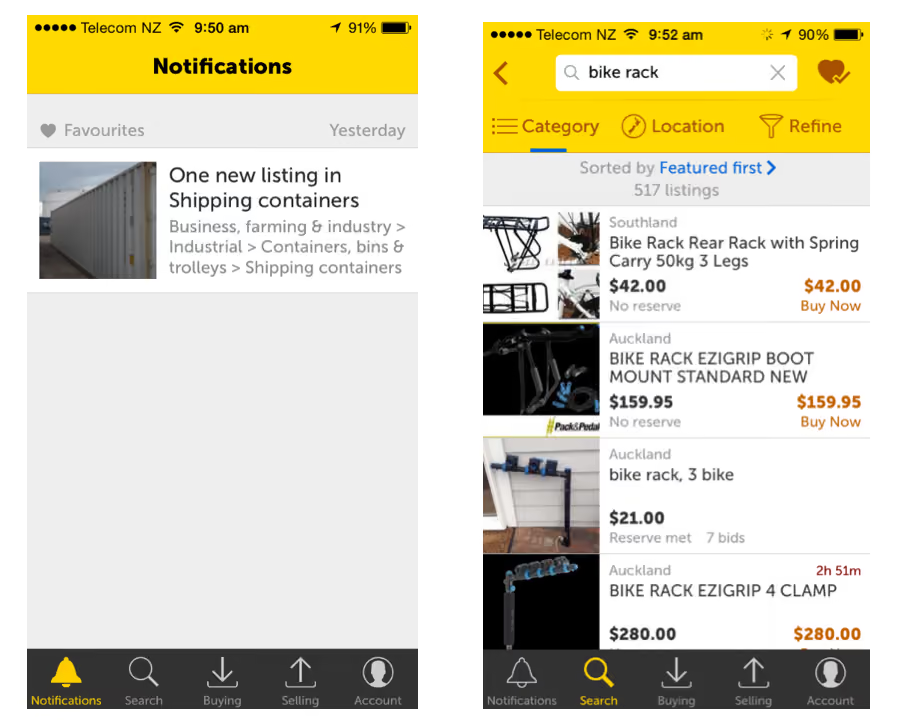
We recently conducted five or six rounds (no one can quite remember, we did it so quickly) of testing of our new iPhone application (pictured above) — sometimes testing more than one version at a time. The development team would receive our feedback face-to-face, make changes and we’d be testing the next version of the app the same or the next day. It’s only by doing this that we can ensure that Trade Me members will see positive changes happening daily rather than monthly.
To help us try to decide what we should be doing at any one time we have some simple rules to prioritise:
Applying these rules to any situation makes the decision whether to jump in and help pretty easy.At any one time, each of us in the UX team will have one or more long-term projects, some medium-term projects, and either some short-term projects or the capacity for some short-term projects (usually achieved by putting aside a long-term project for a moment).
We manage our time and projects on Trello, where we can see at a glance what’s happening this and next week, and what we’ve caught sniff of in the wind that might be coming up, or definitely is coming up.On the whole, both we and the squads favour fast response, bulleted list, email ‘reports’ for any short-term requests for user testing. We get a report out within four hours of testing (usually well within that). After all, the squads are working in short sprints, and our involvement is often at the sharp end where delays are not welcome. Most people aren’t going to read past the management summary anyway, so why not just write that, unless you have to?
Even though we mainly keep our reporting brief, we want the knowledge we’ve gained from working with each squad or on each product to be available to everyone. So we maintain a wiki that contains summaries of what we did for each piece of work, why we did it and what we found. Detailed reports, if there are any, are attached. We also send all reports out to staff who’ve subscribed to the UX interest email group.
Finally, we send out a monthly email, which looks across a bunch of research we’ve conducted, both short and long-term, and draws conclusions from which our colleagues can learn. All of these latter activities contribute to one of our key objectives: making Trade Me an even more user-centred organization than it is.I’ve been with Trade Me for about six months and we’re constantly refining our UX practices, but so far it seems to be working very well.Right, I’d better go – I’ve just been told I’m user testing something pretty big tomorrow and I need to write a test script!
