Subscribe to OW blog for an instantly better inbox
Oops! Something went wrong while submitting the form.

Articles and Podcasts on Customer Service, AI and Automation, Product, and more
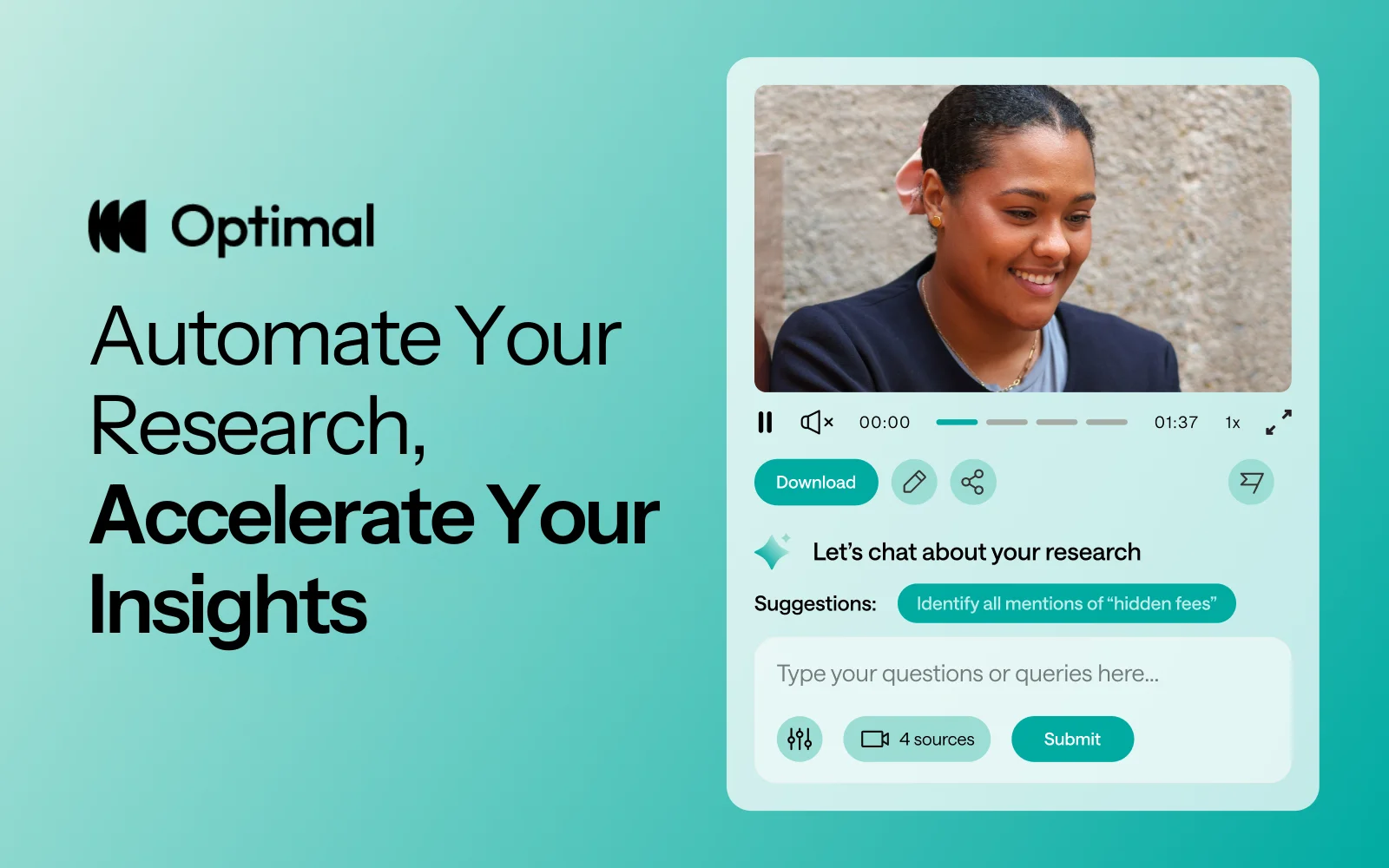
At Optimal, we know the reality of user research: you've just wrapped up a fantastic interview session, your head is buzzing with insights, and then... you're staring at hours of video footage that somehow needs to become actionable recommendations for your team.
User interviews and usability sessions are treasure troves of insight, but the reality is reviewing hours of raw footage can be time-consuming, tedious, and easy to overlook important details. Too often, valuable user stories never make it past the recording stage.
That's why we’re excited to announce the launch of Interviews, a brand-new tool that saves you time with AI and automation, turns real user moments into actionable recommendations, and provides the evidence you need to shape decisions, bring stakeholders on board, and inspire action.
We surveyed more than 100 researchers, designers, and product managers, conducted discovery interviews, tested prototypes, and ran feedback sessions to help guide the discovery and development of Optimal Interviews.
The result? What once took hours of video review now takes minutes. With Interviews, you get:
This tool is powered by AI designed for researchers, product owners, and designers. This isn’t just transcription or summarization, it’s intelligence tailored to surface the insights that matter most. It’s like having a personal AI research assistant, accelerating analysis and automating your workflow without compromising quality. No more endless footage scrolling.
The AI used for Interviews as well as all other AI with Optimal is backed by AWS Amazon Bedrock, ensuring that your AI insights are supported with industry-leading protection and compliance.
A big thank you to our early access users! Your feedback helped us focus on making Optimal Interviews even better. Here's what's new:
This new tool is just the beginning. Our vision is to help you manage the entire moderated interview process inside Optimal, from recruitment to scheduling to analysis and sharing.
Here’s what’s coming:
Imagine running your full end-to-end interview workflow, all in one platform. That’s where we’re heading, and Interviews is our first step.
Interviews is available now for our latest Optimal plans with study limits. Start transforming your footage into minutes of clarity and bring your users’ voices to the center of every decision. We can’t wait to see what you uncover.

It’s a chicken and egg situation when it comes to securing funding for a large transformation program in government. On one hand, you need to submit a business case and, as part of that, you need to make early decisions about how you might approach and deliver the program of work. On the other hand, you need to know enough about the problem you are going to solve to ensure you have sufficient funding to understand the problem better, hire the right people, design the right service, and build it the right way.
Now imagine securing hundreds of millions of dollars to design and build a service, but not feeling confident about what the user needs are. What if you had the opportunity to change this common predicament and influence your leadership team to carry out alignment activities, all while successfully delivering within the committed time frames?
Meera Pankhania, Design Director and Co-founder of Propel Design, recently spoke at UX New Zealand, the leading UX and IA conference in New Zealand hosted by Optimal Workshop, on traceability and her learnings from delivering a $300 million Government program.
In her talk, Meera helps us understand how to use service traceability techniques in our work and apply them to any environment - ensuring we design and build the best service possible, no matter the funding model.
As a design leader, Meera is all about working on complex, purpose-driven challenges. She helps organizations take a human-centric approach to service transformation and helps deliver impactful, pragmatic outcomes while building capability and leading teams through growth and change.
Meera co-founded Propel Design, a strategic research, design, and delivery consultancy in late 2020. She has 15 years of experience in service design, inclusive design, and product management across the private, non-profit, and public sectors in both the UK and Australia.
Meera is particularly interested in policy and social design. After a stint in the Australian Public Service, Meera was appointed as a senior policy adviser to the NSW Minister for Customer Service, Hon. Victor Dominello MP. In this role, she played a part in NSW’s response to the COVID pandemic, flexing her design leadership skills in a new, challenging, and important context.
Contact Details:
Email address: meera@propeldesign.com.au
Meera’s talk explores a fascinating case study within the Department of Employment Services (Australia) where a substantial funding investment of around $300 million set the stage for a transformative journey. This funding supported the delivery of a revamped Employment Services Model, which had the goal of delivering better services to job seekers and employers, and a better system for providers within this system. The project had a focus on aligning teams prior to delivery, which resulted in a huge amount of groundwork for Meera.
Her journey involved engaging various stakeholders within the department, including executives, to understand the program as a whole and what exactly needed to be delivered. “Traceability” became the watchword for this project, which is laid out in three phases.
Meera’s work initially meant conducting extensive research and engagement with executives, product managers, researchers, designers, and policymakers. Through this process, a common theme was identified – the urgent (and perhaps misguided) need to start delivering! Often, organizations focus on obtaining funding without adequately understanding the complexities involved in delivering the right services to the right users, leading to half-baked delivery.
After this initial research, some general themes started to emerge:
The conclusion of this phase was that “what” needed to be delivered wasn’t clearly defined. The same was true for “how” it would be delivered.
Meera’s journey heavily revolved around the concept of "traceability” and sought to ensure that every step taken within the department was aligned with the ultimate goal of improving employment services. Traceability meant having a clear origin and development path for every decision and action taken. This is particularly important when spending taxpayer dollars!
So, over the course of eight weeks (which turned out to be much longer), the team went through a process of combing through documents in an effort to bring everything together to make sense of the program as a whole. This involved some planning, user journey mapping, and testing and refinement.
Numerous artifacts and documents played a crucial role in shaping decisions. Meera and her team gathered and organized these artifacts, including policy requirements, legislation, business cases, product and program roadmaps, service maps, and blueprints. The team also included prior research insights and vision documents which helped to shape a holistic view of the required output.
After an effort of combing through the program documents and laying everything out, it became clear that there were a lot of gaps and a LOT to do.
As a result of these gaps, a process of task prioritization was necessary. Tasks were categorized based on a series of factors and then mapped out based on things like user touch points, pain points, features, business policy, and technical capabilities.
This then enabled Meera and the team to create Product Summary Tiles. These tiles meant that each product team had its own summary ahead of a series of planning sessions. It gave them as much context (provided by the traceability exercise) as possible to help with planning. Essentially, these tiles provided teams with a comprehensive overview of their projects i.e. what their user needs, what certain policies require them to deliver, etc.
Meera wanted every team to feel confident that we weren’t doing too much or too little in order to design and build the right service, the right way.
Standard design and research check-ins were well adopted, which was a great start, but Meera and the team also built a Delivery Readiness Tool. It was used to assess a team's readiness to move forward with a project. This tool includes questions related to the development phase, user research, alignment with the business case, consideration of policy requirements, and more. Ultimately, it ensures that teams have considered all necessary factors before progressing further.
As the program progressed, several sustainable work practices emerged which Government executives were keen to retain going forward.
Some of these included:
Meera's journey serves as a valuable resource for those working on complex design programs, emphasizing the significance of aligning diverse stakeholders and maintaining traceability. Alignment and traceability are critical to ensuring that programs never lose sight of the problem they’re trying to solve, both from the user and organization’s perspective. They’re also critical to delivering on time and within budget!

At Optimal Workshop, we're dedicated to building the best user research platform to empower you with the tools to better understand your customers and create intuitive digital experiences. We're thrilled to announce some game-changing updates and new products that are on the horizon to help elevate the way you gather insights and keep customers at the heart of everything you do.
Last month, we joined forces with design powerhouse Figma to launch our integration. You can import images from Figma into Chalkmark (our click-testing tool) in just a few clicks, streamlining your workflows and getting insights to make decisions based on data not hunches and opinions.
With session replay you can focus on other tasks while Optimal Workshop automatically captures card sort sessions for you to watch in your own time. Gain valuable insights into how participants engage and interpret a card sort without the hassle of running moderated sessions. The first iteration of session replays captures the study interactions, and will not include audio or face recording, but this is something we are exploring for future iterations. Session replays will be available in tree testing and click-testing later in 2024.
Say goodbye to juggling note-taking and hello to more efficient ways of working with Transcripts! We're continuing to add more capability to Reframer, our qualitative research tool, to now include the importing of interview transcripts. Save time, reduce human errors and oversights by importing transcripts, tagging and analyzing observations all within Reframer. We’re committed to build on transcripts with video and audio transcription capability in the future, we’ll keep you in the loop and when to expect those releases.
The team is fizzing to be working on a new Prototype testing product designed to expand your research methods and help test prototypes easily from the Optimal Workshop platform. Testing prototypes early and often is an important step in the design process, saving you time and money before you invest too heavily in the build. We are working with customers and on delivering the first iteration of this exciting new product. Stay tuned for Prototypes coming in the second quarter of 2024.
Making Optimal Workshop easier for large organizations to manage teams and collaborate more effectively on projects is a big focus for 2024. Workspaces are the first step towards empowering organizations to better manage multiple teams with projects. Projects will allow greater flexibility on who can see what, encouraging working in the open and collaboration alongside the ability to make projects private. The privacy feature is available on Enterprise plans.
Our survey product Questions is in for a glow up in 2024 💅. The team are enjoying working with customers, collecting and reviewing feedback on how to improve Questions and will be sharing more on this in the coming months.
We are looking for new customers to join our research panel to help influence product development. From time to time, you’ll be invited to join us for interviews or surveys, and you’ll be rewarded for your time with a thank-you gift. If you’d like to join the team, email product@optimalworkshop.com

The Ministry for Primary Industry’s (MPI) customers have some of the most varied information needs — possibly the most varied in New Zealand. MPI provides information on how to follow fishing rules, what the requirements are to sell dairy products at the market, and how to go about exporting honey to Asia. Their website mpi.govt.nz has all the information.
However the previous website was dense and complicated, and MPI’s customers were struggling to find the information they needed, often calling the contact center instead — one of several indicators that people were lost and confused on the website.
Ruth Hendry, Head of Strategic Growth at Springload, recently spoke at UX New Zealand, the leading UX and IA conference in New Zealand hosted by Optimal Workshop, about how new IA helped MPI’s broad range of customers find the information they needed.
In her talk, Ruth takes us through the tips and techniques used to create an IA that met a wide variety of user needs. She covers the challenges they faced, what went well, what didn’t go so well, and what her team would do differently next time.
Ruth was Springload’s Content Director; now she’s Head of Strategic Growth. She has broad experience in content, UX, and customer-led design. A data nerd at heart, she uses analytics, research and testing to drive decision-making, resulting in digital experiences that put the customer at the forefront.
At Springload Ruth has worked on large-scale content and information architecture projects for organisations including Massey University, Vodafone and Air New Zealand. She got into the world of websites in her native UK, working on Wildscreen's ARKive project. After she arrived in Aotearoa, she spent four years looking after Te Papa's digital content, including the live broadcast of the colossal squid dissection. She's Springload's resident cephalopod expert.
She finds joy in a beautiful information architecture, but her desk is as messy as her websites are tidy.
Contact Details:
Email address: ruthbhendry@gmail.com
LinkedIn URL: https://www.linkedin.com/in/ruth-hendry-658a0455/
Ruth begins her talk by defining IA. She says, “If IA is the way information is organized, structured, and labeled, then an IA strategy is the plan for how you achieve an effective, sustainable, people-focused IA.”
Considering this, applying an IA strategy to the Ministry of Primary Industries (MPI) website was a challenge due to its diverse user groups. MPI is responsible for a range of things, such as publishing food recalls, looking after New Zealand’s biosecurity, outlining how much fish can be caught, how to export products, and even how to move pets between countries. Needless to say, the scope of this IA project was huge.
The current state of the website was challenging to navigate. In fact, one customer said, “It’s hard to find what you need and hard to understand”. MPI Contact Center staff often found themselves simply guiding customers to the right information online over the phone.
So, in solving such a massive problem, does having an IA strategy work? Ruth says yes! And it can have a huge impact. She backs up her strategy with the results of this project before broadly outlining how she and her team achieved the following improvements.
The project achieved:
Ruth attempts to summarize 14 weeks' worth of work that she and her team delivered in this project.
During this step, Ruth and her team looked at finding out exactly what MPI wanted to achieve, what its current state is, what its digital maturity is, what its current IA was like (and the governance of it), how the site got to be in the way that it was, and what their hopes and aspirations were for their digital channels. They conducted:
Step two: Understand the customers
In this step, the team looked at what people want to achieve on the site, their mental models (how they group and label information), their main challenges, and whether or not they understood what MPI does. They conducted:
This talk doesn’t cover strategy development in depth, but Ruth shares some of the most interesting things she learned (outlined below) throughout this project that she’ll take into other IA strategy projects.
Throughout the project, Ruth felt that there were eight fundamental things that she would advise other teams to do when creating an IA strategy for large organizations with massively diverse customer needs.
Your IA strategy needs to consider
Finally, Ruth reemphasizes that AI is more than just designing a new menu! There’s a lot more to consider when delivering a successful IA strategy that meets the needs of the customer - approach the project in a way that reflects this.

Every month we have fun and informative “bite sized” presentations to add some inspiration to your lunch break. These virtual events allow us to partner with amazing speakers, community groups and organizations to share their insights and hot takes on a variety of topics impacting our industry.
Join us at the end of every month for Lunch n' Learn.
Join us for a FREE Fireside chat on Jan 31st @ 12-1pm PST (Jan 30th at 9am NZT) with Eniola. You’ll learn about her career journey from integrative biology to UX, 3 things that are changing about the industry, and what you need to know to transition into UX this year. This is a casual, Q/A style conversation so bring your questions and get excited to meet Eniola!
Eniola Abioye, Founder of UX Outloud and UX Researcher at Meta will be hosting a HYBRID masterclass to help you uplevel your UX career. This event will take place on Feb 24th in the SF Bay Area & virtually worldwide!
I help UX Researchers improve their research practice. Whether you’re seasoned and looking to level up or a new researcher looking to get your bearings in UX, I can help you focus and apply your skillset.
Now, I am a UX Researcher at Meta and speak to all different types of users their experience on the platform. I take an agile approach and often employ Rapid Iterative Testing and Evaluation. I am innately curious, a self-starter, adaptable and communicative with a knack for storytelling.
Grab your lunch, invite your colleagues and we hope to see you at our next Lunch n’ Learn! 🥗

It’s no secret - New Zealand has a diversity problem in design and technology.
Throughout her career, Sachi often felt like the odd one out - the only woman, the only Pasifika person, the one who laughed too loud, the one who looked different and sounded different. But as a leader, Sachi has been able to create change.
Sachi Taulelei, Head of Design, ANZ, recently spoke at UX New Zealand, the leading UX and IA conference in New Zealand hosted by Optimal Workshop, on how she is building a diverse team of designers at New Zealand’s largest bank.
In her talk, Sachi shares the challenges she’s faced as a Pasifika woman in design and technology; and how this has shaped her approach to leadership and her drive to create inclusive environments where individuals and teams thrive.
Sachi is a creative strategist, a design leader, and a recovering people pleaser. She has worked in digital and design for over 25 years, spending most of her career creating and designing digital experiences centered on people.
As a proud Pasifika woman, she has a particular interest in diversity, equity, and inclusion. She has spoken out about the need for more diversity within design and technology and the impact it can have on the technology we create.
Sachi is passionate about giving back - when she's not running after her two kids, you'll find her mentoring Pasifika youth, cheering on young leaders through the Young Enterprise Scheme, judging awards for Women in AI, or volunteering at the local hospice.
Contact Details:
Email: sachi.taulelei@anz.com
LinkedIn: https://www.linkedin.com/in/sachi-taulelei/
Looking and sounding different from her peers, Sachi always felt like she was trying to find her place in the office. She always felt like she didn’t belong.
Sachi has experienced all forms of racism and discrimination as a result of her heritage. These experiences aren’t spoken about and often go unnoticed by the majority. She has held equivalent jobs to male counterparts but received lower pay, and was advised to change her name from Sachi to Sacha on her job applications to improve her chances.
Sachi’s response was to work hard and become great at what she does, which was recognized over time. Slowly, she began to rise through the ranks. However, having reached leadership roles, she struggled to be heard and participate, without knowing why. The advice was given freely by managers to “stick at it”, to “grow thicker skin”, and to grow through the “school of hard knocks”. Although this advice worked at face value and she flourished, Sachi began to feel like a fraud and constantly second-guessing herself. She began to “edit” herself to fit into an acceptable mold and, in doing so, felt like she lost part of who she was.
Success often comes in the form of our leaders who have already climbed the mountains of achievement. When you see success in this way, as someone who doesn’t fit the mold, there is pressure to conform to get ahead. Using the same tools and advice given to these leaders, she realized, would actually hold her back.
Sachi recounts the treatment of Japanese-American citizens in the U.S. in the years following Pearl Harbour, where Japanese-American citizens were moved to concentration camps. This happened despite an official report finding conclusively that there was no threat from this population. Even though Germany and Italy were also at war with the U.S., for example, citizens with Italian and German heritage were not treated this way. This caused immeasurable pain, shame, and fear for the victims, and fostered a head-down, work-hard mentality in order to try and forget the treatment they received. This attitude, Sachi believes, was passed down to her from her ancestors who experienced that reality. Sachi explains that while there are many things that can hold someone back in life, creating meaningful change starts with introspection. Often, that requires us to work through fear and shame.
Reflecting on her heritage, which is part Samoan and part Japanese, Sachi started to embrace her unique traits. In her case, she embraced the deep empathy and human compassion from her Japanese side and the deep sense of community and connection from her Samoan side. Her uniqueness is something to celebrate, not to hide behind.
Becoming a leader and realizing this, Sachi wanted to create a team culture based on equity, openness, and a sense of belonging – all things that Sachi wished for herself on her journey.
Once she understood herself and what she wanted for her team, Sachi set to work on building a new team culture. Sachi breaks down key learnings from how she turned this vision into reality.
Define what diversity means for your team. You need to clearly understand what it is you want to achieve before you can achieve it. For Sachi’s team, they knew that they wanted to create a team that was representative of New Zealand. Sachi knew, for example, that she had a lack of Māori and Pacific representation within the team. Māori and Pasifika represent 25% of the population. So, an effort was made to increase ranks by hiring talent from these cultures.
Additionally, Sachi focused on creating new role levels - from intern right through to graduates, juniors, and intermediate-level positions. This helped to acknowledge age differences within her team and also helped to manage career progression opportunities.
It can be difficult to achieve diversity and inclusion and it requires a lot of work. For example, Sachi learned that posting an ad on job boards and expecting to receive hundreds of Māori and Pasifika applicants wasn’t realistic. Instead, partnerships were built with local design schools, and networking events were consistently attended. Job referrals from within the team were also leveraged, as well as establishing a strong direction for recruitment specialists within the organization.
Sachi also recognized that, as a leader, she needed to be more visible and more vocal about sharing her views of the world and what she was trying to achieve. It was important to be clear about the type of culture she was building within her team so that she could promote it.
In less than a year her team grew (from 11 to 40!) which meant a focus on building an inclusive team culture was required. The central theme throughout this time was, “You have to connect to yourself and your strengths first and foremost, before you can connect with others and as a team”. This meant that the team used tools like the Clifton Strength Finder, in order to learn about themselves and each other. Each designer was then encouraged to delve into their own natural working styles and were taught how to amplify their own strengths through various workshops. This approach also becomes handy when recruiting and strengthening potential weak spots.
It’s important to have leaders who care - you can’t do it on your own. There can be pain points on the journey to creating diversity and inclusion, so it’s necessary to have leaders who listen, support, and work through some of the challenges that can arise.
Why push for diversity and inclusion? Sachi argues that the benefits are evident in the way that her team designs.
For example, her team:
Most importantly, the benefits show up in the way that each other is treated, and the relationships that are built with key stakeholders. Diversity and inclusion are wins for everyone - the team, the organization, and the customer.

Natalie and Lulu have forged a unique team culture that focuses on positive outputs (and outcomes) for their app’s growing user base. In doing so, they turned the traditional design approach on its head and created a dynamic and supportive team.
Natalie, Director of Design at Hatch, and Lulu, UX Design Specialist, recently spoke at UX New Zealand, the leading UX and IA conference in New Zealand hosted by Optimal Workshop, on their concept of “radical collaboration”.
In their talk, Nat and Lulu share their experience of growing a small app into a big player in the finance sector, and their unique approach to teamwork and culture which helped achieve it.
Over the last two decades, Lulu and Nat have delivered exceptional customer experiences for too many organizations to count. After Nat co-founded Hatch, she begged Lulu to join her on their audacious mission: To supercharge wealth building in NZ. Together, they created a design and product culture that inspired 180,000 Kiwi investors to join in just 4 years.
Contact Details:
Email: natalie@sixfold.co.nz
LinkedIn: https://www.linkedin.com/in/natalieferguson/ and https://www.linkedin.com/in/lulupach/
Nat and Lulu discuss how they nurtured a team culture of “radical collaboration” when growing the hugely popular app Hatch, based in New Zealand. Hatch allows everyday New Zealanders to quickly and easily trade in the U.S. share market.
The beginning of the COVID pandemic spelled huge growth for Hatch and caused significant design challenges for the product. This growth meant that the app had to grow from a baby startup to one that could operate at scale - virtually overnight.
In navigating this challenge, Nat and Lulu coined the term radical collaboration, which aims to “dismantle organizational walls and supercharge what teams achieve”. Radical collaboration has six key pillars, which they discuss alongside their experience at Hatch.
Listening to hundreds of their customers’ stories, combined with their own personal experiences with money, compelled Lulu and Nat to change how their users view money. And so, “Grow the wealth of New Zealanders” became a powerful mission statement, or North Star, for Hatch. The mission was to give people the confidence and the ability to live their own lives with financial freedom and control. Nat and Lulu express the importance of truly believing in the mission of your product, and how this can become a guiding light for any team.
As Hatch grew rapidly, trusting each other became more and more important. Nat and Lulu state that sometimes you need to take a step back and stop fueling growth for growth’s sake. It was at this point that Nat asked Lulu to join the team, and Nat’s first request was for Lulu to be super critical about the product design to date - no feedback was out of bounds. Letting go, feeling uncomfortable, and trusting your team can be difficult, but sometimes it’s what you need in order to drag yourself out of status quo design. This resulted in a brief hiatus from frantic delivery to take stock and reprioritize what was important - something that can be difficult without heavy doses of trust!
During their journey, the team at Hatch heard lots of stories from their users. Many of these stories were heard during “Hatcheversery Calls”, where team members would call users on their sign-up anniversary to chat about their experience with the app. Some of these calls were inspiring, insightful, and heartwarming.
Everyone at Hatch made these calls – designers, writers, customer support, engineers, and even the CEO. Speaking to strangers in this way was a challenge for some, especially since it was common to field technical questions about the business. Nevertheless, asking staff to wear many hats like this turned the entire team into researchers and analysts. By forcing ourselves and our team outside of our comfort zone, we forced each other to see the whole picture of the business, not just our own little piece.
In an increasingly competitive industry, designers and developers are often tempted to consistently deliver new and exciting features. In response to rapid growth, rather than adding more features to the app, Lulu and Nat made a conscious effort to really listen to their customers to understand what problems they needed solving.
As it turned out, filing overseas tax returns was a significant and common problem for their customers - it was difficult and expensive. So, the team at Hatch devised a tax solution. This solution was developed by the entire team, with almost no tax specialists involved until the very end! This process was far from glamorous and it often fell outside of standard job descriptions. However, the team eventually succeeded in simplifying a notoriously difficult process and saved their customers a massive headache.
Over time Hatch’s user base changed from being primarily confident, seasoned investors, to being first-time investors. This new user group was typically scared of investing and often felt that it was only a thing wealthy people did.
At this point, Hatch felt it was necessary to take a step back from delivering updates to take stock of their new position. This meant deeply understanding their customers’ journey from signing up, to making their first trade. Once this was intimately understood, the team delivered a comprehensive onboarding process which increased the sign-up conversion rate by 10%!
Nat and Lulu describe a moment when Allbirds wanted to work with Hatch to allow ordinary New Zealanders to be involved in their IPO launch on the New York stock exchange. Again, this task faced numerous tax and trade law challenges, and offering the service seemed like yet another insurmountable task. The team at Hatch nearly gave up several times during this project, but everyone was determined to get this feature across the line – and they did. As a result, New Zealanders were some of the few regular investors from outside the U.S that were able to take part in Albirds IPO.
Over four years, Hatch grew to 180,000 users who collectively invested over $1bn. Nat and Lulu’s success underscores the critical role of teamwork and collaboration in achieving exceptional user experiences. Product teams should remember that in the rapidly evolving tech industry, it's not just about delivering the latest features; it's about fostering a positive and supportive team culture that buys into the bigger picture.
The Hatch team grew to be more than team members and technical experts. They grew in confidence and appreciated every moving part of the business. Product teams can draw inspiration from Hatch's journey, where designers, writers, engineers, and even the CEO actively engaged with users, challenged traditional design decisions, and prioritized solving actual user problems. This approach led to better, more user-centric outcomes and a deep understanding of the end-to-end user experience.
Most importantly, through the good times and tough, the team grew to trust each other. The mission weaved its way through each member of the team, which ultimately manifested in positive outcomes for the user and the business.
Nat and Lulu’s concept of radical collaboration led to several positive outcomes for Hatch:
Over the next week, Lulu and Nat encourage designers and researchers to get outside of their comfort zone and:
