December 22, 2025
2 min read

A Breakthrough Year for Optimal: Reflecting on 2025

As we close out 2025, we’ve been reflecting on what we’ve achieved together and where we’re headed next. 

We’re proud to have supported customers in 45+ countries and nearly 400 cities, powering insights for teams at LEGO, Google, Apple, Nike, and many more. Over the last 12 months alone, more than 1.2 million participants completed studies on Optimal, shaping decisions that lead to better, more intuitive products and experiences around the world.

We also strengthened and brought our community together. We attended 10 industry events, launched 4 leadership circle breakfasts for senior leaders in UX, product and design, and hosted 19 webinars, creating spaces to exchange ideas, share best practices, and explore the future of our changing landscape across topics like AI, automation, and accessibility.

But the real story isn't in the numbers. It's in what we built to meet this moment.

Entering a New Era for Insights


This year, we introduced a completely refreshed Optimal experience - a new Home and Studies interface designed to remove friction and help teams move faster. Clean, calm, intentional. Built not just to look modern, but to feel effortless.

Optimal: From Discovery to Delivery


2025 was a milestone year:
it marked the most significant expansion of the Optimal platform we think we’ve ever accomplished, with an introduction of automation powered by AI.

Interviews

A transformative way to accelerate insights from interviews and videos through automated highlight reels, instant transcripts, summaries, and AI chat, eliminating days and weeks of manual work.

Prototype Testing

Test designs early and often. Capture the nuance of user interactions with screen, audio, and/or video recording.

Live Site Testing

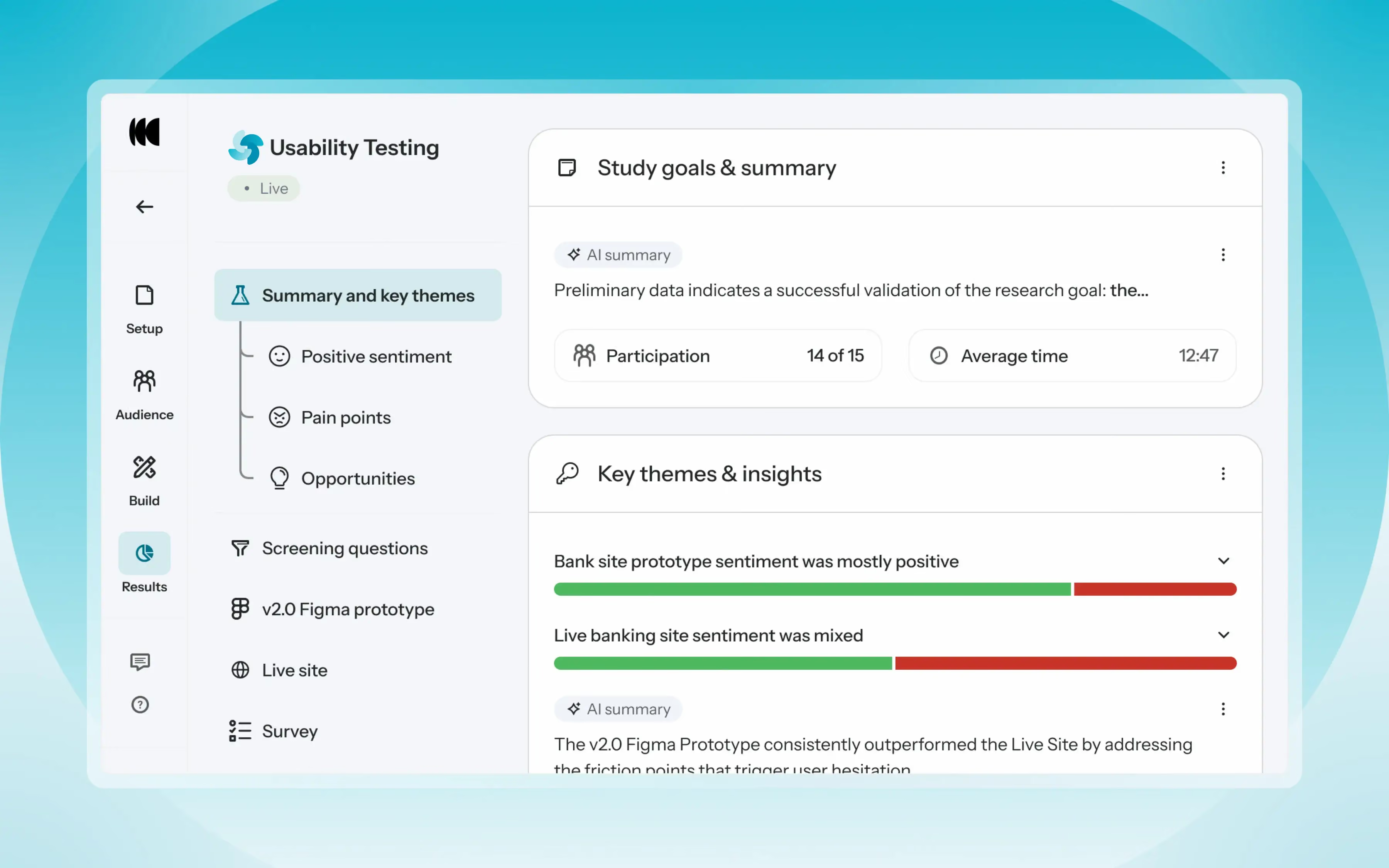
Watch real people interact with any website and web app to see what’s actually happening. Your direct window into reality.

We also continued enhancing our core toolkit, adding display logic to surveys and launching a new study creation flow to help teams move quickly and confidently across the platform.

AI: Automate the Busywork, Focus on the Breakthroughs

The next era of research isn't about replacing humans with AI. It’s about making room for the work humans do best. In 2025, we were intentional with where we added AI to Optimal, guided by our core principle to automate your research. Our ever-growing AI toolkit helps you:

  • accelerate your analysis and uncover key insights with automated insights
  • transcribe interviews 
  • refine study questions for clarity
  • dig deeper with AI chat 

AI handles the tedious parts so you can focus on the meaningful ones.

Looking Ahead: Raising the Bar for UX Research & Insights

2025 built out our foundation. The next will raise the bar.

We're entering a phase where research and insights becomes:

  • faster to run
  • easier to communicate
  • available to everyone on your team
  • and infinitely more powerful with AI woven throughout your workflow

To everyone who ran a study, shared feedback, or pushed us to do better: thank you. You make Optimal what it is. Here’s to an even faster, clearer, more impactful year of insights.


Onwards and upwards.

Share this article
Author
Optimal
Workshop
Topics
No items found.

Related articles

View all blog articles
Learn more
1 min read

Optimal Interviews: What We Learned About Modern Interview Workflows & Building a Research Repository

User interviews have always been one of the most trusted and powerful UX research methods. They give you something beyond dashboards or written surveys: real, in-depth conversations and context.

But they’ve historically come with a cost – time, coordination, and a heavy lift to review recordings and turn videos into insights. Sometimes insights get buried. Recordings sit unused and research becomes challenging to revisit.

In our recent webinar, we explored how that’s changing and how you can reduce the heavy lift of interview review, while building a research repository. 

What is a research repository?


A research repository is a centralized system for storing, analyzing, and reusing research data, especially qualitative data like user interviews. It helps teams answer questions like what users said, what patterns emerged, and how past research can inform future decisions.

For interviews, this means:

  • Storing recordings and transcripts
  • Organizing insights and themes
  • Making research searchable
  • Enabling teams to revisit past findings
  • Supporting continuous discovery

Optimal Interviews brings this to life by automatically capturing recordings, generating transcripts, structuring insights from the start, and making everything searchable so teams can easily revisit, build on, and continuously learn from their research.

So what did we learn? Here are some key takeaways from this webinar, plus answers to the most common questions we heard.

1. The biggest bottleneck isn’t conducting interviews. It’s everything surrounding it.


Running interviews isn’t just about talking to users. It’s everything before and after:

  • Recruiting participants
  • Coordinating calendars
  • Managing reschedules and no-shows
  • Setting up emails and reminders
  • Transcribing, organizing, and synthesizing findings

That overhead adds up quickly. There’s opportunity in automating these workflows and removing the friction around them. Optimal Interviews solves this by:

  • Creating a central calendar
  • Emailing participants with confirmations and session reminders
  • Automatically capturing recordings
  • Generating transcripts
  • Uploading and generating summaries and insights
  • Structuring insights from the start
  • Allowing you to explore instantly with AI Chat

2. Speed matters more than ever (and it’s finally achievable)


Research isn’t slowing down. Product cycles are getting faster, and teams expect insights just as quickly.


What stood out most:

  • Interviews can now go from recording → transcript → insights in minutes
  • Teams can share highlight reels, clips and findings almost immediately
  • Analysis can start while context is still fresh

One team told us that a few years ago it took them three weeks to analyze user interviews for an initiative. When they replicated the same study in Optimal Interviews, they were able to generate usable insights in about five minutes.

That shift from lagging insight to near real-time understanding is where the real impact lies.

3. Scheduling should feel effortless


Interview scheduling sounds simple, but it’s often where things break down.
You can use Optimal Interviews to ensure:

  • Availability blocks with buffers
  • Controlled rescheduling and cancellations
  • Video conferencing integrations
  • Support for collaborators
  • Built-in, secure participant communication & messaging (coming soon)

When done right, scheduling fades into the background so teams can focus on conversations, not coordination.

4. AI is reshaping analysis but humans stay in control


AI is already proving its value in the analysis phase:

  • Automatic transcription across multiple languages
  • Theme and insight extraction across interviews
  • Highlight reels and supporting evidence
  • Natural language queries over your research

But one point came through clearly: AI accelerates analysis but it doesn’t replace human judgment and sensitivity.

Researchers still play a critical role in validating insights, interpreting nuance, and deciding what matters for the business. Think of AI as getting you to 80% faster, while you own the final 20%.

5. The real unlock is continuous, reusable research


Here’s what you can achieve with Optimal Interviews:

  • You can ask questions of past interviews using natural language
  • Create new custom themes or topics on demand for AI to add new insights into
  • Re-analyze old research with fresh context
  • Add new interviews to your existing Optimal Interviews study and refresh the insights
  • Identify gaps and spin up new studies faster

This turns research from static storage into something dynamic, something you can continuously mine and build on.

FAQs from the Webinar


Does the platform synthesize insights or just aggregate data?


Both. You can extract insights from individual interviews, but the real value often comes from patterns across multiple sessions. Aggregation helps surface stronger, more reliable themes, while still preserving standout moments from single participants.

How is sensitive data handled?


Privacy is a core focus and consideration with Optimal Interviews. Some of the key protections include automatic redaction of personally identifiable information (PII) and enterprise-grade AI infrastructure with strict data isolation. We're also looking to expand Optimal Interviews anonymized scheduling and communication and manual redaction controls before analysis.

What if I can’t connect my video conferencing tools?


Integrations are available for Google Meet, Microsoft Teams, and Zoom. 


You can still run everything without integrations:

  • Set availability without integrations
  • Add conferencing links yourself
  • Manage sessions independently

Integrations are helpful but not required.

Can I search across multiple studies?


Today, teams often bring relevant interviews into one project for analysis. Looking ahead, the goal is broader. Optimal’s looking into how the platform can search and query across all research, use AI chat to explore insights across studies, and surface insights at a Workspace level.

Can I query transcripts or AI summaries?


Yes. You can search transcripts directly and use AI-powered chat to explore themes, generate summaries, or even turn findings into shareable outputs like Slack posts or reports.

Final thought


Interviews aren’t new. But the way we run them and what we can get out of them is changing fast.

By removing operational overhead and reducing time to insight, teams can talk to users more often, share insights faster, and build a research repository that becomes part of everyday product decision-making.

If you want to experience the full walkthrough, demo, and Q&A from the session, we encourage you to watch the full webinar.

👉 You can watch the full training webinar here.

Learn more
1 min read

7 Ways to Use AI Chat to Boost Collaboration in Mural, FigJam, and Miro

Collaboration tools like Mural, FigJam, and Miro are staples of how modern teams can brainstorm, map ideas, align on plans, and build together. But a canvas alone can't tell you if you're on the right track or guide you to what comes next when progress stalls. That's where Optimal AI Chat and user insights come in.

By starting or bringing real user insights into the boards your team already works in, you can reduce ambiguity, ground discussions in real research, and accelerate decision-making. 

Here are 7 ways to use AI Chat alongside your collaboration boards.


1. Align on key objectives

Before your next planning session, use Optimal AI Chat to surface relevant insights from your interview recordings. Add a summary directly into your Mural, Miro, or FigJam board so everyone comes in with the same context and understanding of the objectives. Instead of starting with assumptions, your team can start with real user insights and clear trade-offs to discuss.

Try this prompt: "Summarize the key considerations for [decision topic] and flag any trade-offs we should discuss as a team."

AI Chat example

2. Create a user journey map

AI Chat can analyze interview transcripts and video recordings and highlight common jobs to be done, behaviors, and friction points. You can then map those steps visually on your board and identify where the experience breaks down.

Try these prompts: “Summarize the typical jobs to be done for the people we interviewed.”
“For this job you identified [paste job details], detail the journey steps.” 


3. Turn pain points into design and product decisions

AI Chat can analyze recurring themes from your interview recordings and convert them into concrete opportunities your team can explore next. Adding these to your board gives the team a clear starting point rather than a vague list of problems.

Try this prompt:  "Based on these pain points [paste notes or themes], suggest three product improvements we could explore."


4. Sharpen your marketing messaging

Interview insights aren’t just valuable for product, research, and design teams. Marketing teams can also use AI Chat to quickly evaluate messaging, positioning, and customer perception.

When running preference or concept testing interviews, AI Chat can quickly analyze the feedback and suggest positioning directions you can workshop on your board.

Try this prompt: “Suggest positioning options based on the interview feedback.”


5. Facilitate workshops

Running workshops and brainstorming sessions with cross-functional teams can be challenging. Conversations drift, discussions stall, and teams sometimes struggle to focus on the most important issues. 

AI Chat can help you structure the conversation before the workshop even begins by generating discussion guides based on user insights from your interviews. Add the chat outputs directly to your board to guide the session.

Try this prompt: “Generate a structured discussion guide based on the pain points of the interviewees.”


6. Make brainstorming more focused

Open brainstorming can be valuable. It can also be chaotic without clear direction. By leveraging AI Chat, you can guide your brainstorming sessions with intelligent suggestions, topic generation, and idea organization.

Try this prompt: “Generate 10 brainstorm ideas based on these user insights and group them into themes we could explore.”


7. Map complex processes

Visualizing complex processes and systems is easier with tools like Miro, FigJam, and Mural. AI Chat can help you map out each step. AI Chat can help break down a process step-by-step, highlighting decisions, dependencies, and potential friction points based on your interviews. Your team can then map these steps visually and identify opportunities for improvement.

Try this prompt: “Create a step-by-step process map for how users complete [task], including key decisions and potential friction points.”


Using Optimal AI Chat for seamless collaboration

The best collaboration happens when teams have the right information at the right time. 

Optimal AI Chat gives your team a jumpstart for your interview analysis: clearer inputs, faster synthesis, and smarter outputs that translate directly into what you're building on your boards.

Whether you're running a workshop, mapping a user journey, or planning a product launch, AI Chat helps you spend less time getting oriented and more time making decisions.

Ready to see what your team can do with it?
Learn more about best practices for AI Chat or book a demo

Learn more
1 min read

Introducing Live Site Testing: Real Insights from Real Interactions

Creating successful products is tough. Whether you're gathering competitive intelligence before entering a market, discovering user needs for a brand new product, redesigning a website, optimizing a sign-up flow, or improving internal tools, the stakes are high.

Poor user experiences cost businesses up to 35% of potential sales, while organizations that deliver superior experiences drive 5-6x more revenue. Optimal helps you turn user insights into better business decisions so you can deliver products your users love.

From Discovery to Continuous Optimization

Great products don’t just happen. They’re guided by real user feedback at every stage.

Start with discovery.
Use live site testing to watch real users navigate competitor experiences or test early concepts in staging environments. Combine this with surveys and interview insights to understand what users actually need. Validate navigation and information architecture with card sorting and tree testing.

Validate before you build.
With prototype testing, you can connect to Figma or create clickable prototypes in minutes or use live site testing to test a website or web app in a staging environment. Identify pain points early and fix them before development.

Continuously optimize.
Even after launch, the best experiences evolve with their users. Ongoing testing, surveys, and interviews can reveal opportunities to refine and grow, keeping your product relevant and effective.

But nothing beats seeing users interact with your actual site. With Optimal’s newest tool - live site testing - you can see how users engage with your actual websites or web apps or even a competitor's. No guesswork, no assumptions.

Introducing Live Site Testing

We’re excited to announce live site testing has officially joined Optimal’s platform! Here’s what makes it powerful:

  • Test any live site. Yes, any.
    Understand exactly how users interact with your website or web app in a production or staging environment or gain valuable insights by testing a competitor’s site.
  • No code. No friction.
    Unlike many other live site testing tools, with Optimal, setup takes minutes. There's no plugins or technical hurdles for you or your testers. Just paste a URL to set up your test and start testing.
  • Validate at every stage.
    Catch issues before they cost you conversions. Identify blockers pre-launch on staging sites or improve existing user flows on live sites.
  • Video recordings with real insights
    Watch exactly where users hesitate, struggle, or abandon their journey. Back every decision with user feedback and evidence and confidently prioritize your next decisions.

Why This Matters

With live site testing, you get real insights from real user interactions beyond quantitative data.

The result?

  • Better competitive insights and analysis
  • Fewer surprises post-launch
  • Improved usability
  • Higher conversion or adoption rates
  • Increased user or customer satisfaction
  • Faster, data-backed decisions

Live site testing is now available for all plans, except for our legacy Individual plan. 

Already an Optimal user? Log in now to start testing your websites and web apps. 

Not yet using Optimal? Get started with a free trial to try it for yourself.

No items found.

Seeing is believing

Explore our tools and see how Optimal makes gathering insights simple, powerful, and impactful.